
Smart lock OEM China: how to vet factory claims
author
Sourcing from a smart lock OEM in China is not mainly a price exercise anymore. For procurement teams, operators, and commercial evaluators, the real question is simpler and more important: can this factory prove its claims with test data, process control, and certification traceability? In practice, most supplier risk comes from a gap between brochure language and production reality. A factory may claim Matter readiness, secure chips, low power consumption, or stable biometric performance, but if those claims are not backed by protocol test reports, component traceability, reliability data, and audit-ready quality systems, your project risk remains high. The safest approach is to vet claims in layers: company legitimacy, engineering capability, compliance evidence, sample validation, pilot performance, and ongoing quality control.
This guide explains how to evaluate a smart lock OEM China partner using practical verification steps. It focuses on what buyers actually need to know: how to validate smart home hardware testing results, how to assess biometric false rejection rate FRR claims, how to confirm hardware root of trust, and how to run an IoT supply chain audit that reveals whether a factory is truly dependable.
What buyers really need to verify before trusting a smart lock OEM in China
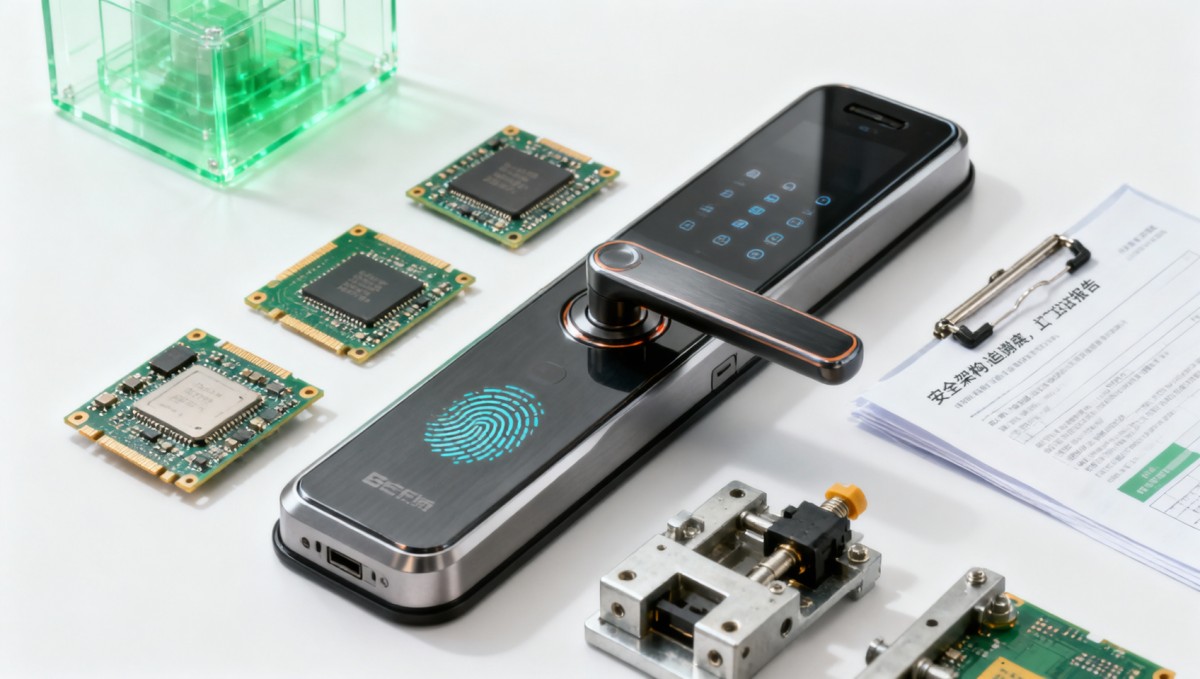
If you are comparing suppliers, do not start with the product catalog. Start with the risk points that can damage a deployment, delay a launch, or create warranty cost later. For smart locks, these risk points usually fall into five areas:
- Protocol truth: Does the lock actually support the connectivity standard claimed, including Matter, Bluetooth, Zigbee, Thread, or Wi-Fi, in a stable production environment?
- Security architecture: Is there a real hardware root of trust, secure element, encrypted credential storage, and secure firmware update path?
- Biometric performance: Are fingerprint or facial entry claims based on measured FRR and FAR data under real use conditions, not just lab demos?
- Production consistency: Can the factory make 10,000 units with the same quality as the approved sample?
- After-sales resilience: Does the supplier have clear failure analysis, firmware maintenance, spare parts support, and corrective action workflows?
For most commercial buyers, the key insight is this: a good-looking sample proves very little. A reliable OEM proves repeatability, traceability, and issue response.
How to separate factory claims from verifiable evidence
Many factories use similar language: “military-grade security,” “works with Matter,” “ultra-low power,” “bank-level encryption,” or “strict quality control.” These phrases are not useless, but they are not evidence. Your task is to convert every claim into a document, test result, or inspection record.
Use a simple rule: every critical claim should have at least one of the following forms of proof:
- Third-party certification or test report
- Internal validation report with defined test conditions
- Production quality record from recent batches
- Bill of materials and component sourcing traceability
- On-site audit observation
- Pilot batch performance data
For example, if a supplier says the lock supports Matter, ask which version, on which chipset, with what certification status, and whether the certification applies to the exact SKU you are buying. If the factory claims low standby power, request actual power test data across sleep, wake, pairing, and event-trigger states. If it promotes secure access, ask whether encryption keys are injected securely, how credentials are stored, and how firmware authenticity is verified at boot.
This approach turns vague supplier communication into audit-ready evaluation criteria.
How to audit smart lock security claims, including hardware root of trust
Security is one of the easiest areas for suppliers to oversimplify and one of the hardest areas for buyers to fix later. A smart lock is not only a door device; it is an identity and access endpoint. Weak security design can expose residential projects, rental properties, offices, and energy-sensitive facilities to operational and reputational risk.
When evaluating security claims, focus on architecture rather than slogans. Ask these questions:
- Does the product use a hardware root of trust or secure element?
- How are encryption keys generated, stored, and rotated?
- Is secure boot implemented to prevent unauthorized firmware loading?
- Are OTA firmware updates signed and verified?
- How is user credential data protected at rest and in transit?
- What penetration testing or vulnerability assessment has been performed?
- What is the product’s response plan for newly discovered vulnerabilities?
A credible smart lock OEM China supplier should be able to explain its security chain from chip level to mobile app and cloud interface. If the team cannot explain secure provisioning, device identity, update signing, and incident response in practical terms, the security claim is likely weak.
For procurement and business evaluation teams, security maturity also signals something broader: engineering discipline. Factories that can document security well often have better process control in other areas too.
How to validate biometric FRR claims without relying on demos
Biometric features sell products, but they also create high customer expectations. One of the most important metrics is false rejection rate (FRR), which measures how often authorized users are rejected. A factory may quote impressive recognition speed or accuracy, but those numbers can be misleading if test conditions are narrow.
To vet biometric claims properly, ask for:
- FRR and FAR data with sample size and test protocol
- Performance by age group, finger condition, humidity, dust, and temperature
- Retry logic and average unlock time in real-world scenarios
- Performance after repeated use and sensor wear
- Results from failed enrollment, partial touch, and wet or dry skin conditions
For operators and installers, the practical issue is not just whether biometrics work once. It is whether they work repeatedly in real homes, rental units, commercial sites, or shared-access environments. If the OEM cannot provide structured biometric testing data, conduct your own field validation with representative users and environments.
This is especially important for projects where lock reliability affects occupancy, maintenance cost, or service workload. High FRR can quickly become a customer support issue, even when the product passes a showroom demonstration.
How to evaluate manufacturing capability beyond the sample stage
A common sourcing mistake is to approve a sample and assume the factory can reproduce it at scale. In reality, many quality failures emerge only when the production line is under pressure. That is why your IoT supply chain audit must assess manufacturing capability, not only product appearance and basic function.
Look closely at these areas:
- SMT and PCBA control: What is the process capability for the main board, and how are solder defects, component placement errors, and ESD risks controlled?
- Incoming quality control: How does the factory verify chipsets, sensors, fingerprint modules, motors, and batteries from upstream suppliers?
- Assembly consistency: Are torque, alignment, sealing, and mechanical tolerance controlled with records?
- Functional testing: Does every unit pass final test for connectivity, motor actuation, battery status, sensor response, and firmware version confirmation?
- Aging and reliability tests: Are there cycle tests, temperature and humidity tests, salt spray tests, and drop or vibration tests relevant to the installation environment?
- Traceability: Can the factory trace each finished unit to batch, key components, operator, and test result?
A dependable OEM does not just say “100% inspection.” It can show the actual test stations, defect criteria, yield trends, and corrective action records. Ask to see how a failed unit is handled, not just how a passing unit is presented.
What certifications and compliance documents actually matter
Certifications matter, but only when they match your target market, your exact product variant, and your real deployment scenario. Buyers often lose time because they see a certificate and assume the product is fully market-ready. That assumption can be costly.
Check the following carefully:
- Whether the certificate belongs to the exact model or only a related series
- Whether wireless modules are certified separately or as part of the final device
- Whether certifications are current and issued by recognized bodies
- Whether battery, radio, EMC, and safety requirements match your destination market
- Whether cybersecurity or data privacy requirements affect your deployment
For smart lock programs with global ambitions, compliance review should include not only access hardware rules, but also app, cloud, and data handling implications. This is particularly relevant when the lock is part of a broader smart home or building ecosystem.
In short, compliance should be treated as a product-system question, not a paperwork checkbox.
How to run a practical IoT supply chain audit before signing
An effective supplier audit should help you predict future performance, not just verify that a factory exists. For that reason, combine document review with on-site or remote process validation and pilot order evidence.
A practical audit workflow looks like this:
- Desktop screening: Verify legal entity, export history, core certifications, product scope, and major markets served.
- Technical questionnaire: Review architecture, chipsets, protocol stack, app support, security controls, and test methods.
- Factory audit: Check production lines, lab capability, quality systems, incoming inspection, calibration control, and engineering staffing.
- Sample validation: Test connectivity stability, battery behavior, lock actuation, biometric FRR, app response, and fail-safe behavior.
- Pilot batch: Validate consistency across a meaningful quantity, not just 2 or 3 samples.
- Commercial review: Confirm MOQ, lead time, tooling ownership, firmware maintenance terms, warranty process, and liability boundaries.
This process helps procurement teams avoid the two most expensive mistakes: trusting marketing too early and negotiating commercial terms before technical risk is understood.
Which red flags usually indicate a weak smart lock OEM
Even if a supplier looks professional, certain warning signs should slow your decision:
- Claims are broad, but reports are missing or outdated
- The sales team answers technical questions with generic wording
- The sample works, but there is no clear production test process
- Security features are advertised, but no one can explain implementation
- Biometric performance claims lack FRR and FAR context
- Certification scope is unclear or does not match the exact SKU
- Firmware ownership and update responsibility are not clearly defined
- Factory capacity seems inconsistent with quoted lead time
- Component substitutions are allowed without strong change control
One or two issues may be manageable. A pattern of these issues usually means the supplier is not yet ready for serious commercial deployment.
How buyers should compare smart lock OEMs side by side
To make better sourcing decisions, use a weighted comparison instead of relying on unit price alone. A simple scorecard can include:
- Protocol and ecosystem compatibility
- Security architecture and update mechanism
- Biometric testing quality
- Manufacturing control and traceability
- Certification fit for target markets
- Pilot batch consistency
- Communication speed and technical transparency
- Commercial flexibility and after-sales support
- Total cost of ownership, not only purchase price
This method is more useful for business evaluation teams because it links engineering evidence to commercial risk. A slightly more expensive factory may be the lower-cost option once you account for returns, installation failure, cybersecurity risk, and delayed market entry.
Conclusion: the best smart lock OEM in China is the one that can prove repeatable truth
When vetting a smart lock OEM China partner, the smartest question is not “Who offers the best quote?” but “Who can prove performance, security, and consistency with evidence?” For procurement teams, operators, and commercial evaluators, the most valuable suppliers are those that can back every important claim with data: Matter compatibility details, hardware root of trust design, biometric FRR results, manufacturing traceability, and clear audit records.
In a mature IoT supply chain, trust should come from measurable proof, not polished language. If you build your sourcing process around structured verification, sample validation, and pilot-batch evidence, you will make better decisions, reduce downstream risk, and choose a factory that supports long-term product success rather than short-term brochure confidence.
Protocol_Architect
Dr. Thorne is a leading architect in IoT mesh protocols with 15+ years at NexusHome Intelligence. His research specializes in high-availability systems and sub-GHz propagation modeling.
Related Recommendations
- Lina Zhao (Security Analyst)Smart lock sourcing mistakes that cost more later
- Lina Zhao (Security Analyst)Which smart lock OEM is easier to scale with?
- Lina Zhao (Security Analyst)Smart lock OEM China: how to vet factory claims
- Lina Zhao (Security Analyst)Smart Lock Matter Compatibility: What Changes
- Lina Zhao (Security Analyst)Access Control System Integration Made Practical
- Lina Zhao (Security Analyst)ANSI Grade 1 Smart Lock Test: What It Means
- Lina Zhao (Security Analyst)What Is a Good FRR for Smart Locks
- Lina Zhao (Security Analyst)How to Evaluate a Smart Safe Box Factory
- Lina Zhao (Security Analyst)Facial Recognition Door Lock Wholesale Checklist
- Lina Zhao (Security Analyst)Radar for perimeter security intrusion: what triggers false alarms
Analyst