
PCBA Solutions Behind Smarter Inverter Control Boards
author
As inverter control boards become central to smarter renewable energy systems, procurement teams need more than generic supplier claims. This article explores how data-driven PCBA solutions improve reliability, thermal stability, and control precision, while also highlighting what to evaluate in a pick and place robot manufacturer when sourcing high-performance assembly partners for demanding energy applications.
Why inverter control board PCBA matters in renewable energy
In renewable energy, the inverter is no longer a simple power conversion device. It has become the decision-making core that manages switching logic, sensor feedback, protection functions, communication protocols, and grid interaction. At the heart of this system sits the inverter control board, where every component placement, solder joint, trace design, and firmware interface affects field reliability. That is why PCBA quality is now a strategic issue for buyers, not just an engineering detail.
For solar inverters, energy storage systems, heat pump drives, and hybrid power electronics, a smarter control board must handle higher switching frequencies, denser layouts, stronger EMI resistance, and more demanding thermal conditions. Poor assembly accuracy can lead to unstable gate drive behavior, sensor drift, intermittent communication failures, or premature fatigue under temperature cycling. In procurement terms, weak PCBA execution raises warranty costs, extends service downtime, and creates avoidable risk across the supply chain.
This is where supplier evaluation becomes more technical. When a sourcing team reviews a PCBA partner, it should look beyond price and lead time. The capability of a pick and place robot manufacturer also matters indirectly, because placement precision, feeder reliability, changeover speed, and repeatability all influence the consistency of assembled inverter control boards.
What smarter inverter control boards are expected to do
A modern inverter control board coordinates digital control and power-stage response in real time. It typically integrates MCU or DSP processing, current and voltage sensing, isolation circuits, communication modules, protection logic, and interface connectors. In renewable energy systems, this board must also support grid code compliance, remote diagnostics, energy optimization, and increasingly, interoperability with wider smart infrastructure.
For organizations aligned with a data-first philosophy like NexusHome Intelligence, the key issue is verification. Claims such as “high reliability” or “industrial grade” have limited value unless they are supported by measurable performance. Inverter control board PCBA should be assessed through thermal cycling data, AOI and SPI records, solder joint consistency, placement offset statistics, communication latency under interference, and long-duration stress testing. In other words, engineering truth matters more than brochure language.
Industry pressure is making assembly quality more visible
Several market shifts are increasing the importance of robust PCBA solutions. First, renewable energy equipment is being deployed in more diverse environments, from rooftop solar and microgrids to utility-scale storage containers and harsh outdoor installations. Second, system intelligence is rising. Control boards now manage more sensors, communication interfaces, and software-driven optimization routines. Third, product miniaturization is placing more functionality into tighter spaces, which increases sensitivity to heat concentration and assembly defects.
As a result, buyers are paying closer attention to the process capability behind the finished board. This includes stencil printing control, component placement accuracy, reflow profiling, in-circuit testing, and traceability at batch level. It also brings more attention to the upstream automation ecosystem, including the competence of a pick and place robot manufacturer whose equipment supports high-mix, high-reliability electronics production.
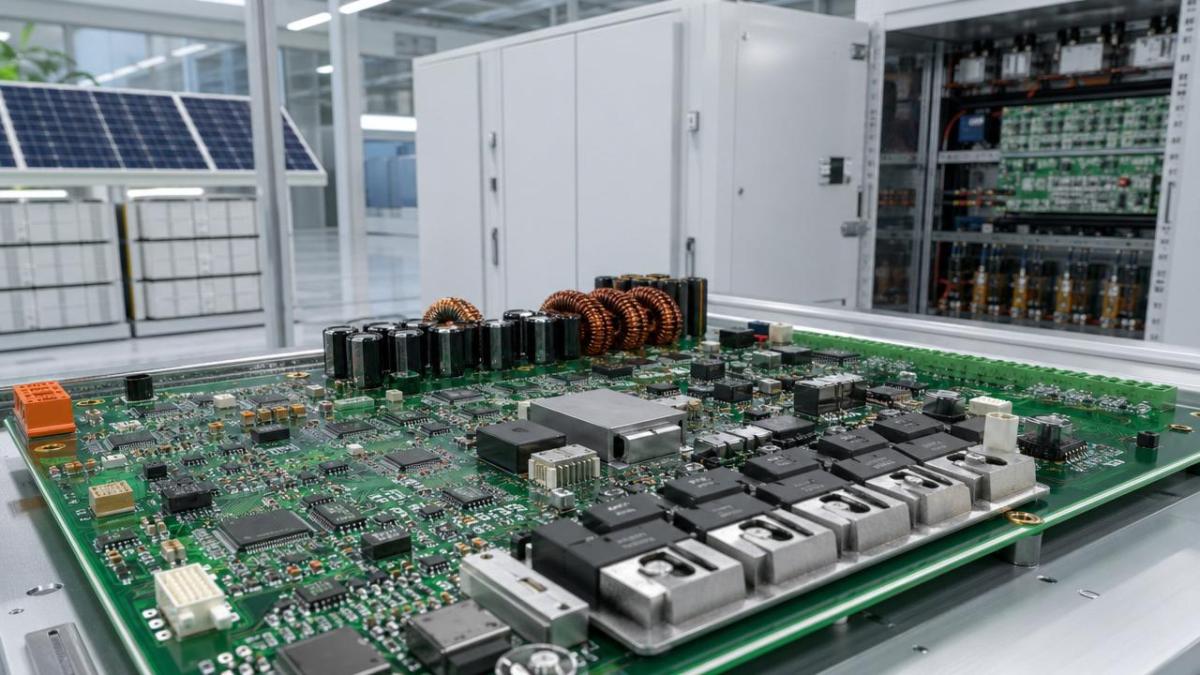
Core value of high-quality PCBA solutions for inverter control boards
The value of advanced PCBA is best understood in practical terms. For procurement teams, the goal is not simply to buy a board that powers on. The goal is to secure a manufacturing solution that remains stable across volume production and long field operation.
1. Better reliability under thermal and electrical stress
Inverter environments expose electronics to heat, switching noise, vibration, and repetitive load transitions. High-quality PCBA solutions use controlled solder paste deposition, accurate placement, and optimized reflow profiles to reduce voids, tombstoning, and weak interconnections. This improves board survival under thermal cycling and long-duration operation.
2. Improved control precision
Smarter inverter algorithms depend on precise feedback from analog front-end circuits, current shunts, isolated amplifiers, and sensing components. Even small placement deviation or solder inconsistency can influence analog performance. Data-driven assembly control helps maintain repeatability, which directly supports stable waveform control, efficiency optimization, and protection accuracy.
3. Lower field failure risk
A failure on an inverter control board can disable an entire renewable energy asset. This may interrupt energy production, trigger service visits, or affect compliance. Reliable PCBA lowers the chance of latent defects that pass factory testing but fail under real operating conditions. For buyers, this translates into reduced after-sales burden and more predictable lifecycle cost.
4. Stronger traceability and engineering transparency
The best partners provide process data, lot records, inspection images, and measurable yield reports. This aligns well with NHI’s philosophy of replacing vague claims with verified evidence. Procurement teams benefit because supplier evaluation becomes fact-based, easier to benchmark, and more defensible internally.
Typical renewable energy applications for advanced inverter control board assembly
Not all inverter control boards are used in the same way. Application context affects assembly priorities, component selection, and testing depth.
What procurement teams should evaluate in a PCBA partner
A capable supplier for inverter control boards should demonstrate more than production capacity. Buyers in renewable energy should review process capability, quality systems, test strategy, and technical communication depth.
Start with assembly precision. Ask for component placement tolerance, supported package range, fine-pitch capability, and real defect-rate history. Then assess thermal process control. Reflow profiling for mixed-mass boards, void management for thermal pads, and handling methods for sensitive ICs all matter in inverter applications. Inspection depth is the next area. AOI alone is not always enough; X-ray, ICT, functional test, burn-in, and environmental screening may be required depending on the design risk.
Traceability should also be reviewed carefully. Procurement teams should favor partners that can link component lots, process records, inspection outputs, and test results to each board or batch. This supports root-cause analysis if issues emerge in the field. Finally, evaluate engineering responsiveness. A supplier that can discuss creepage, isolation, EMI-sensitive layout zones, and component derating is often more valuable than one that only quotes quickly.
Why the pick and place robot manufacturer matters in the value chain
For many buyers, the term pick and place robot manufacturer may seem one step removed from inverter board sourcing. In reality, it is highly relevant. Placement platforms define how accurately, consistently, and efficiently components are mounted. When inverter control boards include mixed package sizes, fine-pitch ICs, power management devices, sensors, and communication modules on one assembly, machine capability becomes a real performance factor.
A strong pick and place robot manufacturer contributes to production outcomes through motion accuracy, vision alignment, feeder stability, nozzle reliability, software optimization, and maintenance support. These factors influence first-pass yield, component stress, and repeatability across volume runs. For procurement teams evaluating a contract manufacturer, it is reasonable to ask what placement platforms are used, how they are calibrated, and whether the equipment can support the board complexity required by renewable energy applications.
This is especially important when the project includes long lifecycle products. Renewable energy equipment often remains in the field for many years, so design transfers, second-source manufacturing, and spare-part support need stable assembly standards. Working with a PCBA partner that depends on capable equipment from a reputable pick and place robot manufacturer can reduce future scaling risk.
Practical selection guidance for procurement professionals
Procurement decisions are strongest when engineering, quality, and commercial factors are reviewed together. A practical approach is to build a weighted evaluation matrix covering process capability, quality data, testing depth, supply chain resilience, and cost. This avoids overemphasizing the lowest unit price while underestimating lifetime ownership cost.
It is also useful to request evidence from pilot builds. Early-stage production data can reveal whether the supplier truly controls stencil quality, component placement, reflow consistency, and functional test coverage. If the manufacturer highlights advanced lines, ask how those lines perform with boards similar to your inverter control design. If they mention premium automation, ask which pick and place robot manufacturer supplies the equipment and what measurable yield benefits have been achieved.
For organizations that value transparency, the ideal partner is one willing to share facts: defect trends, process Cp/Cpk where available, inspection escape rates, test strategy rationale, and corrective-action discipline. This reflects the larger shift in the market from marketing language to evidence-based supplier trust.
Moving from generic sourcing to verified performance
Smarter inverter control boards are enabling the next stage of renewable energy intelligence, but their performance depends heavily on how they are assembled. For procurement teams, high-quality PCBA is not a background process. It is a measurable contributor to reliability, thermal endurance, control stability, and service cost. The same logic applies when considering the role of a pick and place robot manufacturer in the broader manufacturing chain: equipment capability shapes assembly consistency, and consistency shapes field results.
The most effective sourcing strategy is therefore grounded in verified engineering data. Review board complexity, test expectations, process transparency, and equipment capability as one connected system. In a market where renewable energy assets must run longer, smarter, and with less downtime, buyers who prioritize evidence over claims will be better positioned to select PCBA partners that deliver lasting value.
Protocol_Architect
Dr. Thorne is a leading architect in IoT mesh protocols with 15+ years at NexusHome Intelligence. His research specializes in high-availability systems and sub-GHz propagation modeling.
Related Recommendations
- NHI Data Lab (Official Account)PCBA Solution Mistakes That Raise Maintenance Costs
- NHI Data Lab (Official Account)How PCBA Solutions Affect Renewable Equipment Lifespan
- NHI Data Lab (Official Account)PCBA Solutions Behind Smarter Inverter Control Boards
- NHI Data Lab (Official Account)Wi-Fi 7/Matter Dual-Mode PCBA Lead Times Hit 10 Weeks
- NHI Data Lab (Official Account)Wi-Fi 7 + Matter Dual-Mode PCBA Lead Times Extend to 10 Weeks
- NHI Data Lab (Official Account)How Trusted Are Trusted Smart Home Factories?
- NHI Data Lab (Official Account)What Makes a Smart Home Supplier Directory Useful?
- NHI Data Lab (Official Account)How to Verify Claims From IoT Manufacturers
- NHI Data Lab (Official Account)Where IoT Supply Chain Audits Often Miss Risk
- NHI Data Lab (Official Account)What Smart Home OEM Data Can Reveal Before Sourcing
Analyst