
Japan METI Ends Smart Lighting Matter Exemption
author
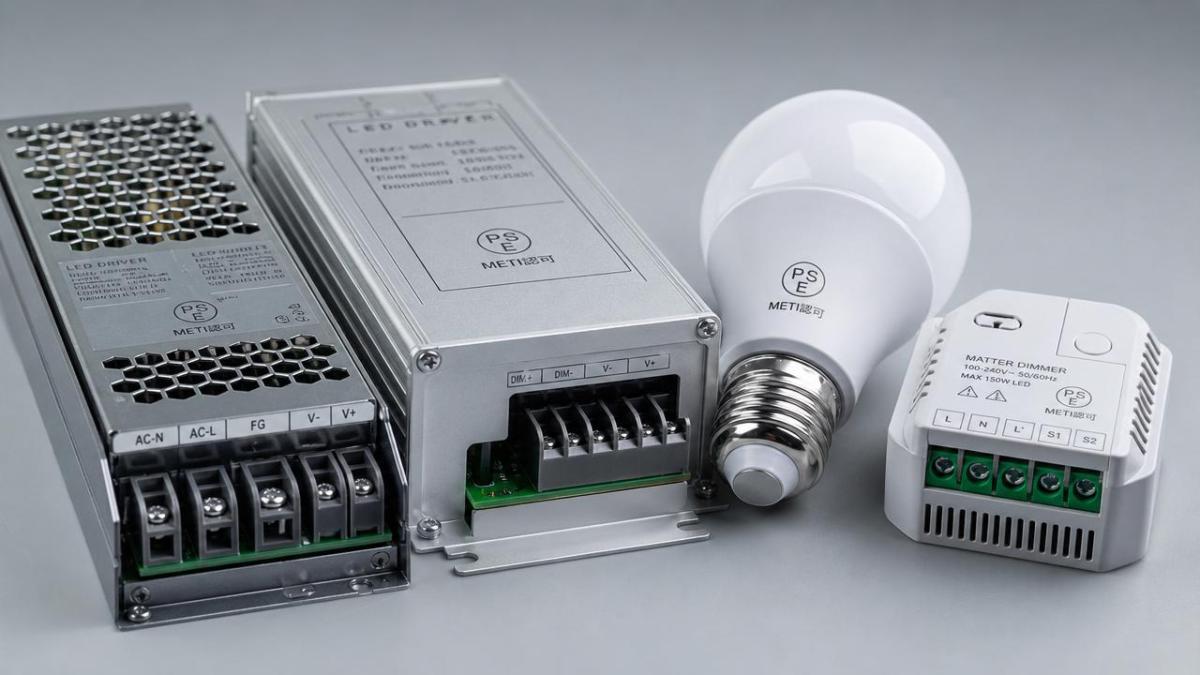
Japan’s Ministry of Economy, Trade and Industry (METI) announced on May 17, 2026, the termination of the PSE certification exemption for Matter-enabled smart lighting products featuring local control capabilities. Effective October 1, 2026, all such products—including LED drivers, smart bulbs, and dimming modules with offline switch or physical-button direct control—must undergo METI-designated dual-mode certification covering both ‘local control safety’ and ‘communication reliability’. This policy shift directly impacts China-based OEMs exporting to Japan, particularly those relying on legacy PCBA designs lacking pre-integrated Matter local control firmware.
Event Overview
On May 17, 2026, METI officially issued a notice confirming the revocation of the existing PSE certification exemption for Matter-compliant smart lighting devices that implement local control functionality. The new requirement mandates full certification by METI-authorized testing bodies, effective October 1, 2026. Certification scope explicitly includes hardware-level safety during offline operation and robustness of local Matter communication (e.g., Thread-based device-to-device control without cloud dependency). No transitional grace period is granted for existing stock or pending shipments.
Industries Affected
Direct Exporters & Trading Companies
These firms face immediate cost and timeline pressure: certification must now be obtained per model, not per platform, and requires functional validation of local control logic under failure conditions (e.g., network outage, firmware rollback). Lead time for dual-mode certification is estimated at 8–12 weeks—up from ~3 weeks under the prior exemption—delaying market entry and increasing inventory holding costs. Re-labeling and documentation updates also trigger compliance revalidation.
Raw Material & Component Suppliers
Suppliers of certified ICs (e.g., Thread SoCs), certified capacitors rated for local-control surge cycles, and pre-validated reference designs are seeing renewed demand—but only for components aligned with METI’s updated test criteria. Legacy BOMs using non-Matter-native MCUs or uncertified power semiconductors may no longer support compliant final assembly, forcing redesign coordination across tiers.
Contract Manufacturers & OEMs
OEMs with high-volume, fixed-PCBA platforms—especially those shipping white-label bulbs or integrated drivers—are most exposed. Retrofitting local control firmware into existing firmware stacks often violates bootloader security policies or exceeds flash memory limits. Hardware revisions (e.g., adding secure element chips or dedicated local control co-processors) entail NRE costs and 6+ month requalification cycles, disrupting production continuity.
Supply Chain Service Providers
Testing labs, certification consultants, and logistics firms offering PSE compliance support must rapidly upskill on METI’s newly published TK-2026-LLC (Local Lighting Control) test guideline. Labs without accredited local control stress-test benches (e.g., intentional network partitioning + concurrent load switching) will lose eligibility for METI designation. Concurrently, customs brokers report increased scrutiny on HS codes 8539.39 and 8543.70 for pre-clearance verification of certification status.
Key Considerations and Recommended Actions
Verify Firmware Architecture Compatibility Before June 2026
OEMs should audit whether current Matter implementations support mandatory local control fallback modes (e.g., BLE-initiated Thread commissioning, state persistence across reboots) as defined in METI Annex D. Devices relying solely on cloud-mediated local control (e.g., ‘LAN-only’ mode via vendor app) do not qualify.
Prioritize Dual-Certification for High-Volume SKUs
Given limited lab capacity and extended timelines, exporters should identify top 20% of Japan-bound SKUs by revenue and initiate certification applications by July 2026 to avoid Q4 2026 shipment delays. Bundling variants (e.g., same driver + different optics) under one certification dossier remains permissible if control logic is identical.
Engage METI-Accredited Labs Early for Pre-Testing
Three labs—JET, UL Japan, and TÜV Rheinland Tokyo—have confirmed readiness for TK-2026-LLC testing as of May 2026. Pre-testing (non-certifying) helps identify firmware logic gaps or hardware timing violations before formal submission, reducing retest risk by ~40% based on early adopter feedback.
Editorial Perspective / Industry Observation
Analysis shows this is not merely a technical tightening but a strategic pivot toward sovereignty in edge intelligence: METI’s explicit emphasis on ‘offline safety’ signals growing regulatory concern over single-point-of-failure architectures in consumer IoT. Observably, the requirement mirrors similar developments in EU’s ETSI EN 303 645 updates—but with stricter local execution mandates. From an industry perspective, this move accelerates consolidation among Chinese lighting OEMs: smaller players lacking firmware R&D capacity will likely exit the Japanese premium segment, while larger firms investing in certified Matter SDKs (e.g., Silicon Labs, Nordic) gain competitive insulation. Current more critical than cost is architectural future-proofing—certification today may not cover Matter 1.4 local control enhancements expected in 2027.
Conclusion
This policy marks a definitive transition from interoperability-as-convenience to interoperability-as-safety obligation in Japan’s smart lighting market. It reframes local control not as a feature enhancement but as a foundational safety layer—raising the technical and operational bar for global suppliers. Rational observation suggests the impact extends beyond compliance: it catalyzes long-term shifts in firmware strategy, component selection criteria, and cross-border certification partnership models.
Source Attribution
Official Notice: METI Ordinance No. 28 of 2026, “Amendment to Technical Requirements for Electrical Appliances under the Electrical Appliance and Material Safety Act”, published May 17, 2026 (available at meti.go.jp/english).
TK-2026-LLC Test Guideline v1.0 released concurrently; full text available to accredited labs only as of June 1, 2026.
Note: METI has indicated plans to publish FAQ clarifications on firmware update traceability requirements by August 2026—this remains under active monitoring.
Protocol_Architect
Dr. Thorne is a leading architect in IoT mesh protocols with 15+ years at NexusHome Intelligence. His research specializes in high-availability systems and sub-GHz propagation modeling.
Related Recommendations
- Kenji Sato (Infrastructure Arch)Smart Home Installation Cost Trends: What Drives Pricing for Lighting, Locks, and HVAC Controls?
- Kenji Sato (Infrastructure Arch)Smart Lighting in North America: Key Standards, Retrofit Options, and ROI Factors
- Kenji Sato (Infrastructure Arch)IoT Interoperability for Smart Lighting: Matter, Zigbee, or Wi-Fi for Multi-Vendor Systems?
- Kenji Sato (Infrastructure Arch)Smart Building IoT Lighting Management: Best Use Cases for Offices and Campuses
- Kenji Sato (Infrastructure Arch)Smart Dimmer Switches With RF Control vs Wi-Fi Dimmers: Key Differences for Retrofit Projects
- Kenji Sato (Infrastructure Arch)How to Choose Hotel Sofas for High-Traffic Spaces: Materials, Comfort, and Durability
- Kenji Sato (Infrastructure Arch)Smart Lighting Hardware Verification: What to Test Before Pilot Deployment
- Kenji Sato (Infrastructure Arch)How to Turn Project Specification Planning for Smart Lighting Into a Scalable Retrofit Plan
- Kenji Sato (Infrastructure Arch)SixG301 Gains First-Wave Matter Platform Certification
- Kenji Sato (Infrastructure Arch)Executive Office Desks Buying Guide: Sizes, Materials, Storage, and Cable Management
Analyst