
Japan METI Ends Smart Lighting Matter Exemption
author
On May 14, 2026, Japan’s Ministry of Economy, Trade and Industry (METI) announced revisions to the PSE Law Enforcement Regulations, terminating the exemption for Matter-based local control functionality in smart lighting products—including dimmers and drivers. Effective October 1, 2026, all new PSE certification applications for such devices must demonstrate Matter-over-Thread local control latency ≤100 ms and submit supplementary JIS C 61000-4-3 electromagnetic immunity test reports. The policy shift is already prompting urgent firmware updates among LED driver manufacturers in Dongguan and Ningbo.
Event Overview
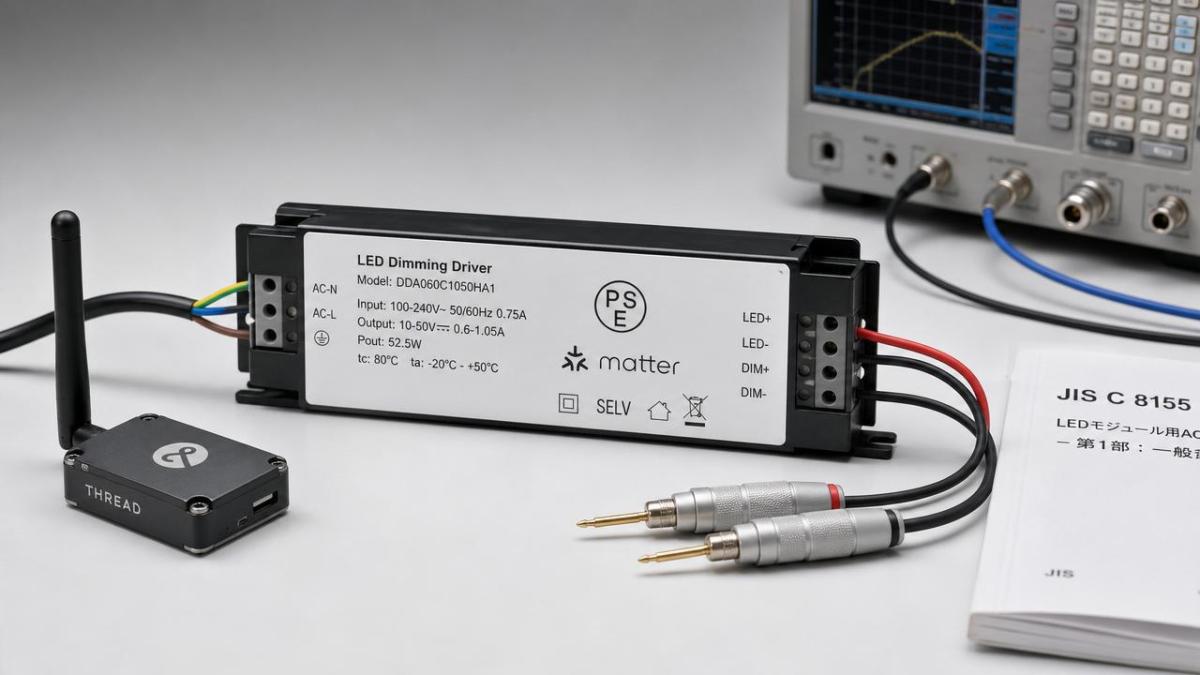
METI issued the Revised Enforcement Rules under the Electrical Appliance and Material Safety Act (PSE Law) on May 14, 2026. The revision formally withdraws the transitional exemption previously granted to smart lighting products for Matter local control certification. Starting October 1, 2026, any new PSE conformity assessment application for smart lighting devices with local control capability must include validated Matter-over-Thread latency performance (≤100 ms) and a JIS C 61000-4-3 radiated RF immunity test report beyond standard PSE requirements.
Industries Affected
Direct Exporters
Companies exporting smart lighting hardware—especially dimmers and constant-current drivers—to Japan face immediate certification rework. Previously exempted models now require full Matter-over-Thread validation and additional EMC testing, extending time-to-market by 6–10 weeks per SKU and increasing third-party lab costs by an estimated 18–25% per application.
Raw Material Suppliers
Suppliers of SoCs, Thread radio modules, and certified Matter SDKs are seeing revised demand signals: orders now emphasize low-latency thread stack compliance and pre-certified JIS C 61000-4-3 compatibility. Notably, vendors supplying Nordic Semiconductor nRF52840 or Silicon Labs EFR32MG24 modules report accelerated requests for Japanese market-specific firmware variants.
Contract Manufacturers & OEMs
LED driver and lighting controller OEMs in Dongguan and Ningbo have initiated emergency firmware rollouts to integrate Matter 1.3+ local control stacks with optimized Thread commissioning and latency profiling. Factory-level test fixtures must now include Thread network analyzers and RF anechoic chamber access—infrastructure not previously required for PSE-only production lines.
Supply Chain Service Providers
Testing laboratories accredited for PSE (e.g., JET, UL Japan, TÜV Rheinland Japan) are updating service portfolios to include Matter-over-Thread latency benchmarking and JIS C 61000-4-3 supplemental testing. Logistics and certification consultants are revising client onboarding checklists to flag Matter readiness gaps before submission—adding pre-audit steps that were previously optional.
Key Focus Areas and Recommended Actions
Verify Matter Stack Version and Latency Profile
Manufacturers must confirm their Matter implementation uses version 1.3 or later and includes real-time Thread commissioning and local action routing. Internal latency validation (end-to-end from physical input to light state change) must be documented under representative load conditions—not just lab-simulated idle networks.
Secure JIS C 61000-4-3 Test Capacity Early
JIS C 61000-4-3 testing requires specialized RF anechoic facilities and calibrated field probes. Lead times at accredited labs in Japan and ASEAN are already stretching to 12+ weeks; firms should book slots by July 2026 for Q4 submissions.
Update Technical Documentation for PSE Application
The revised PSE application dossier must now include: (i) Matter-over-Thread latency test report signed by an accredited lab; (ii) JIS C 61000-4-3 test report covering both 80–1000 MHz and 1.4–2.7 GHz bands; and (iii) firmware version traceability linking binary hashes to validated test configurations.
Editorial Perspective / Industry Observation
Analysis shows this is not merely a technical tightening but a strategic alignment of Japan’s smart home interoperability policy with global Matter ecosystem maturity. METI’s decision reflects growing confidence in Thread’s reliability—and a deliberate move to reduce cloud dependency for critical lighting controls. Observably, the 100 ms threshold targets human-perceptible responsiveness, suggesting Japan prioritizes user experience over backward compatibility. From an industry perspective, the timing—just 18 months after CSA’s Matter 1.3 release—indicates coordinated readiness across chipmakers, stack providers, and regulators. Current more relevant interpretation is that METI is treating Matter local control as a de facto safety-critical feature, warranting stricter verification than general EMC compliance alone.
Conclusion
This regulatory update marks a structural shift: local control is no longer a convenience feature but a certified functional requirement for market access in Japan. It accelerates convergence between safety regulation (PSE) and connectivity standards (Matter), setting a precedent other markets may follow. A rational reading is that compliance will increasingly demand integrated engineering—spanning firmware, RF design, and certification strategy—not siloed development.
Sources and Ongoing Monitoring
Official source: METI Notification No. 92 of 2026, Revised Enforcement Rules under the Electrical Appliance and Material Safety Act, published May 14, 2026 (available via METI’s English portal).
Pending clarification: Whether legacy PSE-certified products manufactured before October 1, 2026—but imported or sold after that date—will require retroactive validation. METI has indicated this will be addressed in a forthcoming FAQ, expected by August 2026.
Protocol_Architect
Dr. Thorne is a leading architect in IoT mesh protocols with 15+ years at NexusHome Intelligence. His research specializes in high-availability systems and sub-GHz propagation modeling.
Related Recommendations
- Kenji Sato (Infrastructure Arch)How to Choose Smart Dimmer Switches with Neutral for Stable Smart Lighting Control
- Kenji Sato (Infrastructure Arch)METI Tightens Smart Lighting Label Rules for LED Drivers
- Kenji Sato (Infrastructure Arch)METI Draft Rule Ties Smart Lighting Labels to Power Data
- Kenji Sato (Infrastructure Arch)Smart Home Installation Cost Trends: What Drives Pricing for Lighting, Locks, and HVAC Controls?
- Kenji Sato (Infrastructure Arch)Smart Lighting in North America: Key Standards, Retrofit Options, and ROI Factors
- Kenji Sato (Infrastructure Arch)IoT Interoperability for Smart Lighting: Matter, Zigbee, or Wi-Fi for Multi-Vendor Systems?
- Kenji Sato (Infrastructure Arch)Smart Building IoT Lighting Management: Best Use Cases for Offices and Campuses
- Kenji Sato (Infrastructure Arch)Smart Dimmer Switches With RF Control vs Wi-Fi Dimmers: Key Differences for Retrofit Projects
- Kenji Sato (Infrastructure Arch)How to Choose Hotel Sofas for High-Traffic Spaces: Materials, Comfort, and Durability
- Kenji Sato (Infrastructure Arch)Smart Lighting Hardware Verification: What to Test Before Pilot Deployment
Analyst