
Japan METI Ends Smart Lighting Matter Exemption
author
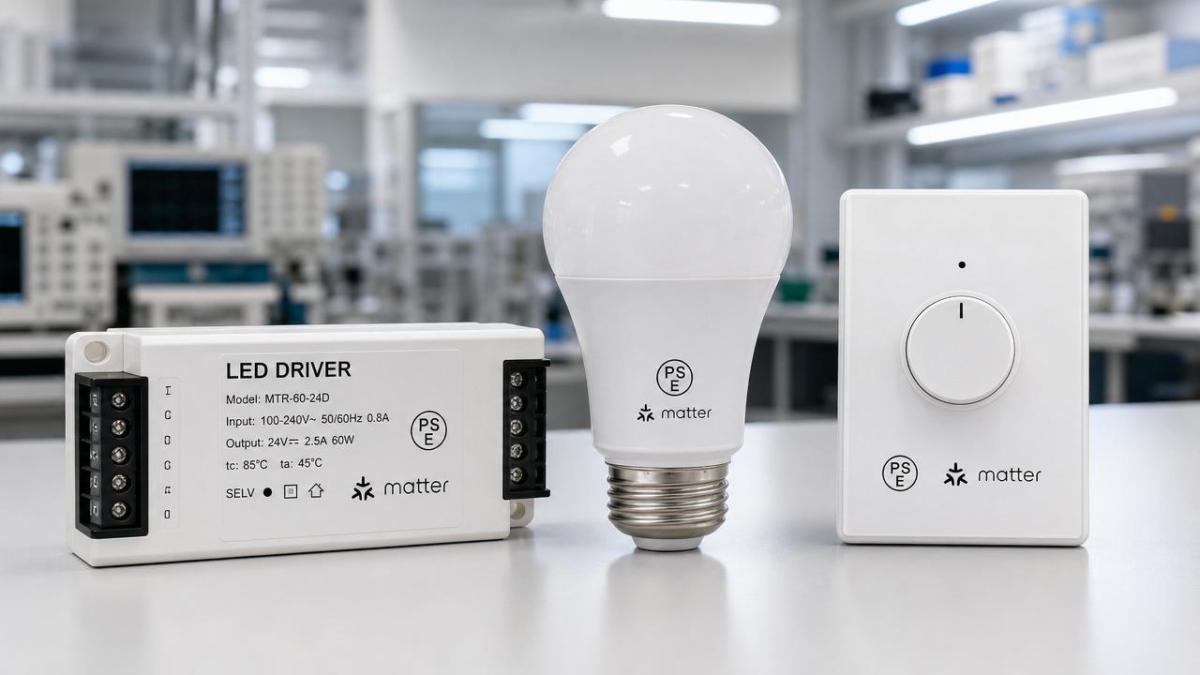
Japan’s Ministry of Economy, Trade and Industry (METI) announced on May 15, 2026, that the PSE certification exemption for Matter-enabled smart lighting products will be terminated effective October 1, 2026. This policy shift directly affects LED drivers, smart bulbs, and dimming controllers using Matter connectivity — all of which will now require individual PSE certification for local control functionality. Exporters of lighting OEM products from China to Japan, as well as manufacturers and distributors engaged in this supply chain, must assess implications for compliance timelines, testing costs, and market access.
Event Overview
On May 15, 2026, Japan’s Ministry of Economy, Trade and Industry (METI) confirmed the termination of the PSE certification exemption for smart lighting devices compliant with the Matter protocol. Starting October 1, 2026, all Matter-connected LED drivers, smart bulbs, and dimming controllers sold in Japan must obtain separate PSE certification covering local control functionality, issued by METI-designated conformity assessment bodies.
Industries Affected
Direct Exporters (OEM/ODM Lighting Manufacturers)
Manufacturers exporting smart lighting products from China to Japan are directly impacted, as their current PSE-exempt Matter-certified products will no longer qualify for market entry without additional local control verification. The requirement introduces new test scope (e.g., offline operation, local command responsiveness, firmware isolation), extending certification lead times and increasing third-party testing fees.
Component Suppliers (LED Driver & Control Module Makers)
Suppliers providing core components — especially integrated drivers or wireless control modules embedded in Matter-compliant luminaires — may face revised qualification demands. If these components implement local control logic, they may need standalone PSE evaluation or co-certification with end products, affecting bill-of-materials planning and technical documentation handover.
Distribution & Brand Owners (Importers & Retailers)
Importers and Japan-based brand owners responsible for product registration and PSE marking must verify whether existing inventory or incoming shipments meet the new requirement. Products certified under the previous exemption framework will not be grandfathered; post-October 1, 2026, non-compliant stock cannot be legally placed on the Japanese market.
Key Considerations and Recommended Actions
Monitor official METI guidance and designated body updates
METI has not yet published detailed technical criteria for ‘local control functionality’ under PSE. Companies should track announcements from METI and accredited bodies (e.g., JET, UL Japan, TÜV SÜD Japan) regarding test standards, sample requirements, and transitional arrangements — particularly whether limited pre-October submissions will be accepted.
Identify and prioritize high-risk product categories
Focus initial compliance efforts on products where local control is implemented via embedded firmware (e.g., Matter-over-Thread bulbs with onboard commissioning), rather than cloud-dependent models. Prioritize items already scheduled for Japan shipment between August–September 2026 to avoid clearance delays.
Distinguish policy announcement from enforcement readiness
The October 1, 2026, date marks a formal regulatory deadline, but customs enforcement capacity and inspector training timelines remain unconfirmed. While compliance is mandatory from that date, practical enforcement ramp-up may vary — making early engagement with Japanese import agents and certification consultants advisable.
Adjust procurement and certification scheduling now
Allocate additional 8–12 weeks for PSE certification cycles due to added local control testing. Update internal product development roadmaps to include parallel PSE preparation alongside Matter certification — especially for new SKUs targeting Q4 2026 launch windows.
Editorial Perspective / Industry Observation
This measure is best understood not as an isolated regulatory update, but as a signal of Japan’s broader alignment with functional safety and resilience expectations for connected devices. Analysis shows METI is reinforcing domestic control requirements in response to growing emphasis on data sovereignty, interoperability reliability, and offline usability — trends also visible in recent EU Cyber Resilience Act provisions. Observably, the timing coincides with global Matter 1.3 adoption, suggesting Japan is calibrating its certification framework to match evolving protocol capabilities. From an industry perspective, this is less a sudden barrier and more a formalization of an emerging expectation: Matter compliance alone no longer suffices for Japanese market access — local control assurance is now a distinct, mandatory layer.
Conclusion: The termination of the Matter exemption reflects a tightening of technical accountability for smart lighting in Japan — shifting responsibility from protocol-level conformance to device-level functional assurance. It does not invalidate Matter adoption but requires layered compliance planning. Currently, this development is most accurately interpreted as a procedural escalation with clear operational consequences, rather than a strategic pivot away from Matter. Companies should treat it as a fixed timeline requirement demanding structured technical and logistical preparation — not a negotiable or optional adjustment.
Source: Official announcement by Japan’s Ministry of Economy, Trade and Industry (METI), dated May 15, 2026. Details regarding test specifications, designated bodies’ implementation timelines, and potential transitional allowances remain pending further METI publications and are subject to ongoing observation.
Protocol_Architect
Dr. Thorne is a leading architect in IoT mesh protocols with 15+ years at NexusHome Intelligence. His research specializes in high-availability systems and sub-GHz propagation modeling.
Related Recommendations
- Kenji Sato (Infrastructure Arch)Smart Lighting in North America: Key Standards, Retrofit Options, and ROI Factors
- Kenji Sato (Infrastructure Arch)IoT Interoperability for Smart Lighting: Matter, Zigbee, or Wi-Fi for Multi-Vendor Systems?
- Kenji Sato (Infrastructure Arch)Smart Building IoT Lighting Management: Best Use Cases for Offices and Campuses
- Kenji Sato (Infrastructure Arch)Smart Dimmer Switches With RF Control vs Wi-Fi Dimmers: Key Differences for Retrofit Projects
- Kenji Sato (Infrastructure Arch)How to Choose Hotel Sofas for High-Traffic Spaces: Materials, Comfort, and Durability
- Kenji Sato (Infrastructure Arch)Smart Lighting Hardware Verification: What to Test Before Pilot Deployment
- Kenji Sato (Infrastructure Arch)How to Turn Project Specification Planning for Smart Lighting Into a Scalable Retrofit Plan
- Kenji Sato (Infrastructure Arch)SixG301 Gains First-Wave Matter Platform Certification
- Kenji Sato (Infrastructure Arch)Executive Office Desks Buying Guide: Sizes, Materials, Storage, and Cable Management
- Kenji Sato (Infrastructure Arch)PA Systems for Schools: How to Choose Coverage, Zoning, and Emergency Features
Analyst