
Japan METI Ends Smart Lighting Matter Exemption
author
On May 16, 2026, Japan’s Ministry of Economy, Trade and Industry (METI) announced the full termination of the PSE certification exemption for Smart Lighting products implementing the Matter protocol, effective October 1, 2026. This change directly affects LED drivers, smart dimming modules, and DALI gateways that rely on Matter for interoperability — requiring all such devices to obtain independent PSE certification for Local Control Function (LCF) and submit JIS C 8112-2:2026 conformance test reports. Manufacturers—particularly China-based ODM lighting suppliers—must now upgrade firmware logic for LCF and integrate physical button redundancy into hardware design.
Event Overview
Japan’s Ministry of Economy, Trade and Industry (METI) issued an official notice on May 16, 2026, confirming that the PSE certification exemption for Smart Lighting products using the Matter protocol will be fully revoked as of October 1, 2026. From that date, all Matter-enabled LED drivers, smart dimming modules, and DALI gateways sold in Japan must hold separate PSE certification covering Local Control Function (LCF), accompanied by a test report verifying compliance with JIS C 8112-2:2026. No transitional grace period or grandfathering clause has been published in the initial announcement.
Which Subsectors Are Affected
ODM/OEM Lighting Manufacturers (China-based)
These manufacturers are directly impacted because their current Matter-certified smart lighting components lack standalone LCF certification and often omit physical control redundancy. The requirement to retrofit firmware logic and redesign mechanical interfaces (e.g., add dedicated local toggle buttons) introduces new validation cycles, BOM adjustments, and timeline pressure ahead of the October 2026 deadline.
Smart Lighting Module Suppliers
Suppliers of LED drivers and DALI gateways—including those embedded in third-party luminaires—must now treat LCF not as a software feature but as a certified safety-critical function. This shifts product qualification from Matter interoperability testing alone to dual-track certification: Matter + PSE/Local Control. Certification timelines may extend due to limited accredited labs in Japan capable of JIS C 8112-2:2026 testing.
Export Trading Companies & Distributors
Trading firms handling Japan-bound smart lighting shipments face increased pre-shipment verification burdens. Customs clearance after October 1, 2026 will require documented evidence of valid LCF-specific PSE certification—not just general PSE or Matter certification. Incomplete documentation may result in shipment holds or rejections at Japanese ports.
System Integrators & Specifying Engineers
Professionals specifying Matter-based smart lighting for Japanese commercial projects must now verify LCF compliance at the component level—not just system-level Matter certification. Absence of certified LCF functionality may invalidate compliance with Japan’s Electrical Appliance and Material Safety Act (DENAN), affecting project approvals and liability allocation.
What Relevant Enterprises or Practitioners Should Focus On and How to Respond Now
Monitor Official METI Guidance and JETRO Updates
Analysis shows METI’s May 16 notice is an initial policy statement—not yet accompanied by detailed implementation guidelines, lab accreditation lists, or interpretation documents. Stakeholders should track updates from METI and Japan External Trade Organization (JETRO), especially regarding accepted test report formats and whether existing JIS C 8112-2:2024 reports can be grandfathered.
Prioritize Product Categories with Highest Japan Market Exposure
Current more relevant is to identify which specific models—especially those already listed under Japan’s PSE “Category A” (designated electrical appliances)—are scheduled for launch or restock between July–September 2026. These units require immediate LCF firmware revision and lab submission to avoid post-October supply gaps.
Distinguish Between Policy Signal and Operational Readiness
Observably, this is a regulatory signal confirming Japan’s intent to decouple local safety control from cloud- or hub-dependent protocols—even within Matter ecosystems. However, actual enforcement depends on customs inspection protocols and PSE certification body readiness, both of which remain unconfirmed. Businesses should treat October 1, 2026 as a hard deadline for certification submission—but allow buffer time for lab backlogs and documentation review.
Initiate Firmware and Hardware Revision Planning Immediately
From industry perspective, LCF implementation involves more than code changes: it requires physical button integration, fail-safe state retention during power loss, and deterministic response timing—all subject to JIS C 8112-2:2026 test criteria. ODMs should begin schematic reviews and firmware alpha builds no later than Q3 2025 to meet testing lead times.
Editorial Perspective / Industry Observation
This announcement is better understood as a formalization of Japan’s long-standing regulatory priority: ensuring local, hardware-based control independence for safety-critical lighting functions—even when networked via global standards like Matter. Analysis shows it reflects alignment with DENAN’s core principle that essential operation must remain functional without external infrastructure. It is not primarily a technical interoperability move, nor a trade barrier per se, but rather a jurisdictional affirmation of domestic safety sovereignty. Observably, similar requirements may emerge in other regulated markets evaluating Matter adoption—making early LCF design discipline a strategic advantage beyond Japan.
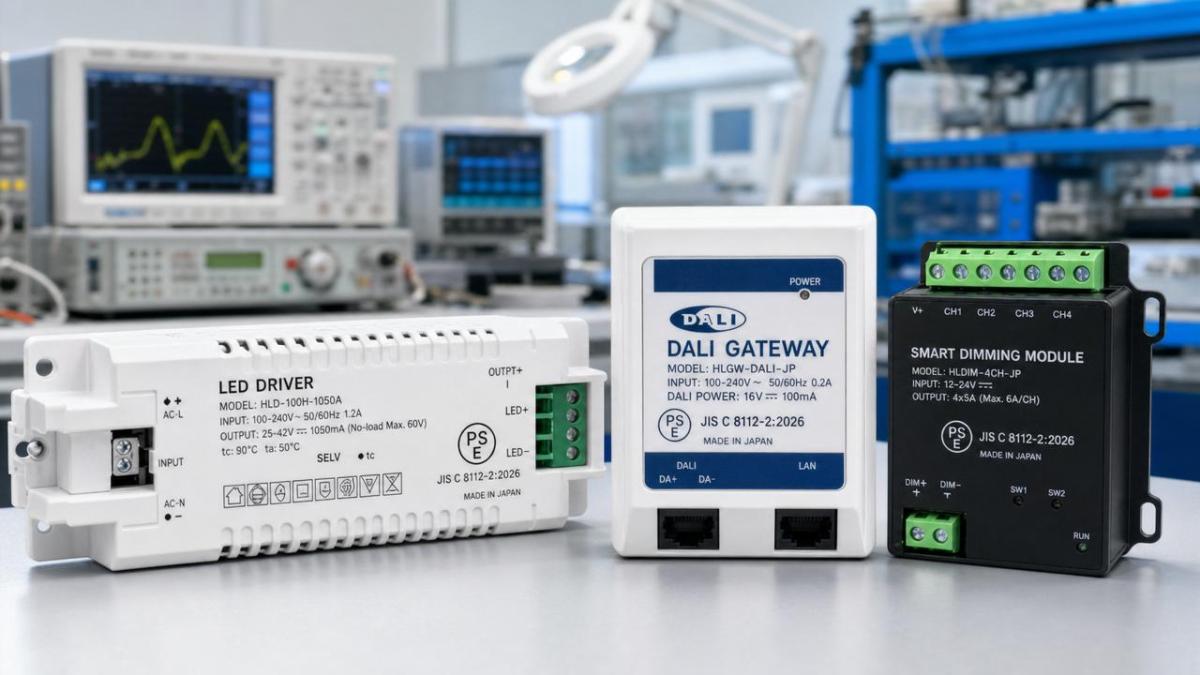
Conclusion: This METI decision marks a definitive shift from protocol-based certification flexibility to function-specific regulatory accountability for smart lighting in Japan. It does not invalidate Matter; rather, it layers mandatory local control assurance atop it. For stakeholders, the current situation is best interpreted not as a sudden disruption, but as the operationalization of an expected regulatory trajectory—one that rewards proactive design integration over last-minute compliance retrofitting.
Source Information:
• Official notice issued by Japan’s Ministry of Economy, Trade and Industry (METI), dated May 16, 2026
• Reference standard: JIS C 8112-2:2026 (published April 2026, effective October 1, 2026)
• Pending observation: Detailed enforcement procedures, accredited laboratory list, and acceptance criteria for legacy test reports remain unannounced and require ongoing monitoring.
Protocol_Architect
Dr. Thorne is a leading architect in IoT mesh protocols with 15+ years at NexusHome Intelligence. His research specializes in high-availability systems and sub-GHz propagation modeling.
Related Recommendations
- Kenji Sato (Infrastructure Arch)Smart Lighting in North America: Key Standards, Retrofit Options, and ROI Factors
- Kenji Sato (Infrastructure Arch)IoT Interoperability for Smart Lighting: Matter, Zigbee, or Wi-Fi for Multi-Vendor Systems?
- Kenji Sato (Infrastructure Arch)Smart Building IoT Lighting Management: Best Use Cases for Offices and Campuses
- Kenji Sato (Infrastructure Arch)Smart Dimmer Switches With RF Control vs Wi-Fi Dimmers: Key Differences for Retrofit Projects
- Kenji Sato (Infrastructure Arch)How to Choose Hotel Sofas for High-Traffic Spaces: Materials, Comfort, and Durability
- Kenji Sato (Infrastructure Arch)Smart Lighting Hardware Verification: What to Test Before Pilot Deployment
- Kenji Sato (Infrastructure Arch)How to Turn Project Specification Planning for Smart Lighting Into a Scalable Retrofit Plan
- Kenji Sato (Infrastructure Arch)SixG301 Gains First-Wave Matter Platform Certification
- Kenji Sato (Infrastructure Arch)Executive Office Desks Buying Guide: Sizes, Materials, Storage, and Cable Management
- Kenji Sato (Infrastructure Arch)PA Systems for Schools: How to Choose Coverage, Zoning, and Emergency Features
Analyst