
Smart Security Access Control Breaks at the Edge Cases
author
Smart security access control rarely fails in the lab for the reasons vendors highlight in brochures. It fails at the edge cases: during low-voltage events, in poor weather, across mixed-protocol deployments, under unstable network conditions, or when a biometric system rejects legitimate users at the worst possible moment. For renewable energy facilities, distributed energy sites, smart buildings, and hybrid infrastructure projects, those failures are not minor inconveniences—they create safety gaps, operational downtime, compliance exposure, and procurement mistakes that are expensive to reverse.
The practical takeaway is simple: if you are evaluating smart security access control for renewable energy-linked infrastructure, do not start with feature lists. Start with failure modes. The most valuable questions are whether the system still works when latency spikes, whether its biometric false rejection rate (FRR) remains acceptable in real environments, whether Matter and other protocol claims hold up in mixed ecosystems, and whether edge processing can maintain security decisions locally when connectivity degrades.
Why smart security access control breaks at the edge cases
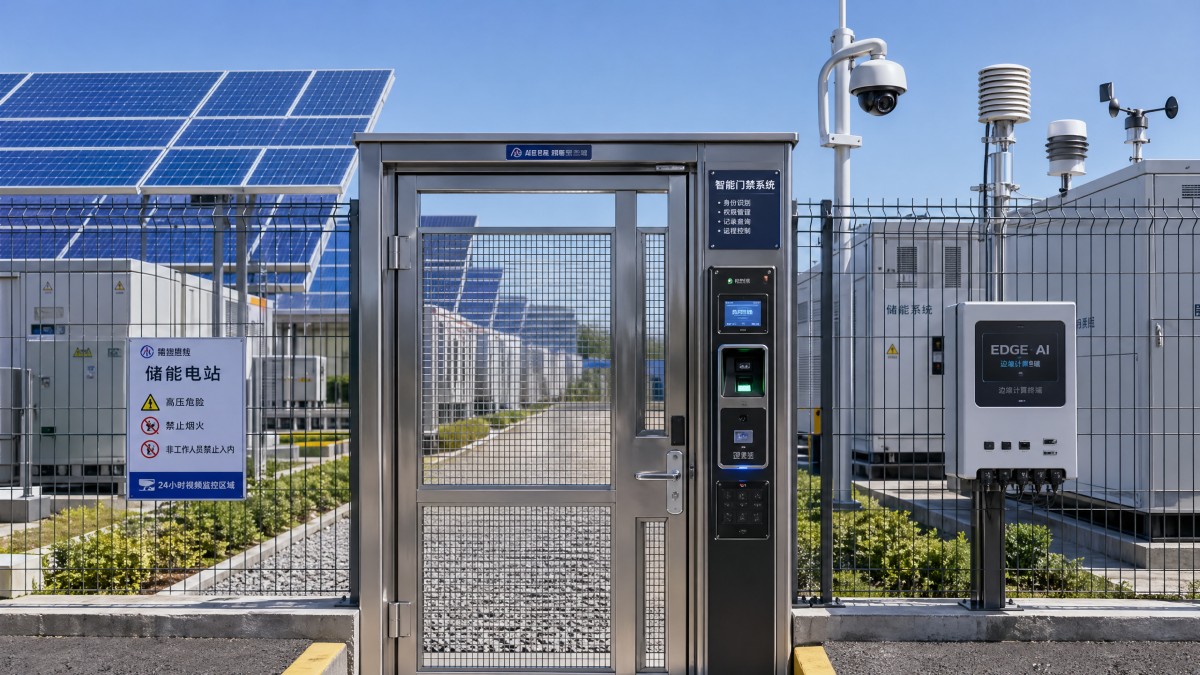
Most access control systems look reliable when tested in stable, ideal conditions. Real operating environments are different. Renewable energy projects often combine remote assets, distributed power systems, smart building controls, IoT gateways, cameras, locks, sensors, and multiple protocol layers. That complexity exposes weaknesses that do not show up in sales demos.
The most common edge-case failures usually come from five sources:
- Latency-sensitive authentication: Delays in identity verification, lock response, or edge-to-cloud decision flow can create failed entries, operator frustration, and security loopholes.
- Biometric instability: Fingerprint, face, or other biometric methods can suffer higher FRR in rain, dust, glare, gloves-on workflows, aging skin conditions, or high-throughput shift changes.
- Protocol mismatch: Devices advertised as compatible with Matter, Thread, Zigbee, BLE, or Wi-Fi may still behave unpredictably in mixed installations.
- Power and resilience issues: In renewable energy environments, transient power conditions, backup switching, or remote site limitations can affect device uptime and response consistency.
- Edge processing limitations: Local AI, video analytics, and offline access logic may degrade under load, causing poor recognition accuracy or delayed authorization decisions.
In other words, smart security access control does not usually fail because the concept is flawed. It fails because system design, hardware quality, and protocol implementation are not stress-tested against real-world operational edge cases.
What procurement teams, operators, and decision-makers actually need to know
Different stakeholders ask different questions, but they are all trying to reduce risk.
Information researchers want to know which technical claims are meaningful and which are marketing language. They need benchmarks, not adjectives.
Operators and users care about whether the system works consistently during shift changes, bad weather, low light, network instability, and emergency overrides. They want fewer false denials and less friction.
Procurement teams need a sourcing framework. They must distinguish between products that are simply feature-rich and products that are operationally reliable, compliant, and maintainable across the lifecycle.
Enterprise decision-makers focus on business impact: downtime risk, incident exposure, vendor lock-in, integration costs, compliance posture, scalability, and total cost of ownership.
For these audiences, the best article is not one that explains access control in generic terms. It is one that helps answer practical evaluation questions such as:
- What performance metrics actually predict failure in the field?
- How should biometric FRR be interpreted in operational environments instead of lab conditions?
- How much does protocol interoperability affect long-term deployment risk?
- When is edge computing essential rather than optional?
- How can buyers verify that a supplier’s security claims are backed by measurable testing?
Which metrics matter most when evaluating access control in renewable energy infrastructure
If the system will protect substations, storage facilities, solar assets, wind operations, control rooms, or mixed-use smart energy campuses, the following metrics deserve priority.
1. Authentication latency under load
A lock that opens in 300 milliseconds in a demo may take much longer when the network is congested, when multiple readers are active, or when edge nodes are processing several camera feeds. Measure response time during peak traffic and degraded connectivity, not just single-user idle conditions.
2. False Rejection Rate (FRR) in non-ideal conditions
FRR is one of the most operationally important biometric indicators. A high FRR means legitimate users are denied access too often. In renewable energy and industrial-adjacent settings, FRR should be tested with dust, moisture, PPE usage, lighting variance, and fast throughput scenarios. A good lab FRR number is not enough.
3. False Acceptance Rate (FAR) balanced against usability
Security teams often focus on keeping unauthorized users out, but systems tuned too aggressively can become unusable. The right balance depends on site criticality, staffing model, and fallback procedures.
4. Local processing speed and offline decision capability
Edge computing matters when sites have unstable backhaul or strict privacy requirements. The key question is whether the system can continue making access decisions locally, logging events securely, and syncing later without creating policy gaps.
5. Protocol compliance and interoperability stability
Matter, Thread, Zigbee, BLE, and Wi-Fi compatibility claims should be verified in mixed-device environments. Buyers should ask whether multi-vendor devices maintain stable enrollment, policy enforcement, event reporting, and firmware updates over time.
6. Power resilience and fail-safe behavior
In renewable energy-linked environments, access control must behave predictably during power transitions. Test lock states, controller recovery time, cached credentials, and event integrity during brownouts, backup switchover, and intermittent outages.
7. Auditability and compliance support
For privacy-sensitive environments, local data handling, log retention, identity records, and video linkage should align with regional requirements. Claims of secure processing should be supported by verifiable architecture and testing evidence.
Why Matter compatibility claims should not be accepted at face value
The rise of Matter has improved the conversation around interoperability, but “works with Matter” does not automatically mean operationally robust access control. In security contexts, compatibility is not just about onboarding a device successfully. It is about whether the entire workflow remains reliable over time.
For example, a device may pair correctly at installation but still fail in real operation because of:
- unstable multi-hop Thread routing,
- firmware mismatch between vendor stacks,
- slow state synchronization across controllers,
- partial support for security-relevant clusters,
- inconsistent recovery after outages or resets.
For procurement and architecture teams, this means protocol support should be evaluated as a performance and lifecycle issue, not a checkbox. In mixed ecosystems, access control reliability is only as strong as the weakest implementation detail in the chain.
How edge computing changes the security and business case
In smart infrastructure connected to renewable energy systems, edge computing is not only a technical enhancement. It can materially improve resilience, privacy, and operating continuity.
When access control logic runs locally, organizations can reduce dependence on constant cloud availability. That matters for remote or bandwidth-constrained sites. It also helps where privacy requirements limit how biometric data or video should be transmitted and stored.
The business value of edge-based access control includes:
- Reduced operational disruption: entry decisions can continue during WAN degradation.
- Faster response: local inference and authorization reduce round-trip delays.
- Better privacy posture: sensitive data can remain on-site or be minimized before transmission.
- Lower system-wide risk: fewer single points of failure in cloud-dependent workflows.
However, edge computing only adds value if the hardware is actually capable. Buyers should verify processor performance, thermal stability, secure storage, local event buffering, and update reliability under sustained workloads.
How to evaluate vendors without getting trapped by marketing language
In the IoT supply chain, access control vendors often use the same language: seamless integration, enterprise-grade security, AI-powered recognition, low power consumption, and broad compatibility. These phrases are not useless, but they are not enough to support purchasing decisions.
A more reliable evaluation process includes the following steps:
- Ask for measured benchmarks, not claims. Request latency ranges, FRR/FAR data, recovery behavior, and multi-device interoperability results.
- Test real deployment scenarios. Simulate adverse lighting, PPE usage, weather, offline mode, congested networks, and power switching.
- Review protocol behavior over time. Confirm how the system performs after firmware updates, controller changes, and cross-vendor expansion.
- Validate edge-case failover logic. Understand what happens when cloud connectivity drops, credentials cannot sync, or local storage fills.
- Check maintainability. Assess battery behavior, component durability, service access, and the maturity of vendor support.
- Map security to operations. The most secure product on paper may still be the wrong choice if it creates unacceptable friction for field teams.
This is where independent benchmarking becomes especially valuable. In a fragmented ecosystem, the gap between spec sheet performance and deployed performance is often where cost, risk, and trust are won or lost.
Practical decision framework: when an access control system is likely fit for purpose
A smart security access control solution is more likely to be fit for renewable energy and smart infrastructure use when it demonstrates the following characteristics:
- Consistent low-latency performance during peak and degraded conditions
- Biometric FRR tested in realistic environmental and workflow scenarios
- Verified interoperability across the actual protocols used in the target deployment
- Reliable edge processing and offline authorization capability
- Predictable behavior during power transition and network loss
- Clear audit trails, update policies, and compliance support
- Supplier transparency backed by repeatable test data
If one or more of these areas is weak, the organization is not just buying technical uncertainty. It is buying future integration delays, operator frustration, service tickets, and hidden project cost.
Conclusion: edge cases are where the truth of smart security access control is revealed
Smart security access control breaks at the edge cases because that is where hardware quality, protocol integrity, biometric reliability, and system architecture are genuinely tested. For renewable energy-linked infrastructure, the right decision is rarely the product with the most features. It is the one that remains dependable when latency rises, power shifts, the network degrades, and users need access without delay.
For researchers, operators, procurement teams, and enterprise leaders, the strongest approach is to evaluate access control through measurable failure scenarios rather than marketing narratives. When benchmarking focuses on FRR, latency, Matter compatibility, edge processing, and resilience under stress, buyers can make decisions based on engineering truth instead of assumption.
That is the difference between a system that looks intelligent in a brochure and one that actually protects critical connected infrastructure in the real world.
Protocol_Architect
Dr. Thorne is a leading architect in IoT mesh protocols with 15+ years at NexusHome Intelligence. His research specializes in high-availability systems and sub-GHz propagation modeling.
Related Recommendations
- Lina Zhao (Security Analyst)Apple Expands Smart Home Push with LG and Schneider Electric
- Lina Zhao (Security Analyst)Choosing Weatherproof Smart Locks: IP Ratings, Temperature Limits, and Battery Life
- Lina Zhao (Security Analyst)What Smart Lock Data Should Home Hardware Teams Collect to Improve Security and Reliability?
- Lina Zhao (Security Analyst)Choosing a Z-Wave Smart Lock: Hub Compatibility, Security, and Backup Access
- Lina Zhao (Security Analyst)Door Access Control for Solar Farms: Choosing Reliable Systems for Remote Sites
- Lina Zhao (Security Analyst)EN 303 645:2026 Takes Effect, Making Matter Certification Mandatory for Smart Lock Exports
- Lina Zhao (Security Analyst)EU EN 303 645:2026 Takes Effect for Smart Locks
- Lina Zhao (Security Analyst)EU CE Update Makes Matter Testing Mandatory for Smart Locks
- Lina Zhao (Security Analyst)EN 303 645:2026 Takes Effect for Smart Locks
- Lina Zhao (Security Analyst)How to Choose Thread for Smart Locks in Multi-Unit Residential Projects
Analyst