
EN 303 645:2026 Takes Effect for Smart Locks
author
From July 16, 2026, the revised EN 303 645:2026 is in force following its publication in the Official Journal of the European Union on July 15. The change matters because Smart Locks and Biometric Sensors are now expressly covered, and market access is tied to cybersecurity testing that directly affects CE compliance. For manufacturers, exporters, import-facing supply partners, testing providers, and procurement teams, this is not only a technical update but also a trade and delivery issue, since products that do not meet the standard may be blocked from customs clearance and sale.
What the new mandatory scope now covers
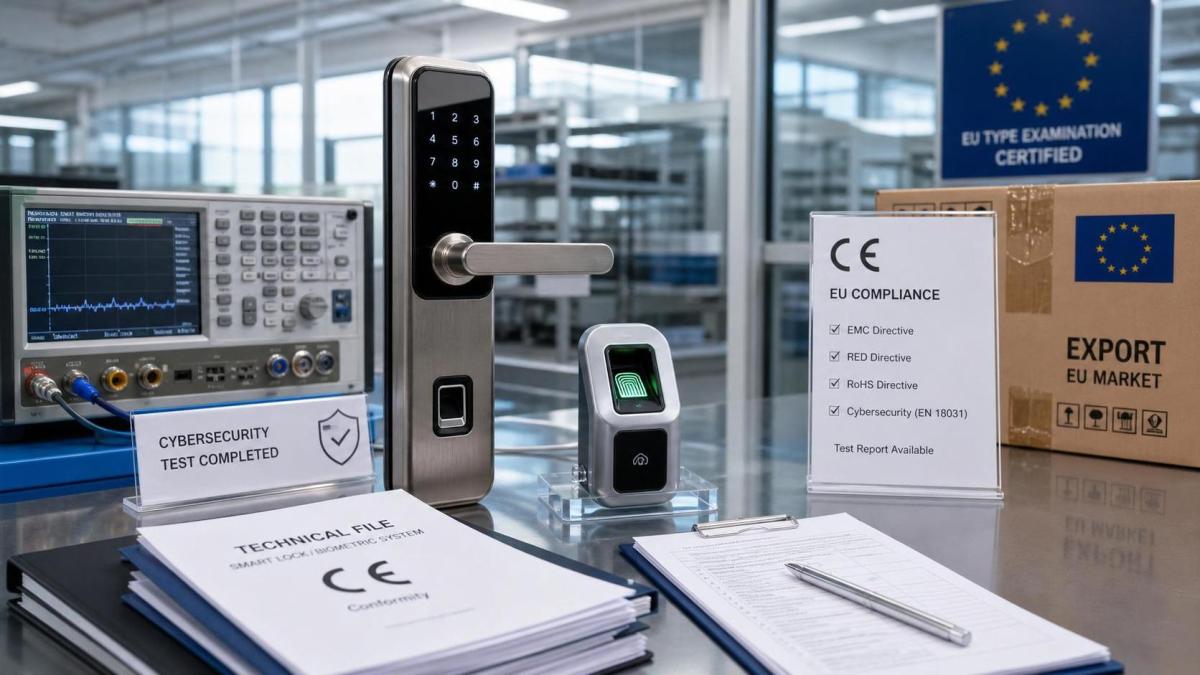
The confirmed change is that the revised EN 303 645:2026 was published on July 15, 2026 and became mandatory on July 16, 2026. Under the revised version, Biometric Sensors and Smart Locks are explicitly included within scope. Devices placed on the EU market must pass eight newly added tests, including dynamic firmware update capability, remote wipe, least-privilege access control, and resistance to physical bypass attacks. The standard is directly linked to CE marking compliance, and products that fail to meet it will be prohibited from customs clearance and sale.
Where the pressure is likely to appear first
Manufacturing and product release now face a narrower compliance window
From an industry perspective, device manufacturers are likely to feel the impact first because the rule change connects technical design requirements with market entry conditions. The immediate pressure points are product validation, release scheduling, and technical documentation readiness. For Smart Locks and Biometric Sensors intended for the EU market, teams need to pay closer attention to whether product functions and test evidence align with the newly added cybersecurity checks before shipment or launch.
Export and channel operations need closer control over market-entry documents
For exporters and distribution partners, the main issue is that the standard is tied to CE compliance and to customs clearance outcomes. Analysis shows that shipment planning, sales commitments, and channel delivery timelines may all be affected if compliance materials are incomplete or if product status is not clearly verified before export. What deserves closer attention is the consistency between product claims, certification status, and the documents used in trade and delivery processes.
Testing and certification-related service providers may see demand shift toward evidence readiness
For testing services and certification-related support providers, the rule change is likely to shift demand toward earlier review of product capabilities and supporting records. Observably, the business impact is less about abstract cybersecurity positioning and more about whether manufacturers can present test-aligned evidence for functions such as firmware updating, remote wipe, access control, and resistance to physical bypass. This affects project sequencing, report preparation, and client communication around compliance readiness.
Procurement and after-sales teams should treat compliance as a delivery condition
Procurement teams and after-sales operators may also be affected because the new requirements reach beyond factory testing and into product lifecycle expectations. Analysis shows that supplier qualification, delivery acceptance, service commitments, and traceability records deserve closer review where EU-bound Smart Locks or Biometric Sensors are involved. In practice, compliance can no longer be treated as a separate technical matter if customs clearance and sale are contingent on the standard being met.
Practical points companies should review now
Recheck whether affected product lines are clearly within scope
Companies dealing in Smart Locks and Biometric Sensors should first review whether EU-bound models, variants, and related technical files are being managed under the revised scope. This is especially relevant where internal classification, product naming, or bid materials were prepared before the revised version became mandatory.
Review technical files against the newly added test items
Analysis shows that the immediate task is not to assume general cybersecurity readiness, but to verify whether the required functions and evidence correspond to the eight added tests named in the summary. Particular attention should be given to records and descriptions related to dynamic firmware updates, remote wipe, least-privilege access control, and resistance to physical bypass attacks, because these are expressly identified in the input information.
Assess delivery plans and export commitments for EU-bound shipments
Where products are intended for the EU market, companies should closely review shipment timing, order commitments, and delivery promises in light of the standard's mandatory status from July 16, 2026. Observably, this is a compliance checkpoint with direct trade implications, so any unresolved certification or test-readiness issue may affect clearance and sales execution.
Keep monitoring implementation language and downstream document changes
The input does not provide detailed enforcement procedures or interpretive guidance, so companies should treat follow-up wording, certification practice, procurement specifications, and downstream tender or buyer documents as items requiring continued verification. It is more appropriate to understand this stage as one where execution details still need to be watched closely, even though the mandatory status itself is already clear.
Why this looks like an execution signal, not a watch-only headline
Observably, this development is more than a policy discussion because the revised standard has already become mandatory and is directly linked to CE compliance, customs clearance, and sales eligibility. At the same time, analysis should remain disciplined: the available facts confirm the rule change and its immediate compliance consequences, but they do not yet establish a detailed market response, a uniform enforcement pattern, or a complete operational timetable across all affected business processes. That is why the event is better understood as a landed compliance change with ongoing implementation questions, rather than as a purely preliminary regulatory signal.
How the market should read this update
The clearest takeaway is that EN 303 645:2026 now functions as an immediate market-access condition for the covered Smart Locks and Biometric Sensors described in the input. For industry participants, the significance lies in the merger of cybersecurity testing, CE compliance, and trade execution into one practical checkpoint. A measured reading is appropriate: this is already an effective rule change, while the finer points of enforcement approach, documentation practice, and commercial response still merit continued observation.
Basis of this article and what still needs verification
This article is generated based on the user-provided news title, event date, and event summary. For developments of this kind, relevant source types usually include official notices, regulatory releases, customs or trade authority information, industry association updates, standards organization documents, and reporting by authoritative media. No specific official source link was provided in the input, so the exact source document link still requires further verification. Continued attention should also be given to any later clarification on implementation details, certification interpretation, procurement document changes, industry feedback, and how affected companies carry out compliance in practice.
Protocol_Architect
Dr. Thorne is a leading architect in IoT mesh protocols with 15+ years at NexusHome Intelligence. His research specializes in high-availability systems and sub-GHz propagation modeling.
Related Recommendations
- Lina Zhao (Security Analyst)What Smart Lock Data Should Home Hardware Teams Collect to Improve Security and Reliability?
- Lina Zhao (Security Analyst)Choosing a Z-Wave Smart Lock: Hub Compatibility, Security, and Backup Access
- Lina Zhao (Security Analyst)Door Access Control for Solar Farms: Choosing Reliable Systems for Remote Sites
- Lina Zhao (Security Analyst)EN 303 645:2026 Takes Effect, Making Matter Certification Mandatory for Smart Lock Exports
- Lina Zhao (Security Analyst)EU EN 303 645:2026 Takes Effect for Smart Locks
- Lina Zhao (Security Analyst)EU CE Update Makes Matter Testing Mandatory for Smart Locks
- Lina Zhao (Security Analyst)EN 303 645:2026 Takes Effect for Smart Locks
- Lina Zhao (Security Analyst)How to Choose Thread for Smart Locks in Multi-Unit Residential Projects
- Lina Zhao (Security Analyst)Japan Tightens EMI Test Rules for Imported Smart Locks
- Lina Zhao (Security Analyst)Project Specification Support for Smart Security: How to Define Devices, Protocols, and Scope
Analyst