
What to Ask a Hardware Compliance Service About Solar Inverters
author
A solar inverter that performs well on a datasheet may still face certification delays or grid-integration risks in its target market. Before selecting a hardware compliance inquiry service, technical evaluators need to ask which safety, electromagnetic compatibility, and grid-connection requirements apply—and how those requirements will be verified. This guide outlines the questions to raise about standards, test methods, documentation, and evidence, helping you assess compliance claims and identify potential gaps before deployment.
What exactly is being assessed?
Start with the product configuration, not a list of standards. A grid-tied photovoltaic inverter, a hybrid inverter connected to a battery, and an inverter with backup power capability can present different safety and grid-interconnection questions. The service should know whether it is reviewing one model, a product family, a component, or an assembled system.
Ask what information it needs before giving an applicability opinion. At a minimum, be ready to discuss the intended market, rated AC output, DC input characteristics, installation environment, grounding arrangements, battery interface where relevant, and communication options. A single-phase residential unit and a three-phase commercial unit may not follow the same local connection process, even if they share a platform.
The distinction between an inquiry and a certification engagement matters. A service may research requirements, review existing reports, coordinate testing, or issue a certification through an authorized scheme. Those are different deliverables. Ask who makes the final conformity decision, what the service can actually issue, and whether its work will be accepted by the parties involved in your project.
Which requirements apply in the intended market?
Request a written standards and requirements matrix, with the applicable edition, amendments, transition dates where relevant, and the reason each item applies. It should separate product safety, electromagnetic compatibility (EMC), grid interconnection, radio requirements, and any installation or marking obligations. A list of standard numbers without that context is a weak starting point.
IEC 62109-1 and IEC 62109-2 address safety for power conversion equipment used in photovoltaic power systems. In the United States, UL 1741 is a key standard for inverters and related distributed energy equipment. IEEE 1547 addresses interconnection and interoperability of distributed energy resources, while IEEE 1547.1 covers associated conformance test procedures. Their relevance and the required editions depend on the product, jurisdiction, utility, and project timing; they should not be treated as an interchangeable global checklist.
For an EU-bound product, ask the service to identify applicable legislation and harmonised standards for the exact configuration, rather than assuming that a CE mark settles the question. A CE marking is not, by itself, a third-party certificate or proof of acceptance by a local grid operator. If the inverter includes a wireless interface, clarify whether radio-equipment requirements enter the assessment and which party is responsible for the combined product.
Also ask who checks the local utility’s interconnection rules. National requirements, regional implementation, approved-equipment lists, and site-specific settings can overlap. A product certificate may be necessary but still leave a separate application, configuration review, or commissioning step.
How will grid behavior be demonstrated?
An inverter can be electrically safe yet unsuitable for connection under the rules of a particular network. Ask the service to explain the evidence required for anti-islanding, voltage and frequency responses, reconnection behavior, and any required active or reactive power functions. The relevant test methods and acceptance criteria should be tied to the target market, not borrowed from a different certification package.
Pay particular attention to settings. A report may demonstrate a capability, while the utility expects an approved profile and limits on who can change it. Ask which firmware version and parameter set were tested, how the country or grid profile is selected, and whether a commissioning record is required to show what was actually installed.
For a hybrid system with backup output, describe every intended operating state: grid-connected, transition to backup, isolated operation, and return to grid. The service should identify which states fall inside the proposed assessment and which depend on external equipment or installation design. Do not assume that a report for grid-tied operation automatically covers an assembled backup system.
What will the laboratory test—and what might invalidate the results?
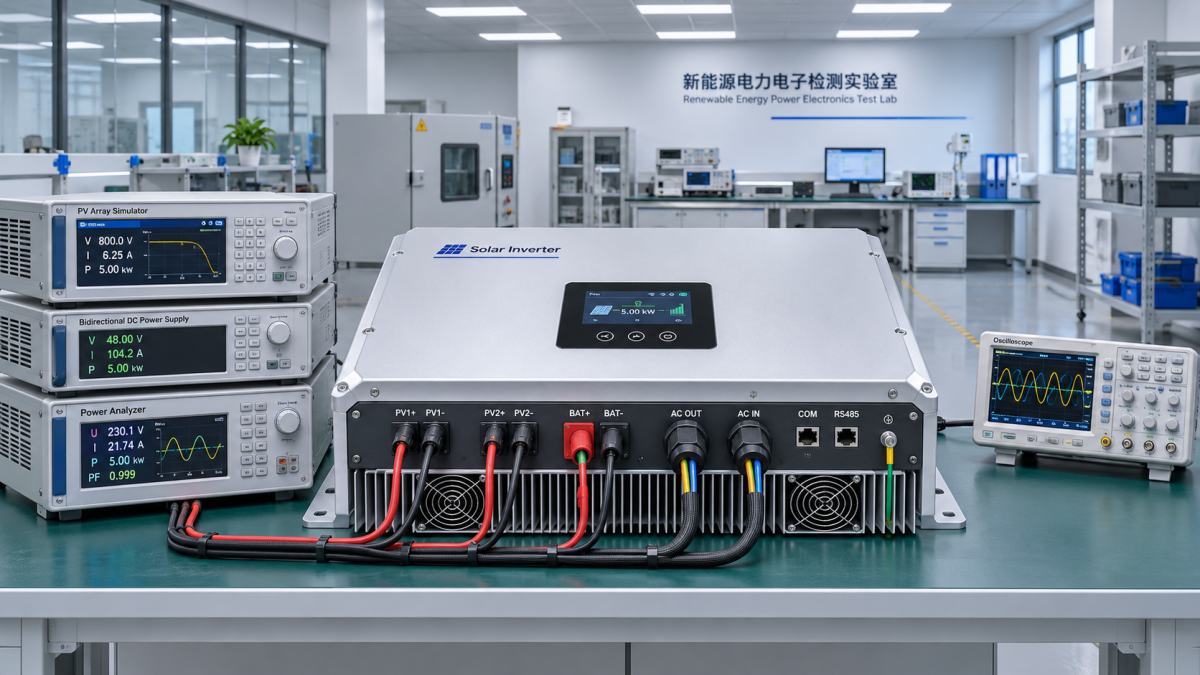
Ask for a test plan before sending samples. It should identify the test configurations, operating modes, critical accessories, proposed worst cases, and the rationale for selecting models from a family. If one sample represents several output ratings, the service should explain why the differences do not undermine the assessment. “Same platform” is not a technical justification on its own.
For safety, discuss insulation coordination, protective bonding, temperatures, abnormal operation, enclosure suitability, and safeguards relevant to the design. For EMC, ask which emissions and immunity tests apply, what cable lengths and interfaces will be used, and how representative operating conditions will be established. An inverter’s switching behavior, filters, enclosure, wiring, and operating point can all affect results.
Configuration control is where apparently minor changes become expensive. A replacement power module, filter component, transformer, fan, connector, PCB layout, or enclosure material may affect a prior evaluation. Firmware changes can also alter protection or grid-response behavior. Ask for a change-control process that identifies which modifications need notification, engineering review, or retesting under the relevant scheme.
Where possible, request a pre-compliance review before booking formal testing. It can reveal missing documentation or design concerns while changes are still manageable. It is not a substitute for accredited testing or certification, and a favorable preliminary result should not be described as a pass.
Are the service provider and test results recognized?
Ask for the name of each laboratory and certification body involved, then verify the relevant scope—not just the existence of an accreditation logo. ISO/IEC 17025 accreditation concerns laboratory competence for activities within an accredited scope; ISO/IEC 17065 is relevant to bodies certifying products, processes, and services. Neither reference means that every test, standard, or market approval offered by an organization is automatically covered.
Find out whether work will be subcontracted, which tests are covered by the laboratory’s scope, and whether the receiving certification body, regulator, or grid operator accepts the resulting evidence. For North American projects, clarify whether a listing or other certification by an appropriate recognized body is expected by the authority having jurisdiction. For other markets, ask about the applicable national scheme and local acceptance route.
A good answer includes boundaries. If a provider can review an IEC report but cannot determine utility acceptance, that is useful information—as long as it is stated before the schedule and budget are committed.
Can the compliance claim be traced to the shipped product?
Ask to inspect the certificate and supporting report, subject to confidentiality arrangements. Check the manufacturer and factory details, model designations, ratings, standard editions, report date, configuration, and any conditions of use. A certificate for a component supplier or an earlier private-label model does not automatically establish coverage for the finished inverter being delivered.
Request the relevant parts of the bill of materials, circuit and isolation information, critical component list, labels, installation instructions, firmware identification, and manufacturing controls. The goal is not to collect paperwork for its own sake. It is to connect the tested sample to the production unit, and the production unit to the configuration that will be installed.
Ask what happens after certification: whether factory inspections or surveillance are required under the chosen scheme, who maintains the file, and how design changes are reported. A certificate can remain on a website long after a product has changed; its status and scope should be checked with the issuing organization when material to a purchasing or deployment decision.
How are connectivity and monitoring claims checked?
Connected inverters add another layer to the assessment. A Wi-Fi, cellular, Ethernet, or other communication interface may be used for monitoring, remote configuration, or grid-support functions. Ask whether the compliance review covers the interface itself, the finished product with that interface installed, and any remote-control functions that affect grid settings. Electrical safety certification should not be mistaken for proof of cybersecurity or interoperability.
For a building energy-management integration, ask for the protocol version, supported functions, register or data-point documentation where applicable, update mechanism, and behavior when communications fail. If the inverter reports energy or power values used for control decisions, establish the measurement conditions and accuracy evidence separately from the grid certification claim.
This distinction reflects the evidence-led approach advocated by NexusHome Intelligence: a connectivity claim is more useful when it is tied to a specific configuration and observable behavior. A statement that a device “integrates” with an ecosystem does not establish what happens after a network interruption, a firmware update, or a change in operating mode.
What should the final inquiry deliver?
Before approving the work, ask for a sample deliverable and a clear list of exclusions. A useful response should identify applicable requirements and assumptions, map existing evidence to each requirement, flag gaps, and distinguish confirmed findings from issues requiring laboratory testing or local authority input. It should also name the organizations responsible for the next decision.
Get the schedule and quotation broken down by document review, sample preparation, testing, certification, and any expected follow-up. Ask how failures, design revisions, retests, and additional market profiles would affect cost and timing. If the service cannot quote a later stage yet, it should say what information is missing rather than hide uncertainty in a single fixed-looking number.
The practical decision is whether the evidence supports this inverter, in this configuration, for this connection. If a provider cannot trace its answer to an applicable requirement, a test configuration, and an accountable decision-maker, keep the issue open until those links are established.
Protocol_Architect
Dr. Thorne is a leading architect in IoT mesh protocols with 15+ years at NexusHome Intelligence. His research specializes in high-availability systems and sub-GHz propagation modeling.
Related Recommendations
- Dr. Aris ThorneWhat to Ask a Hardware Compliance Service About Solar Inverters
- Dr. Aris ThorneBuying Dart Boards Wholesale: How to Compare Quality, Pricing and MOQs
- Dr. Aris ThorneSourcing Cloud-Connected Smart Home Devices: What to Ask Suppliers
- Dr. Aris ThorneChoosing a 10kg Cobot for Packaging: Payload, Reach and Cycle Time
- Dr. Aris ThorneSubmitting Smart Home IoT Benchmark Data: Formats and Metrics
- Dr. Aris ThorneChoosing a Smart Home Hub OEM: Integration and Production Checklist
- Dr. Aris ThorneSmart Home Sourcing in North America: How to Vet Suppliers and Certifications
- Dr. Aris ThorneInsert Wear When Machining Inconel 718: Causes and Ways to Extend Tool Life
- Dr. Aris ThorneRobotic Polishing for Aerospace Parts: Controlling Surface Finish and Accuracy
- Dr. Aris ThorneST Launches MatterConnect to Simplify Smart Home Device Credential Provisioning
Analyst