
Submitting Smart Home IoT Benchmark Data: Formats and Metrics
author
A smart relay can look efficient in a product summary yet produce a very different result when measured with its radio active, its contacts energized, or its energy-reporting function enabled. When several devices are compared for an energy-efficient building, figures without those operating conditions can lead to the wrong selection.
To submit IoT benchmark data smart home evaluations can use, provide machine-readable measurements alongside a data dictionary, device identification, test procedures, and a concise results summary. Report the metric definition and test conditions with every result—not just a headline number. CSV is useful for tabular measurements, JSON for nested configuration details, and a readable document for methods and interpretation.
Build a submission that can be reproduced
Separate the evidence into three parts: raw or minimally processed observations, configuration and test metadata, and derived results. A reviewer should be able to trace a reported latency percentile or standby-power figure back to the observations and calculation that produced it. If a file cannot be shared because it contains sensitive information, identify what was withheld and provide a suitably anonymized alternative where possible.
A practical package can contain a measurement file in CSV, a metadata file in JSON, and a methods document in a readable format such as PDF. These are suggested formats, not a claim that every receiving organization accepts them. Confirm its submission requirements, file-size limits, naming rules, and confidentiality arrangements before preparing the final package.
Keep the original exported data unchanged and put cleaned or aggregated data in separate files. Assign a stable run identifier to each test and use it across files. Record software and firmware versions, hardware revision, device settings, test dates, and any changes made between runs. A result from a different firmware build is not automatically equivalent, even when the model number is unchanged.
Choose fields that preserve context
CSV works well when each row represents one observation or one clearly defined aggregation interval. Use a header row, consistent units, a documented character encoding, and an unambiguous timestamp format. Do not mix seconds and milliseconds in the same column or use blank cells interchangeably for zero, unavailable, and not applicable. Explain missing-value codes in the data dictionary.
JSON is useful when a run has nested properties: a controller, several routers, end devices, channel settings, and multiple firmware versions. Keep field names consistent across runs and document allowed values. A machine-readable schema is helpful when submissions will be checked automatically, but a schema alone does not explain the measurement method.
Include time zone information or use UTC consistently. For latency measurements drawn from multiple devices, document how clocks were synchronized and the expected timing uncertainty. If timing is measured on a single instrument instead, describe the trigger points. Without that information, a small reported difference may reflect the measurement system rather than device behavior.
Define connectivity results before comparing them
“Latency” is not a complete metric. State the start and end events: for example, from a command issued at the controller to an application-level acknowledgment received there, or from a physical input transition to a measured output transition. These are different intervals. Specify whether the measurement includes controller processing, network transit, retries, and actuator response.
Submit individual observations where permitted, plus the number attempted, number completed, median, relevant tail percentiles, and the calculation method. Averages alone can hide occasional long delays. State how timeouts and failed commands were handled: excluding them from a percentile without reporting their count can make an unreliable device appear responsive. Report the timeout threshold separately and do not silently substitute it for an unobserved completion time.
Reliability needs an equally explicit denominator. Packet delivery rate might be received packets divided by packets sent, while command success rate could require the requested action to complete within a defined time. Note whether counts include retransmissions and whether duplicate packets were removed. Application-level success and link-layer delivery should not be presented as the same result.
Attach the network conditions to each run: protocol and version, topology, node roles, hop count where relevant, radio channel, device placement, traffic load, and observed interference conditions or the method used to assess them. For a mesh test, identify whether routes were established before measurement and whether the topology changed during the run. A direct comparison between Matter over Thread and another configuration is meaningful only when differences in topology and measurement boundaries are visible.
Report energy metrics in their operating state
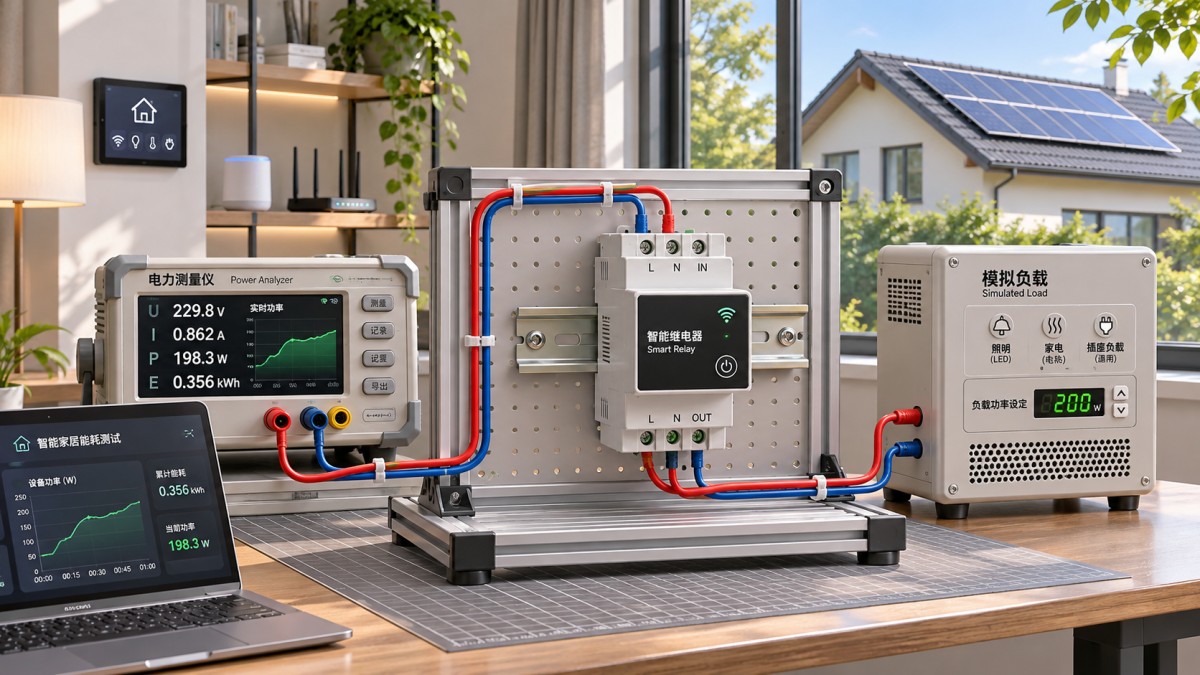
Standby power is particularly easy to misinterpret in connected devices. A relay with contacts open, a relay holding contacts closed, and a relay periodically transmitting telemetry may have materially different power profiles. Name each state, describe how it was entered, and record whether radios, indicator lights, sensing, and reporting were enabled. Include supply voltage and frequency where applicable, measurement duration, instrument range, and the measurement location.
For variable consumption, report energy over a stated interval as well as average power; include the sampling interval and explain how periodic wake-ups were captured. A short window can miss infrequent radio activity. If the measurement is near the instrument’s resolution or noise floor, disclose that limitation and the uncertainty if it is available. Do not convert a short standby reading into a battery-life claim without a documented usage model and battery assumptions.
For battery-powered sensors, identify the battery chemistry, condition or state of charge where known, supply method, reporting interval, and behavior during sleep and transmission. Current profiles can be more informative than a single average, provided the acquisition bandwidth and sampling method are sufficient to capture short peaks. Estimated runtime should be labeled as an estimate, with assumptions about capacity, self-discharge, operating temperature, and workload.
Energy-monitoring accuracy needs a reference
When assessing a smart meter or energy-monitoring plug, record the reference instrument, its relevant uncertainty or calibration status, wiring arrangement, load type, voltage, current, power factor where applicable, and measurement interval. State whether the result concerns instantaneous power or accumulated energy; their errors are not interchangeable.
A useful signed error is (device reading − reference reading) / reference reading × 100%, with the sign convention stated in the data dictionary. Avoid percentage error when the reference value is zero or too close to zero to make the ratio meaningful; report absolute error and the applicable range instead. Test across the intended operating range, including low loads where resolution and offsets can dominate. For solar or battery-connected systems, specify import and export direction and how negative values are represented.
Accuracy under one steady resistive load does not establish accuracy for changing loads or other power factors. Preserve the paired device and reference readings so the reviewer can examine drift, load transitions, and aggregation effects rather than relying on a single reported maximum or average error.
Make the method auditable without overstating compliance
Identify the test procedure or standard used, including its edition and the clauses relevant to the measurement, when applicable. Record any deviations, omitted tests, and additional conditions. Following part of a published method is not the same as demonstrating full compliance, and a benchmark result is not by itself a certification.
The methods document should explain instrument setup, calibration status, warm-up or stabilization periods, sampling rates, test sequence, and criteria for invalid runs. Record the number of units tested and runs per unit. Distinguish variation between units from variation between repeated runs of the same unit; a single sample cannot establish manufacturing-wide consistency.
Describe data processing in enough detail to reproduce the reported figures: filtering, aggregation windows, percentile calculation, rounding, and treatment of outliers or missing values. Corrections should be traceable to the source data, with the reason documented. If an automated script produces the summary, include its version and, where sharing is permitted, the script or an equivalent description of its logic.
Resolve common submission problems before sending
- Match results to runs. Check that every summary row references an existing run and that the run points to the correct device configuration and measurement file.
- Check units and denominators. Confirm that latency units, power units, attempt counts, success definitions, and timeout thresholds agree across files and the report.
- Inspect gaps and exclusions. Flag interrupted captures, clock discontinuities, missing reference readings, and discarded observations; explain their effect on each derived result.
- Verify comparable conditions. Mark comparisons where firmware, load, topology, ambient conditions, or measurement boundaries differ. Do not combine those runs into a single ranking without explaining the differences.
- Protect sensitive data. Remove or pseudonymize personal information, credentials, network identifiers, and unnecessary location details while retaining the technical context needed to interpret the test.
Finally, include a short limitations note with the submission: which device states were not tested, which instruments or reference values constrain precision, and which results cannot be compared directly. If a receiver requests a single score, supply the underlying metrics and weighting method as well. A composite value without its components can conceal a device that performs well on connectivity but poorly on standby power, or the reverse.
Protocol_Architect
Dr. Thorne is a leading architect in IoT mesh protocols with 15+ years at NexusHome Intelligence. His research specializes in high-availability systems and sub-GHz propagation modeling.
Related Recommendations
- Dr. Aris ThorneBuying Dart Boards Wholesale: How to Compare Quality, Pricing and MOQs
- Dr. Aris ThorneSourcing Cloud-Connected Smart Home Devices: What to Ask Suppliers
- Dr. Aris ThorneChoosing a 10kg Cobot for Packaging: Payload, Reach and Cycle Time
- Dr. Aris ThorneSubmitting Smart Home IoT Benchmark Data: Formats and Metrics
- Dr. Aris ThorneChoosing a Smart Home Hub OEM: Integration and Production Checklist
- Dr. Aris ThorneSmart Home Sourcing in North America: How to Vet Suppliers and Certifications
- Dr. Aris ThorneInsert Wear When Machining Inconel 718: Causes and Ways to Extend Tool Life
- Dr. Aris ThorneRobotic Polishing for Aerospace Parts: Controlling Surface Finish and Accuracy
- Dr. Aris ThorneST Launches MatterConnect to Simplify Smart Home Device Credential Provisioning
- Dr. Aris ThorneRobot Arm Ingress Testing: Verifying IP Ratings for Solar Cleaning
Analyst