
Sourcing Cloud-Connected Smart Home Devices: What to Ask Suppliers
Cloud connected smart home sourcing requires more than comparing unit prices and connectivity claims. For procurement teams selecting devices for energy-efficient homes and buildings, the right supplier questions can reveal risks in interoperability, cloud reliability, cybersecurity, and long-term support. Can the manufacturer provide protocol compliance evidence, independent test results, and accurate energy consumption data? This guide outlines the questions to ask suppliers so you can evaluate connected devices with greater confidence and make purchasing decisions grounded in verifiable performance.
A connected thermostat, relay, meter, or gateway is not just a piece of hardware. It is part of a service chain that may include a local network, a cloud platform, an app, and a building or home energy management system. A low device price can become expensive if the gateway is mandatory, the API carries usage fees, or a cloud outage prevents an installed system from operating as expected.
Start with the energy task, not the protocol badge
Before requesting quotations, define what the device must do in the building. A relay intended to switch a water heater when solar generation is available has different requirements from a sensor used only to report room temperature. The former needs clear electrical ratings, control logic, and safe failure behavior; the latter may be judged more heavily on battery life, reporting intervals, and installation effort.
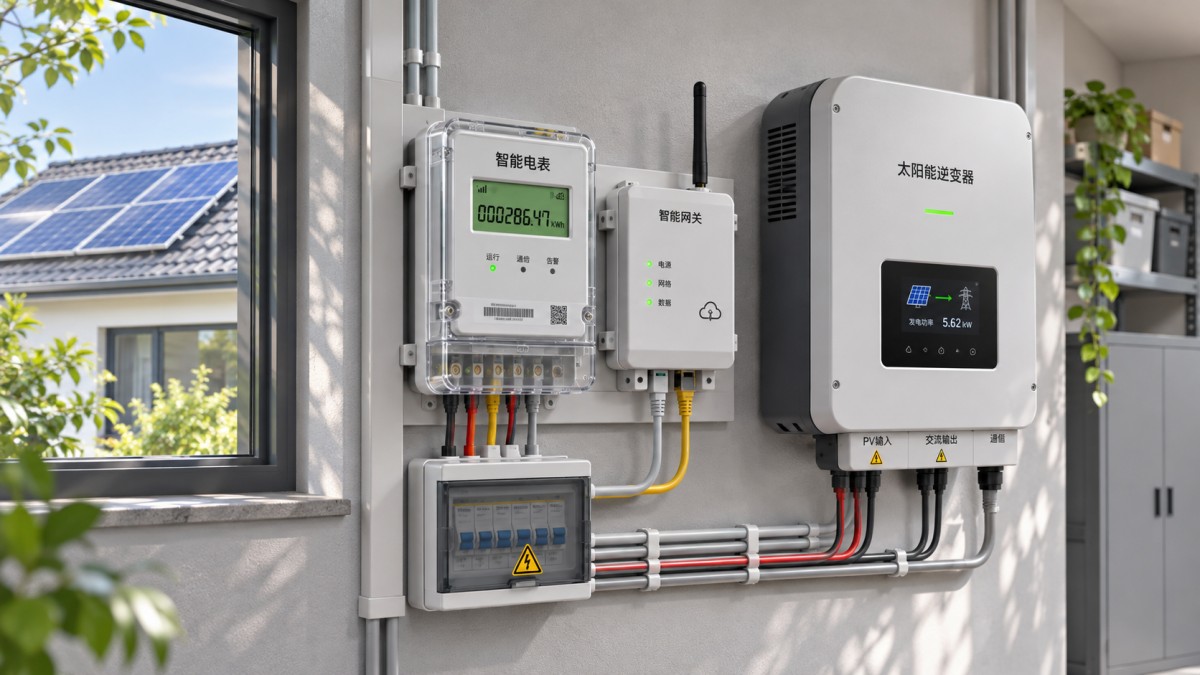
Ask the supplier to describe the complete path from measurement to action. Where does the energy data come from? Is the decision made locally, in a gateway, or in the cloud? What happens if the inverter, internet connection, or platform is unavailable? A device may connect to an app without being able to exchange the data needed for solar self-consumption or load scheduling.
For each use case, document the equipment to be controlled, the available network, the expected operating conditions, and who is responsible for commissioning. This gives suppliers a common basis for pricing and makes exclusions easier to spot.
What does “compatible” mean in the proposed installation?
Connectivity labels do not guarantee that every function will work together. Zigbee, Z-Wave, Thread, Bluetooth Low Energy, and Wi-Fi describe different parts of the connectivity landscape. Matter is an application-layer standard that can operate over supported network technologies, including Thread and Wi-Fi. A Matter claim alone does not establish that a particular energy feature, controller, or firmware combination is supported.
Request the exact model number, hardware revision, firmware version, supported device type, and relevant protocol version. If certification is claimed, ask for evidence that applies to the offered configuration, then check it against the relevant certification program’s public records where available. Also ask which features have been tested with the specific gateways and management platforms in your project.
A useful question is: “Which functions work locally, and which require your cloud or a third-party integration?” A thermostat might expose basic temperature control to one ecosystem but reserve scheduling or energy data for the supplier’s app. Those limits affect both the user experience and the cost of maintaining multiple platforms.
For larger buildings, request test conditions as well as results: device count, network layout, radio environment, message frequency, packet loss, and response time. A demonstration with two devices on a quiet bench is not evidence of performance across a building with dense networks and obstructed signal paths.
Can the device keep operating when the cloud cannot?
Cloud connectivity can simplify remote management, software updates, and portfolio reporting. It also introduces dependencies that need commercial and technical scrutiny. Ask the supplier to map the services involved, including any third-party cloud provider, identity service, notification service, or external integration needed for normal operation.
The outage question should be specific. Can occupants still operate a relay manually? Will an existing heating schedule continue? Are measurements buffered and uploaded after reconnection, or are they lost? Can the system recover automatically without a site visit? Answers may differ by product and configuration, so include the required behavior in the acceptance criteria rather than relying on a general promise of reliability.
Ask for the service-level agreement, its exclusions, how availability is measured, and what remedies apply. A service credit may be useful, but it does not replace a workable local fallback for an essential building function. Also establish what happens if the cloud service is discontinued: notification period, data export, migration assistance, and whether devices retain any useful local functionality.
How credible are the energy measurements and savings claims?
Energy data is only useful if it is accurate enough for the decision being made. Ask for the measurement method, stated accuracy, operating range, sampling or reporting interval, and test conditions. Clarify whether the device measures active power and energy directly or estimates consumption from a rated load. An estimate may be adequate for a simple dashboard but unsuitable for comparing flexible loads or allocating costs.
Where solar generation or battery storage is involved, confirm whether the device can distinguish import from export and how it handles reverse power flow. Check compatibility with the site’s electrical configuration, current transformers, phase arrangement, and inverter or meter interface. If billing or regulated settlement is intended, verify the applicable local metering requirements separately; a general-purpose smart meter feature is not automatically sufficient.
Standby consumption deserves attention too. Request power measurements for relevant operating states, including normal connection, active switching, and any gateway required to support the device. For battery-powered sensors, ask for the assumptions behind battery-life estimates: reporting frequency, signal strength, temperature, update behavior, and battery specification. A figure without those conditions is difficult to compare.
Treat projected energy savings as a project calculation, not a property of the device alone. The result depends on load characteristics, occupant behavior, tariffs, control settings, and available renewable generation. Ask suppliers to separate measured device performance from modeled savings and to disclose the assumptions behind any projection.
What security and data commitments are contractual?
“Secure cloud” is not an acceptance criterion. Ask how devices establish trust, whether credentials are unique per device, how software updates are authenticated, and how vulnerabilities can be reported. Request the supported update period, the process for urgent security fixes, and who pays for deployment when devices are already installed.
For cloud accounts, examine role-based access, administrator controls, audit logs, and the process for removing access when an installer or property manager changes. Confirm what data is collected, where it is processed, retention periods, subcontractor access, and available deletion and export mechanisms. Privacy and data-transfer obligations depend on the deployment and applicable jurisdiction; involve legal and security teams before treating a supplier’s statement as sufficient.
Independent security assessments can help, but their scope matters. A report covering a mobile app does not necessarily cover device firmware or cloud infrastructure. Check the assessment date, the versions tested, significant exclusions, and whether identified issues were remediated. Where reports cannot be shared in full, ask what evidence can be reviewed under a confidentiality agreement.
Compare the installed cost, not just the quotation
Request a cost breakdown over the intended service life. The lowest hardware bid may require a proprietary gateway, a recurring platform subscription, or more expensive commissioning. Conversely, a higher initial price may include API access and remote diagnostics that reduce later support effort. Neither outcome should be assumed without a comparable quote.
- Hardware and deployment: devices, gateways, accessories, wiring, mounting, commissioning tools, and installer training.
- Recurring services: cloud subscriptions, connectivity, data storage, API calls, user accounts, and minimum annual commitments.
- Support and replacement: warranty terms, return shipping, spare stock, failure diagnosis, on-site labor, and replacement lead times.
- Change and exit: firmware maintenance, integration changes, data extraction, migration, and any charges after the initial contract.
Use the same deployment volume and contract period for every bid. Ask whether prices change with device count, message volume, or feature activation, and whether fees are fixed or subject to revision. Model at least a normal operating case and a higher-support case; a modest difference in site visits can outweigh an attractive unit-price discount.
What can the manufacturer actually deliver at scale?
A successful prototype does not automatically translate into a repeatable production supply. Ask who manufactures the device, which components are controlled by subcontractors, and how hardware or firmware changes are communicated. A radio module substitution, for example, may affect interoperability testing or market approvals even if the enclosure and model name remain unchanged.
The purchase agreement should address lead time, minimum order quantity, forecast commitments, production test coverage, traceability, defect handling, and notice of end-of-life decisions. For customized firmware or branding, establish ownership and access rights, update responsibilities, and what happens to tooling or documentation if the relationship ends.
Request documentation relevant to each destination market, including applicable electrical safety, radio, and environmental requirements. The required evidence depends on the device, configuration, and jurisdiction. A component-level approval does not necessarily cover the finished product, so match the documents to the exact item being purchased.
Turn supplier answers into a practical pilot
Before committing to a large order, test a representative configuration with the actual gateway, network, cloud account, and energy equipment. Include poor connectivity, power interruption, device replacement, firmware updates, and normal installer workflows. Record response times and failures alongside the conditions under which they occurred; a single pass or fail label hides useful procurement information.
Agree in advance on measurable acceptance criteria, who performs each test, how defects are corrected, and whether a firmware change triggers retesting. Independent evidence can strengthen the comparison when suppliers use different test methods. This data-led approach reflects the principle behind NexusHome Intelligence: evaluate connectivity and energy performance against observable conditions, rather than taking broad integration claims at face value.
The best next step is a short supplier questionnaire tied to a real deployment, followed by a pilot and a like-for-like cost model. If a supplier cannot identify the supported configuration, explain offline behavior, or price the cloud service for the expected contract period, resolve those gaps before treating its unit price as a reliable basis for selection.