
UL Launches SOH Transparency Pilot for Medical IoT Devices
author
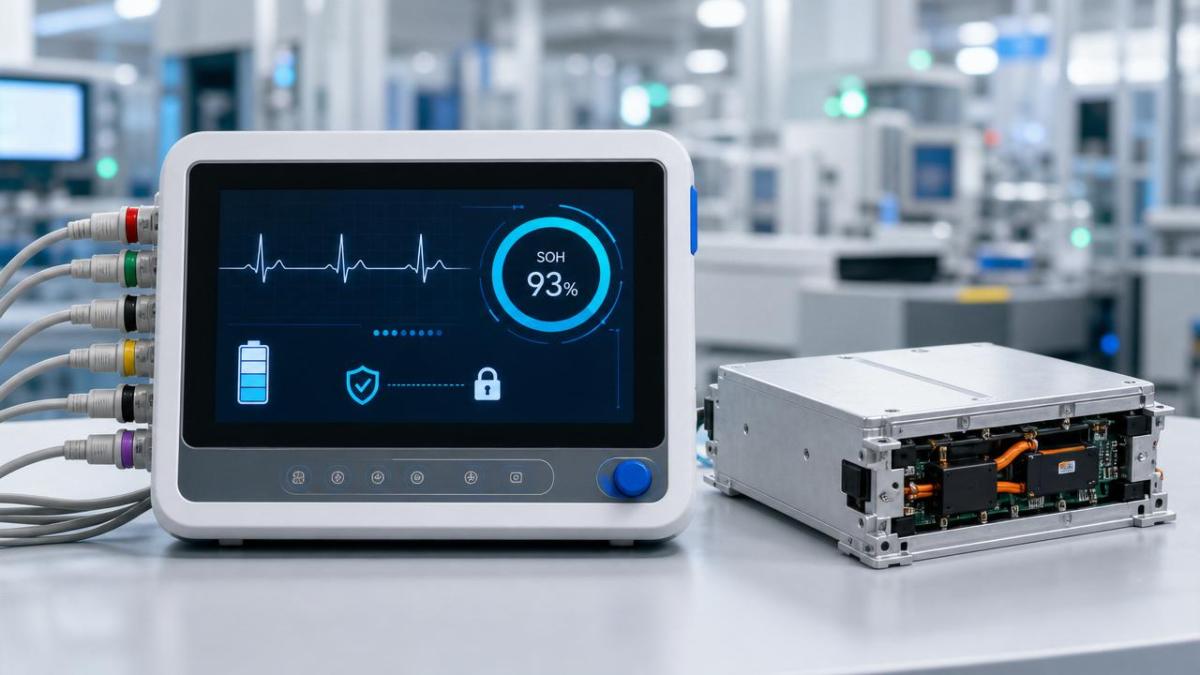
On May 4, 2026, UL Solutions announced the launch of a pilot program under UL 2900-2-2 Annex G, mandating real-time battery State of Health (SOH) calculation, encrypted telemetry, and verifiable lithium-ion degradation curve modeling for all Medical IoT devices seeking UL certification — including remote ECG monitors and CGM patches. This initiative directly impacts medical device manufacturers, battery management system (BMS) developers, and suppliers serving the North American healthcare market.
Event Overview
UL Solutions initiated the UL 2900-2-2 Annex G pilot program on May 4, 2026. The pilot requires that Medical IoT devices — such as remote electrocardiogram (ECG) monitors and continuous glucose monitoring (CGM) patches — implement firmware-level real-time SOH computation and encrypted reporting of battery health data. Devices must also embed a verifiable lithium-ion battery degradation curve model compliant with IEC 62133-2:2025. The pilot is scheduled to transition to mandatory requirement in Q3 2026.
Industries Affected
Medical Device OEMs and Contract Manufacturers
These entities are directly responsible for UL certification submissions. Non-compliance will block market access to U.S. healthcare channels. Impact manifests in firmware redesign cycles, validation timelines for BMS integration, and additional third-party verification costs tied to degradation modeling.
Battery Management System (BMS) Solution Providers
Providers supplying BMS firmware or algorithm modules — particularly those based in China — must adapt their SOH estimation logic to meet UL’s real-time, encryptable, and IEC 62133-2:2025–aligned requirements. Legacy SOC-only or non-encrypted SOH outputs no longer satisfy the pilot criteria.
Medical IoT Component Suppliers (e.g., Battery Module Integrators)
Suppliers embedding lithium-ion cells into medical-grade assemblies must now ensure traceability between cell-level aging data and the host device’s reported SOH. This includes providing validated aging parameters (e.g., capacity fade rate, impedance growth) usable in the certified degradation curve model.
Regulatory Affairs & Certification Service Providers
Firms supporting clients with UL submissions face expanded scope: verifying not only functional safety and cybersecurity per UL 2900-2-2, but now also validating SOH transparency architecture, encryption integrity, and degradation model reproducibility against IEC 62133-2:2025.
What Relevant Enterprises or Practitioners Should Focus On
Monitor official UL documentation updates ahead of Q3 2026 enforcement
UL has not yet published full technical implementation guidance for Annex G. Stakeholders should track UL’s official announcements and draft interpretations, especially regarding acceptable encryption protocols, data format specifications for SOH telemetry, and validation methods for degradation models.
Prioritize firmware-BMS interface redesign for real-time SOH export
Current implementations often estimate SOH offline or at infrequent intervals. To comply, devices must support continuous, low-overhead SOH computation and secure, timestamped data transmission — requiring coordinated updates across MCU firmware, BMS IC drivers, and cloud telemetry stacks.
Distinguish between pilot participation and post-Q3 compliance obligations
Participation in the pilot is voluntary at launch, but certification applications submitted after Q3 2026 will be subject to mandatory Annex G requirements. Enterprises should treat pilot engagement as a de facto deadline for internal readiness — not merely an optional trial.
Align battery procurement and qualification with SOH transparency requirements
Procurement teams must verify that cell suppliers provide aging characterization data compatible with IEC 62133-2:2025–based modeling. Pre-qualified batteries lacking documented degradation behavior may require revalidation or substitution before Q3 2026.
Editorial Perspective / Industry Observation
Observably, this pilot signals UL’s strategic shift from assessing static battery safety to enforcing dynamic, data-driven battery lifecycle accountability in clinical-grade connected devices. Analysis shows it reflects growing FDA and ISO 13485 emphasis on traceable device reliability over time — especially where battery failure could impact diagnostic accuracy or patient monitoring continuity. It is currently a regulatory signal rather than an enforced outcome; however, its linkage to mandatory certification makes early alignment operationally urgent. From an industry perspective, this represents less a technical novelty and more a formalization of emerging expectations around embedded battery intelligence in regulated environments.
Conclusion
This initiative marks a procedural tightening in how battery performance integrity is verified for Medical IoT devices entering the U.S. market. Its significance lies not in introducing entirely new science, but in institutionalizing SOH transparency as a non-negotiable layer of certification — one that binds hardware, firmware, and battery supply chain actors into a unified compliance workflow. Currently, it is best understood as a near-term operational checkpoint with enforceable consequences starting Q3 2026, rather than a long-term policy forecast.
Information Sources
Primary source: UL Solutions official announcement, May 4, 2026.
Note: Full technical annex language, test methodology details, and vendor-specific implementation guidance remain pending publication and are under active observation.
Protocol_Architect
Dr. Thorne is a leading architect in IoT mesh protocols with 15+ years at NexusHome Intelligence. His research specializes in high-availability systems and sub-GHz propagation modeling.
Related Recommendations
- NHI Data Lab (Official Account)UL Launches SOH Transparency Pilot for Medical IoT Devices
- NHI Data Lab (Official Account)Commercial Drone Payload Benchmarks by Mission Type
- NHI Data Lab (Official Account)What Affects Commercial Drone Payload Capacity Most?
- NHI Data Lab (Official Account)What Separates a Reliable Heavy Duty AGV Manufacturer
- NHI Data Lab (Official Account)Heavy Duty AGV Manufacturer Questions to Ask Before Approval
- NHI Data Lab (Official Account)Commercial drone payload capacity benchmark for mapping accuracy tradeoffs
- NHI Data Lab (Official Account)Heavy duty AGV manufacturer comparisons often ignore floor conditions
- NHI Data Lab (Official Account)Commercial drone payload capacity benchmark by mission type
- NHI Data Lab (Official Account)Where heavy duty AGV manufacturers differ on battery runtime
- NHI Data Lab (Official Account)Battery Tech Choices That Change Wind Storage Costs
Analyst