
What Separates a Reliable Heavy Duty AGV Manufacturer
author
Choosing a reliable heavy duty AGV manufacturer is no longer just about payload or price. For commercial evaluators in renewable energy and intelligent infrastructure projects, the real differentiators lie in engineering transparency, protocol compatibility, safety validation, and long-term operational stability. This article explores what truly separates capable manufacturers from marketing-driven suppliers in high-stakes industrial automation.
Why the Evaluation Standard Is Changing in Renewable Energy Logistics
Across renewable energy manufacturing and deployment, material handling is entering a new phase. Wind turbine components are larger, battery packs are heavier, solar module plants are more automated, and energy storage projects are under pressure to deliver faster with fewer safety incidents. In this environment, the role of a heavy duty AGV manufacturer has expanded from equipment supplier to long-term operational partner.
That shift matters because procurement teams are no longer evaluating automated guided vehicles in isolation. They are assessing how AGV systems interact with warehouse software, production lines, charging infrastructure, safety protocols, and future expansion plans. A reliable heavy duty AGV manufacturer must therefore prove not only that the vehicle moves weight, but that the system performs under variable floor conditions, mixed traffic, battery cycling stress, and software integration demands.
For business evaluators, this means old selection logic is becoming risky. A low-cost unit that lacks clear compliance records, interface openness, or lifecycle support may create hidden costs that far exceed the initial savings. In renewable energy operations, downtime is expensive, scheduling windows are tight, and safety failures can damage both margins and reputation.
The Market Signal: From Spec Sheets to Verifiable Performance
One of the clearest industry changes is the move away from brochure-driven sourcing. Buyers increasingly ask for test data, simulation results, interoperability evidence, and field validation. This reflects a wider industrial trend also seen in smart infrastructure: trust is shifting from claims to measurable engineering reality.
A dependable heavy duty AGV manufacturer should welcome this scrutiny. In fact, strong manufacturers usually present detailed operating envelopes, braking distances under load, battery performance curves, navigation tolerances, and fleet scheduling logic. They do not hide behind generic language such as “stable performance” or “intelligent control.” Instead, they explain where the system works best, where adaptation is needed, and how reliability is maintained over time.
This approach aligns with the broader industrial data culture promoted by technically driven organizations like NHI: complex systems should be judged through transparent benchmarks, protocol behavior, stress conditions, and repeatable results. The same mindset applies when evaluating an AGV supplier for renewable energy manufacturing, battery storage logistics, or smart factory expansion.
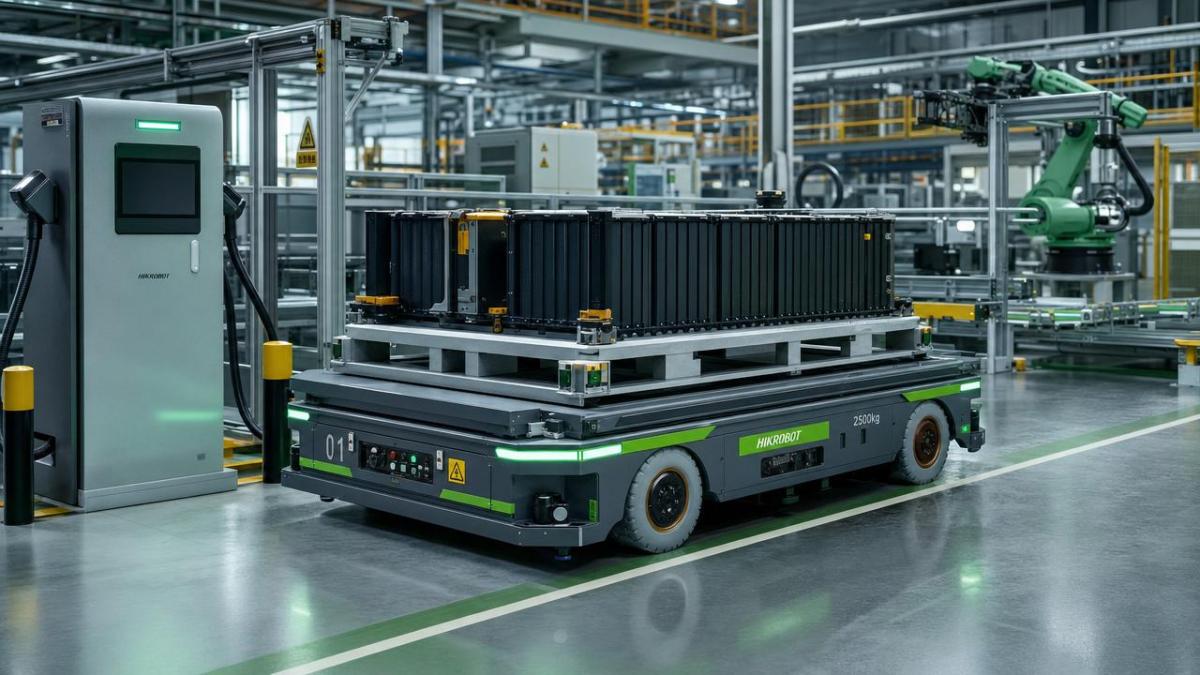
What Is Driving the New Demand for a Reliable Heavy Duty AGV Manufacturer
Several forces are pushing buyers to tighten evaluation standards.
First, payload complexity is rising. Renewable energy facilities increasingly move oversized molds, palletized battery cells, inverter cabinets, and sensitive electrical assemblies. These loads are not only heavy but often high-value and safety-critical. That raises the importance of motion control accuracy, route predictability, and load stability.
Second, labor and safety pressures are increasing. Many facilities are trying to reduce manual transport in hazardous or repetitive tasks. This places greater emphasis on obstacle detection, emergency stop logic, human-machine traffic management, and compliance documentation.
Third, digital integration is becoming mandatory. A modern heavy duty AGV manufacturer is expected to support connectivity with MES, WMS, ERP, and plant-level control systems. In advanced renewable energy plants, fleet behavior can no longer be a closed black box.
Fourth, sustainability goals are influencing procurement. Buyers want equipment with efficient charging strategies, durable battery systems, lower maintenance waste, and upgradeable control architecture. Reliability is now connected to environmental performance, not separate from it.
Key Trend Drivers in Current AGV Evaluation
What Actually Separates a Reliable Heavy Duty AGV Manufacturer
The strongest differentiator is engineering transparency. A reliable heavy duty AGV manufacturer can explain vehicle design limits, floor flatness requirements, turning performance, navigation method tradeoffs, and maintenance intervals in specific terms. That level of clarity is often a stronger sign of capability than aggressive sales language.
The second differentiator is systems thinking. In renewable energy projects, AGVs rarely operate alone. They work with lifts, conveyors, robotic stations, charging points, and software platforms. A qualified supplier should demonstrate how traffic logic, task scheduling, signal exchange, and exception handling work across the wider environment.
The third differentiator is validated safety. Safety should be documented through standards alignment, scenario testing, sensor redundancy where appropriate, and clear emergency response behavior. For evaluators, it is important to distinguish between “safety features included” and “safety performance validated in relevant operating conditions.”
The fourth differentiator is after-deployment resilience. A heavy duty AGV manufacturer may deliver a strong demo, but reliability is proven over months and years. Remote diagnostics, spare parts availability, software update discipline, training quality, and response speed during faults all affect the real value of the partnership.
The fifth differentiator is adaptability. Renewable energy facilities evolve rapidly. Production volume changes, routes are reconfigured, and new digital layers are added. A manufacturer that supports modular upgrades and scalable fleet control is better positioned than one offering a rigid one-time installation.
How These Changes Affect Different Stakeholders
The impact of choosing the right heavy duty AGV manufacturer is not limited to procurement. It affects multiple business functions, each with different decision criteria.
Signals That a Supplier Is Stronger Than Its Marketing
For evaluators, the most useful signals are practical rather than promotional. A reliable heavy duty AGV manufacturer typically provides site survey methodology before quoting. It asks detailed questions about floor conditions, slopes, load center of gravity, traffic density, charging windows, and software environment. This indicates that the supplier is designing for fit, not forcing a standard pitch.
Another strong signal is data-backed discussion of failure modes. Mature manufacturers can explain what happens during sensor obstruction, communication loss, battery degradation, route blockage, or emergency intervention. Suppliers that avoid these topics may be hiding weak engineering maturity.
Reference quality also matters. Instead of only showing logos, strong suppliers can discuss application similarity: comparable payloads, duty cycles, environmental conditions, and integration complexity. In renewable energy settings, sector adjacency can be more meaningful than brand visibility.
Finally, strong suppliers treat commissioning as the beginning of optimization, not the end of delivery. They include performance monitoring, operator training, process tuning, and long-term support planning as part of the value proposition.
How to Judge a Heavy Duty AGV Manufacturer in the Next 12 to 24 Months
Looking ahead, the most important judgment standard is whether the manufacturer is prepared for convergence. AGVs are becoming part of connected industrial ecosystems, where software, energy management, safety analytics, and workflow orchestration interact continuously. In this direction, the best heavy duty AGV manufacturer will not be the one with the loudest feature list, but the one with the clearest evidence of stable integration and scalable operation.
Evaluators should also watch for growing demand for mixed-environment operation. Renewable energy plants often combine indoor and semi-open logistics areas, changing surfaces, and fluctuating traffic patterns. Manufacturers that can demonstrate adaptation across these realities will likely gain an edge.
Another important signal is support for data visibility. As operations teams demand tighter KPI management, fleet utilization, charging behavior, idle time, route congestion, and fault frequency will matter more in supplier comparison. Transparent reporting is becoming part of reliability itself.
Practical Evaluation Questions for Commercial Teams
If your organization is comparing vendors, ask questions that reveal operational truth. How does the heavy duty AGV manufacturer validate performance under maximum rated load over continuous duty cycles? What integration interfaces are standard, and which require customization? How are software updates governed? What is the documented service response process? Which wear parts are locally available? How does the supplier measure safety performance after deployment?
These questions help teams move from feature comparison to risk evaluation. In renewable energy projects, that shift is essential because the cost of poor supplier judgment tends to appear later, during ramp-up, expansion, or incident recovery.
Conclusion: Reliability Is Becoming a Strategic Procurement Decision
The definition of a reliable heavy duty AGV manufacturer is changing with the market. Today, reliability means documented engineering, integration readiness, safety validation, lifecycle support, and the ability to operate inside evolving renewable energy environments. Price and payload still matter, but they no longer tell the full story.
For business evaluators, the best next step is to review potential suppliers through a change-impact lens: what operating conditions are becoming more demanding, which internal stakeholders will be affected, and where could hidden system risk emerge after installation? If those questions are answered with evidence instead of slogans, you are closer to identifying a heavy duty AGV manufacturer that can support long-term industrial performance.
Protocol_Architect
Dr. Thorne is a leading architect in IoT mesh protocols with 15+ years at NexusHome Intelligence. His research specializes in high-availability systems and sub-GHz propagation modeling.
Related Recommendations
- NHI Data Lab (Official Account)What Separates a Reliable Heavy Duty AGV Manufacturer
- NHI Data Lab (Official Account)Heavy Duty AGV Manufacturer Questions to Ask Before Approval
- NHI Data Lab (Official Account)Commercial drone payload capacity benchmark for mapping accuracy tradeoffs
- NHI Data Lab (Official Account)Heavy duty AGV manufacturer comparisons often ignore floor conditions
- NHI Data Lab (Official Account)Commercial drone payload capacity benchmark by mission type
- NHI Data Lab (Official Account)Where heavy duty AGV manufacturers differ on battery runtime
- NHI Data Lab (Official Account)Battery Tech Choices That Change Wind Storage Costs
- NHI Data Lab (Official Account)What Battery Tech Means for Stable Solar Power Output
- NHI Data Lab (Official Account)How to Compare Battery Tech for Renewable Energy Storage
- NHI Data Lab (Official Account)Lithium Battery for IoT: Runtime vs Safety Tradeoffs
Analyst