
What Affects Commercial Drone Payload Capacity Most?
author
For technical evaluators in renewable energy operations, a reliable commercial drone payload capacity benchmark depends on far more than a headline lift number. Battery chemistry, airframe efficiency, wind exposure, sensor integration, and mission profile all shape real-world carrying performance. This article examines the variables that most influence payload capacity, helping teams compare platforms with data-driven clarity before inspection, mapping, or infrastructure maintenance deployments.
Understanding payload capacity beyond the brochure
In commercial drone selection, payload capacity is often simplified into a single maximum number, usually expressed in kilograms or pounds. For renewable energy teams, that number is only a starting point. A drone carrying a thermal camera for solar farm inspections, a LiDAR unit for terrain modeling, or a corona detection sensor for transmission-line surveys does not perform under ideal lab conditions. It operates in heat, dust, crosswinds, altitude shifts, and time-sensitive field schedules. That is why a meaningful commercial drone payload capacity benchmark must reflect usable lift under operational constraints, not just theoretical peak payload.
Technical evaluators should distinguish between absolute payload capacity and mission payload capacity. Absolute capacity refers to the maximum lift the platform can achieve, often for a short duration. Mission payload capacity refers to the weight the drone can carry while still meeting required endurance, stability, safety margin, and sensor performance thresholds. In renewable energy work, mission payload capacity is usually the more useful number because data quality matters as much as lift.
This distinction aligns with a broader engineering principle familiar to data-driven organizations such as NexusHome Intelligence: specifications become valuable only when verified in realistic environments. Just as protocol claims in IoT hardware must be stress-tested rather than accepted at face value, drone payload claims should be evaluated through measurable field conditions, repeatable test loads, and scenario-based benchmarking.
Why renewable energy operators care so much about this metric
Renewable energy assets are distributed, large-scale, and often difficult to access. Wind farms, utility-scale solar arrays, battery energy storage systems, hydro corridors, and grid interconnection points all benefit from aerial inspection. Yet these missions rarely use a single lightweight camera. Operators may need stabilized optical zoom, radiometric thermal imaging, multispectral sensors, gas detection modules, or LiDAR. Some workflows also require onboard edge processing, RTK modules, collision-avoidance systems, and high-capacity data links, all of which consume part of the drone’s carrying and power budget.
As a result, the commercial drone payload capacity benchmark directly affects inspection coverage per flight, image resolution at safe standoff distance, and whether multiple sensors can be flown together. Underpowered platforms may force more flights, more battery swaps, and more site downtime. Overbuilt platforms may add cost, transport complexity, and regulatory burden without delivering better productivity. The goal is not simply the highest payload, but the best payload-to-endurance balance for the intended renewable energy mission.
The variables that influence payload capacity most
1. Battery energy density and discharge behavior
Battery design is usually the strongest limiting factor. Payload requires thrust, and thrust requires power. A drone may have motors capable of lifting a heavy sensor stack, but if the battery cannot provide sustained current without excessive voltage sag, endurance falls sharply. In renewable energy fieldwork, this matters because missions often demand long transit distances across sprawling sites. A strong commercial drone payload capacity benchmark should therefore record not only payload mass, but also flight time under load at different state-of-charge levels and ambient temperatures.
Cold weather at wind farms can reduce available battery output, while high summer temperatures at solar sites may accelerate thermal stress. Evaluators should check battery chemistry, cycle-life degradation curves, and continuous discharge ratings. A payload benchmark that ignores battery aging can overstate long-term fleet capability.
2. Motor, propeller, and ESC efficiency
The propulsion system converts stored energy into lift. Larger propellers can generate thrust more efficiently, but frame geometry, motor KV rating, and electronic speed controller tuning all affect how effectively that happens. Two drones with the same rated payload may deliver very different endurance because one airframe produces lift with lower power draw. For technical evaluators, this means the commercial drone payload capacity benchmark should include watts per kilogram of payload or a similar energy-efficiency indicator.
Efficiency is especially important for hover-intensive renewable energy tasks such as blade inspection, inverter station imaging, or detailed panel hotspot analysis. Hovering under load reveals propulsion inefficiencies that may be hidden during brief promotional demos.
3. Airframe design and structural weight
Payload capacity is not just about how much force a drone can produce. It is also about how much of that force remains available after lifting the aircraft itself. Structural material selection, folding mechanisms, landing gear, vibration isolation, and modular mounting systems all contribute to empty weight. Heavier airframes may offer durability and stability, but they consume a larger share of the total lift budget. A practical commercial drone payload capacity benchmark should separate empty takeoff weight, maximum takeoff weight, and usable payload weight.
In renewable energy operations, ruggedized frames are valuable because field logistics can be harsh. However, evaluators should verify whether ruggedness brings a measurable productivity benefit or simply reduces useful payload headroom.
4. Aerodynamic drag from the payload itself
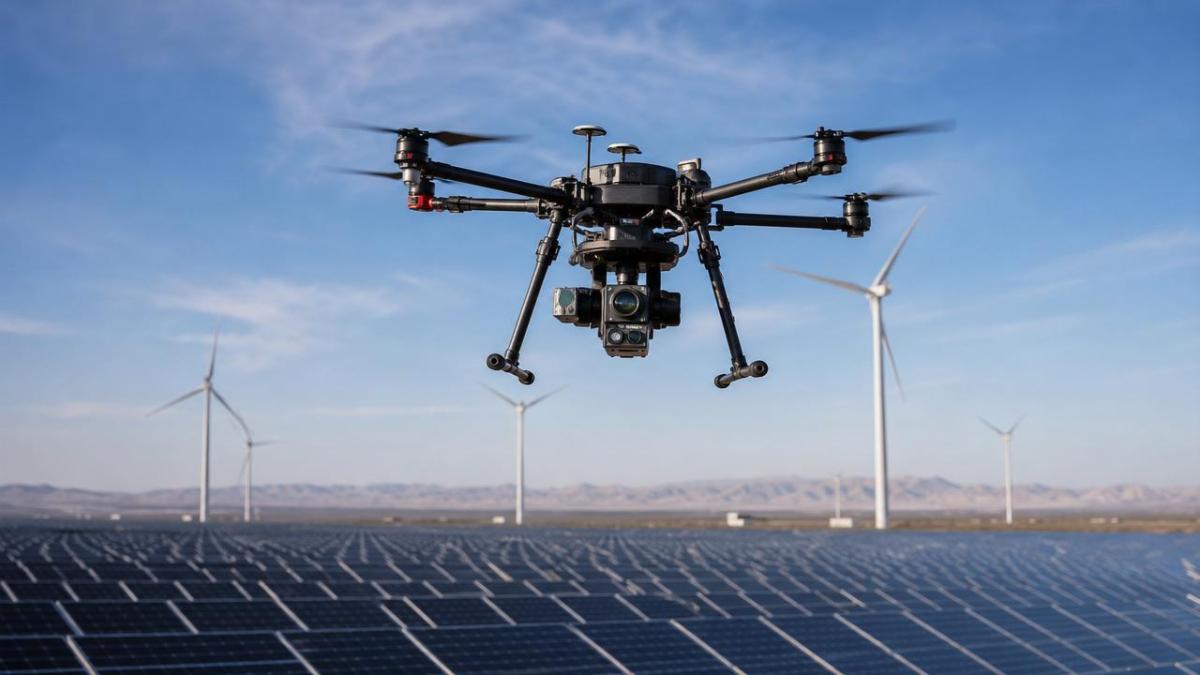
Payload mass is only one part of the story. Payload shape also matters. A compact thermal camera has a different aerodynamic impact than a bulky LiDAR pod or a multi-sensor bracket with exposed wiring. In windy environments common to wind and solar sites, added drag can force constant control corrections and higher power consumption. This means the commercial drone payload capacity benchmark should test payload configurations, not only payload weights.
A drone that performs well with a dense, compact camera may struggle with a lighter but less aerodynamic mapping package. Technical evaluators should therefore compare center-of-gravity tolerance, mounting position, and crosswind stability with the actual sensor stack intended for deployment.
5. Environmental conditions and site geography
Wind, altitude, temperature, humidity, and dust exposure all influence carrying performance. High-altitude sites reduce air density, making it harder for rotors to generate lift. Strong gusts around turbine towers can rapidly increase thrust demand. Heat from reflective solar surfaces can alter battery temperature behavior and sensor calibration. A credible commercial drone payload capacity benchmark should specify the test environment clearly, including wind band, temperature range, and elevation.
For renewable energy teams comparing platforms across countries or regions, this point is critical. A benchmark generated at sea level in calm conditions may not transfer to desert solar projects or mountain wind installations.
6. Mission profile and data-quality requirements
The same drone can have very different effective payload capacity depending on what the mission demands. Fast corridor inspection, low-speed hover inspection, terrain-following mapping, and emergency spot checks place different loads on the aircraft. If a mission requires stable thermal imagery or survey-grade geospatial accuracy, the drone may need more gimbal stabilization, slower speeds, or redundant positioning systems. All of these reduce practical capacity or endurance.
This is why the best commercial drone payload capacity benchmark is mission-linked. It should ask not “How much can the drone lift?” but “How much can the drone carry while still meeting the required inspection resolution, overlap, hover stability, and safety reserve?”
A benchmark view for renewable energy inspection planning
To make comparisons more actionable, technical evaluators can score payload performance against a set of operational dimensions rather than one headline specification. The table below outlines a practical framework.
Typical payload-demand profiles by renewable energy use case
Different renewable energy tasks stress payload capacity in different ways. Evaluators should map platform capability to the actual workflow rather than assume a single benchmark suits all cases.
How technical evaluators should build a credible test method
A strong commercial drone payload capacity benchmark should be repeatable, transparent, and mission-specific. Start by defining a baseline payload and one or two representative advanced payloads. Then test each configuration across identical battery states, environmental conditions, and flight patterns. Record takeoff weight, hover endurance, cruise endurance, maximum stable wind condition, sensor vibration levels, and battery temperature behavior.
It is also useful to include degraded-state testing. For example, compare new batteries against batteries with a meaningful number of charge cycles. Compare calm-condition performance against moderate wind. Compare single-sensor payloads against dual-sensor payloads if multi-modal inspection is part of the operating model. These comparisons expose the gap between nominal lift and real operational value.
Organizations inspired by rigorous verification cultures, such as the benchmark-first approach seen in advanced IoT testing, should avoid qualitative claims like “handles heavy payloads well.” Instead, define measurable acceptance thresholds: minimum flight time with a thermal payload, maximum acceptable vibration level for LiDAR, or required safety reserve upon return-to-home. A commercial drone payload capacity benchmark becomes decision-useful only when it links payload to measurable mission outcomes.
Common evaluation mistakes to avoid
One common mistake is comparing manufacturer payload ratings without normalizing for endurance. Another is ignoring accessory creep. Add-ons such as RTK modules, protective cages, high-brightness beacons, and larger landing gear may seem minor individually, but together they can materially reduce useful capacity. A third mistake is treating all inspection sensors as equivalent by weight alone, even though their aerodynamic profile, vibration sensitivity, and power integration needs may differ significantly.
Evaluators should also avoid using only short demo flights to form conclusions. In renewable energy operations, productivity depends on repeatability across many sorties, not on one successful lift test. Long-cycle evidence is more valuable than a peak-performance anecdote.
From benchmark data to deployment decisions
The most important factor affecting payload capacity is not a single component, but the interaction between battery capability, propulsion efficiency, structural design, environment, and mission requirements. For renewable energy teams, the best commercial drone payload capacity benchmark is therefore multi-dimensional. It should show what the drone can carry, for how long, in what wind, at what data quality, and with what remaining safety margin.
Teams that adopt a data-driven evaluation model make better fleet decisions, reduce underperformance in the field, and align drone selection with actual inspection economics. If your objective is dependable aerial intelligence across solar, wind, storage, or grid infrastructure, benchmark payload the same way high-integrity engineering teams benchmark connected hardware: with verifiable data, realistic stress conditions, and clear operational metrics. That is the path to a commercial drone payload capacity benchmark that supports confident deployment rather than marketing-driven guesswork.
Protocol_Architect
Dr. Thorne is a leading architect in IoT mesh protocols with 15+ years at NexusHome Intelligence. His research specializes in high-availability systems and sub-GHz propagation modeling.
Related Recommendations
- NHI Data Lab (Official Account)Commercial Drone Payload Benchmarks by Mission Type
- NHI Data Lab (Official Account)What Affects Commercial Drone Payload Capacity Most?
- NHI Data Lab (Official Account)What Separates a Reliable Heavy Duty AGV Manufacturer
- NHI Data Lab (Official Account)Heavy Duty AGV Manufacturer Questions to Ask Before Approval
- NHI Data Lab (Official Account)Commercial drone payload capacity benchmark for mapping accuracy tradeoffs
- NHI Data Lab (Official Account)Heavy duty AGV manufacturer comparisons often ignore floor conditions
- NHI Data Lab (Official Account)Commercial drone payload capacity benchmark by mission type
- NHI Data Lab (Official Account)Where heavy duty AGV manufacturers differ on battery runtime
- NHI Data Lab (Official Account)Battery Tech Choices That Change Wind Storage Costs
- NHI Data Lab (Official Account)What Battery Tech Means for Stable Solar Power Output
Analyst