
UL Updates SOH Certification for Smart Glasses Batteries
author
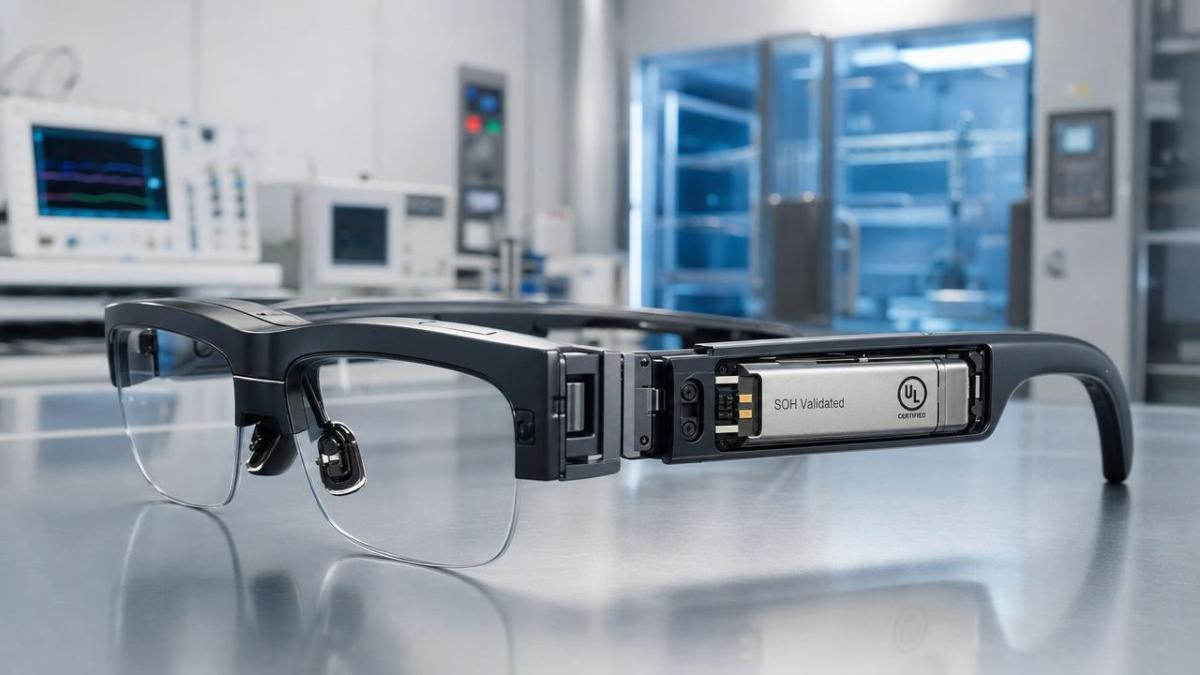
On May 15, 2026, UL Solutions released UL 62368-1 Supplement SB (2026 Edition), introducing a mandatory State of Health (SOH) lifecycle aging validation requirement for lithium-ion batteries in AR/Smart Glasses. This update directly affects manufacturers and exporters of AR eyewear targeting the U.S. market—and increasingly, FDA-reviewed digital health devices—making comprehensive aging documentation essential for UL certification.
Event Overview
On May 15, 2026, UL Solutions published UL 62368-1 Supplement SB (2026 Edition). The supplement adds a new requirement for built-in lithium-ion batteries in AR/Smart Glasses: applicants must submit a full-lifecycle State of Health (SOH) aging report, consisting of capacity retention and internal resistance growth measurements taken every 30 days over a continuous 12-month period. Without this report, UL will not issue the UL Mark. This requirement is now aligned with the U.S. FDA’s pre-submission pathway for digital health devices.
Industries Affected
AR/Smart Glasses Exporters (U.S.-bound)
These companies face immediate compliance pressure: UL certification is often contractually required by U.S. retailers and platform partners. Failure to provide the 12-month SOH report will block UL Mark issuance, potentially delaying or preventing market entry.
OEM/ODM Manufacturing Partners
Manufacturers producing AR glasses for global brands must now integrate long-term battery aging testing into product development timelines. This extends qualification cycles and increases lab resource allocation—especially for battery cells sourced from third-party suppliers without existing SOH traceability.
Battery Component Suppliers
Suppliers of lithium-ion cells—including cylindrical, pouch, and custom-form factor batteries—must now support customers with cell-level aging data packages. The requirement applies to the final integrated battery pack, but validation relies on consistent cell performance; thus, cell-level SOH documentation becomes a de facto prerequisite for qualification.
Regulatory & Certification Service Providers
Firms offering UL submission support or FDA digital health pre-review services must update their technical service offerings to include SOH test planning, data collection coordination, and report compilation—particularly for clients lacking in-house battery reliability labs.
Key Considerations and Recommended Actions
Monitor official guidance on test protocol harmonization
UL has not yet published detailed test parameters (e.g., temperature profile, charge/discharge cycles per interval, allowable deviation thresholds). Companies should track UL’s upcoming technical bulletins and attend UL-hosted webinars scheduled for Q3 2026.
Prioritize models with U.S. market launch plans before Q2 2027
Because the SOH report requires 12 months of data, any AR glasses model intended for U.S. launch in early-to-mid 2027 must initiate aging testing no later than Q2 2026. Delaying initiation risks missing certification deadlines.
Distinguish between regulatory signal and enforceable timeline
The May 15, 2026 release is the effective date of the supplement—but UL has confirmed a 6-month transition period for submissions under legacy requirements. Enforcement of the full SOH report becomes mandatory for all new applications filed on or after November 15, 2026.
Align battery sourcing, integration, and test planning across teams
Procurement, R&D, and QA teams must jointly select battery cells with documented aging behavior—or commission parallel aging tests during prototype builds. Cross-functional alignment is critical: battery firmware, thermal design, and mechanical housing all influence aging outcomes and must be locked before aging testing begins.
Editorial Perspective / Industry Observation
Observably, this update signals a broader shift toward lifecycle-based safety assurance—not just for batteries, but for field-deployed electronics in regulated health-adjacent categories. It does not yet constitute a standalone regulation, nor does it apply retroactively to certified products; however, its inclusion in the FDA’s digital health pre-review pathway elevates its operational weight beyond traditional safety certification. Analysis shows that UL is treating battery SOH less as a one-time pass/fail metric and more as a longitudinal quality gate—one that reflects real-world degradation patterns rather than accelerated lab stress alone. From an industry perspective, this represents less an isolated compliance hurdle and more an early indicator of how functional safety expectations may evolve for embedded power systems in wearable medical-adjacent devices.
Conclusion: This UL update formalizes a new baseline expectation for battery reliability validation in AR eyewear entering the U.S. market. It is not a retrospective mandate, nor does it replace existing electrical or mechanical safety requirements—but it introduces a time-bound, data-intensive layer of evidence that reshapes product development timelines and supplier accountability. Currently, it is best understood as a forward-looking procedural standard with binding enforcement starting November 15, 2026, rather than an immediate market barrier.
Source: UL Solutions official announcement, UL 62368-1 Supplement SB (2026 Edition), published May 15, 2026. Note: UL’s detailed test methodology document and FDA alignment guidance remain pending publication and are subject to ongoing observation.
Protocol_Architect
Dr. Thorne is a leading architect in IoT mesh protocols with 15+ years at NexusHome Intelligence. His research specializes in high-availability systems and sub-GHz propagation modeling.
Related Recommendations
- Dr. Sophia Carter (Medical IoT Specialist)AR Display Glasses for Field Service: Selection Criteria for Hands-Free Repair Work
- Dr. Sophia Carter (Medical IoT Specialist)Industrial AR Devices Cost: What Affects Pricing for Remote Support and Maintenance
- Dr. Sophia Carter (Medical IoT Specialist)Enamel Jewelry OEM Explained: Customization Options, MOQ, Lead Times, and Quality Checkpoints
- Dr. Sophia Carter (Medical IoT Specialist)Meta Launches $299 Smart Glasses Ahead of AR Race
- Dr. Sophia Carter (Medical IoT Specialist)Camping Glamping Tents for Eco Resorts: What to Compare Before You Buy
- Dr. Sophia Carter (Medical IoT Specialist)How to Vet an Iced Out Watches Wholesale Supplier: MOQ, Plating Quality, and Return Risks
- Dr. Sophia Carter (Medical IoT Specialist)Huawei Launches First AI Glasses with Local Matter & Zigbee Control
- Dr. Sophia Carter (Medical IoT Specialist)Huawei Launches First AI Glasses with Matter & Zigbee 3.0 Support
- Dr. Sophia Carter (Medical IoT Specialist)UL Updates SOH Certification for Smart Glasses Batteries
- Dr. Sophia Carter (Medical IoT Specialist)Huawei Launches First AI Glasses with Matter & Zigbee 3.0 Support
Analyst