
Why payload benchmarks can mislead commercial drone selection
author
A commercial drone payload capacity benchmark can look decisive on paper, yet it often obscures the operational realities that matter most in renewable energy inspections, mapping, and maintenance. For technical evaluators, selecting the right platform requires more than headline lift figures—it demands scrutiny of endurance, sensor integration, wind performance, and data reliability under real field conditions.
Why scenario differences matter more than a headline payload figure
In renewable energy operations, the same aircraft can look excellent in a commercial drone payload capacity benchmark and still fail in practice. The reason is simple: a payload benchmark usually isolates one variable, while field missions combine many. A drone lifting a heavy camera for a few minutes in calm weather is not automatically suitable for inspecting offshore wind turbines, surveying a solar farm in high heat, or carrying a methane sensor across a utility corridor.
Technical evaluators are rarely buying lift alone. They are assessing mission continuity, data confidence, safety margins, battery logistics, software compatibility, and total cost of ownership. In renewable energy, a weak platform does not only reduce efficiency; it can delay outage decisions, distort thermal findings, compromise vegetation analysis, or create repeated site visits that erase any savings promised by the original specification sheet.
This is why the most useful interpretation of a commercial drone payload capacity benchmark is contextual. Instead of asking, “How much can it carry?” evaluators should ask, “What can it carry for this mission, in this environment, with acceptable endurance, stability, and data quality?” That shift turns a marketing number into an engineering decision.
Where payload benchmarks commonly mislead renewable energy buyers
The first trap is assuming maximum payload equals usable payload. Manufacturers may publish the highest possible lift under controlled conditions, often without reflecting wind, temperature, battery aging, or the accessory stack actually required in commercial work. Gimbals, RTK modules, protective mounts, extra telemetry hardware, and dual-sensor payloads all consume part of that margin.
The second trap is ignoring performance degradation. In renewable energy sites, drones operate in thermally unstable air over solar arrays, in turbulent rotor wash near wind turbines, and across long distances in open land. A platform that technically carries the load may do so with reduced flight time, slower maneuverability, and lower stabilization quality. That affects data repeatability more than many buyers expect.
The third trap is treating all payloads as equivalent. A LiDAR unit, a thermal camera, a multispectral sensor, and a gas detector differ in weight distribution, power demand, vibration sensitivity, and calibration requirements. Two payloads with the same mass can produce very different effects on flight behavior and data integrity.
The fourth trap is overlooking workflow integration. In a commercial drone payload capacity benchmark, the aircraft may “pass” because it lifts the sensor. In actual procurement, the harder question is whether the aircraft, payload, and software stack deliver usable outputs to maintenance teams, EPC contractors, grid planners, or asset owners without manual rework.
Scenario comparison: the same payload number means different things
Below is a practical comparison for technical evaluators in renewable energy. It shows why the same commercial drone payload capacity benchmark should be interpreted differently depending on the mission profile.
For evaluators, this table highlights a key procurement lesson: the best aircraft is usually the one that protects data quality under mission stress, not the one with the boldest lift figure in a commercial drone payload capacity benchmark.
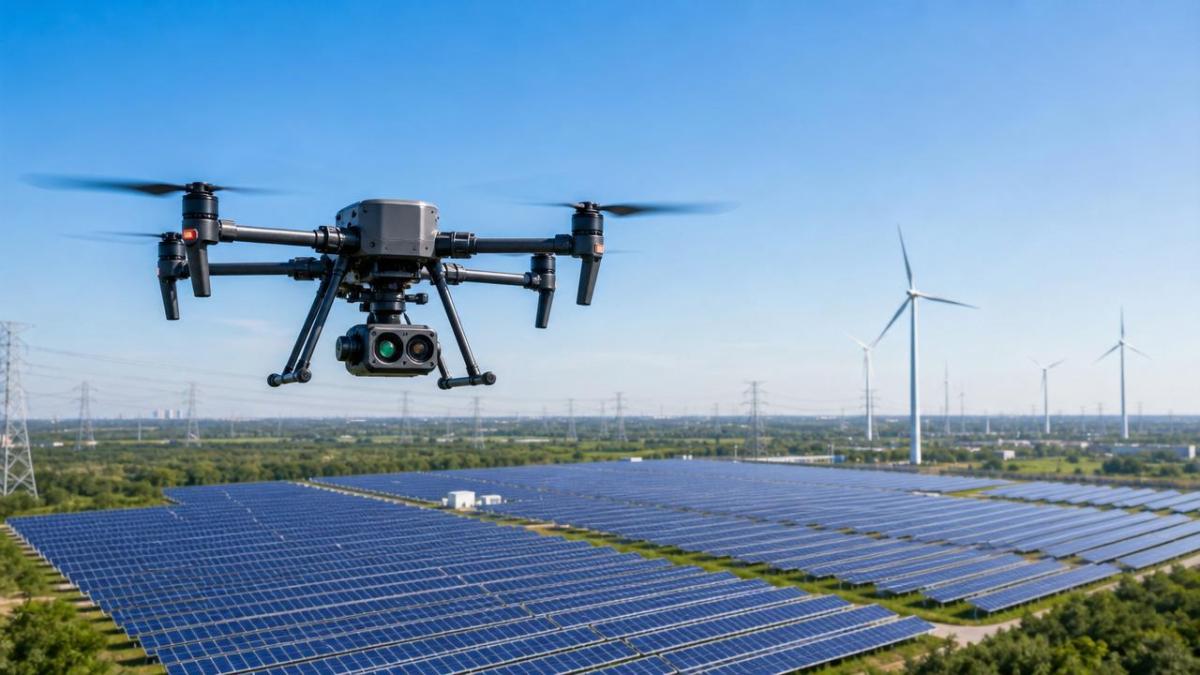
Application scenario 1: Solar farm inspection needs endurance more than extreme lift
In utility-scale solar, teams often inspect thousands of modules across vast, repetitive terrain. Here, the payload is usually moderate, but the operational burden is high. The aircraft must sustain efficient coverage while preserving thermal image consistency and positional accuracy. A drone that carries a heavier sensor but loses too much flight time may force more battery swaps, more takeoff cycles, and more fragmented datasets.
This is where a commercial drone payload capacity benchmark can distort judgment. If one model lifts 30% more than another but flies 25% less time with the actual thermal setup, the “stronger” platform may be the weaker inspection tool. Solar asset managers need repeatable hotspot detection, not maximum cargo flexibility they never use.
Technical evaluators should prioritize: actual endurance with the intended dual-sensor payload, thermal calibration stability under midday heat, mission planning automation, and file output compatibility with analysis software. In this scenario, payload margin still matters, but only as a buffer for safe operation, not as the main buying criterion.
Application scenario 2: Wind turbine inspections demand control authority in turbulent air
Wind turbine inspection is one of the clearest examples of why payload benchmarks can mislead commercial drone selection. The mission often uses a relatively compact visual payload, yet the environment is difficult. Gusts, changing air currents, tower proximity, and the need for precise hovering all place heavy demands on the airframe and flight controller.
A high commercial drone payload capacity benchmark may suggest robustness, but that does not guarantee stable image capture at blade edges or consistent framing during close inspection passes. In many cases, excess payload capability adds weight and complexity without improving mission output. The more relevant performance indicators are wind resistance with the real camera installed, positional hold accuracy, obstacle avoidance confidence, and recovery behavior after sudden gusts.
For onshore and offshore wind operators, the practical question is not whether the drone can carry more, but whether it can safely hold the right viewing angle long enough to support defect classification. The highest-value benchmark is therefore mission stability, not raw lift.
Application scenario 3: Mapping and LiDAR missions punish weak payload interpretation
When renewable energy developers map terrain for solar siting, transmission access, drainage planning, or vegetation management, payload selection becomes more technical. LiDAR and advanced mapping payloads may sit near the practical limits of some aircraft, but the real risk is not simple overload. It is degraded path accuracy, increased vibration, and lower efficiency over large survey blocks.
A commercial drone payload capacity benchmark often says little about how an aircraft behaves across a long corridor mission with repeated turns, elevation changes, and crosswinds. Can the system maintain proper overlap? Does heavier loading reduce safe reserve power for return-to-home? Does mounting the sensor alter balance enough to affect data strip alignment? These are not secondary details. They determine whether deliverables meet engineering-grade standards.
In this scenario, evaluators should request proof of performance using the exact payload model, mounting kit, and navigation setup intended for production. A benchmark without that specificity has limited decision value.
Application scenario 4: Specialized sensing missions expose hidden integration costs
Bioenergy, hydrogen, and grid-adjacent renewable assets increasingly use drones for gas monitoring, flare observation, thermal anomaly checks, and environmental verification. These missions may involve niche payloads that are not especially heavy, yet they are sensitive to mounting geometry, electromagnetic interference, and power supply behavior.
A commercial drone payload capacity benchmark can make these aircraft appear interchangeable if they all exceed the sensor weight. In reality, integration effort may vary dramatically. Some platforms offer clean data channels, stable accessory power, SDK support, and straightforward calibration routines. Others create hidden engineering work that delays deployment and increases operator error.
For technical assessment teams, the selection question becomes broader: can the drone carry the payload, power it reliably, maintain clean telemetry, and deliver traceable data outputs that fit compliance or maintenance workflows? If the answer is no, the benchmark was never the right decision anchor.
How to evaluate payload benchmarks in a more useful way
A stronger evaluation method is to replace a single-number view with a mission-specific scorecard. This is especially important for organizations comparing multiple platforms across renewable energy use cases.
- Test flight time with the real payload, not a nominal equivalent mass.
- Measure image or sensor quality in expected wind and temperature conditions.
- Check balance, vibration behavior, and gimbal performance after full integration.
- Assess battery cycle demands for a full day of field operations.
- Validate software workflow from capture to reporting, not just airframe specifications.
- Review safety margin, including return reserve under worst-case mission conditions.
This approach turns the commercial drone payload capacity benchmark into one input among many, rather than the misleading centerpiece of the selection process.
Common misjudgments technical evaluators should avoid
One common error is overbuying payload capacity for “future flexibility” while underestimating current operating complexity. A larger platform may require more logistics, stricter launch areas, higher maintenance effort, and more training, all without creating value for present renewable energy tasks.
Another mistake is assuming payload headroom automatically improves reliability. Headroom is useful, but only if the airframe, motors, firmware, and thermal management are tuned for sustained commercial use. Otherwise, the additional margin exists mostly on paper.
A third mistake is failing to involve downstream users. The maintenance engineer, GIS specialist, thermography analyst, or EPC operations lead may care less about aircraft lift and more about file consistency, defect visibility, repeatable coordinates, or export compatibility. Their requirements should shape evaluation criteria from the start.
FAQ for renewable energy drone selection
Is a higher commercial drone payload capacity benchmark always better?
No. It is better only if your mission truly needs the extra capacity and the aircraft still maintains safe endurance, stability, and data quality with the intended payload in field conditions.
Which renewable energy scenario is most likely to be misread through payload alone?
Wind turbine inspection is a major example because turbulent air and close-proximity control matter more than simple lift. Solar inspection can also be misjudged when endurance and thermal consistency are ignored.
What should be tested alongside a commercial drone payload capacity benchmark?
Endurance under real load, wind performance, sensor integration quality, vibration effects, return-power reserve, workflow compatibility, and output accuracy should all be verified before purchase.
A better way forward for technical evaluation teams
For renewable energy organizations, the right drone is not the one that wins a simplified commercial drone payload capacity benchmark. It is the one that fits the mission profile, preserves data integrity, scales across field operations, and reduces rework over time. Scenario-based evaluation is the most reliable path because solar, wind, mapping, and specialized sensing missions each punish different weaknesses.
At NHI, this data-first mindset reflects a broader principle: engineering truth matters more than brochure language. When technical evaluators compare drones for renewable energy use, they should translate every benchmark into a field question: under our conditions, for our payload, for our workflow, what will actually perform? That is the question that leads to better procurement decisions, lower operational risk, and more trustworthy asset intelligence.
Protocol_Architect
Dr. Thorne is a leading architect in IoT mesh protocols with 15+ years at NexusHome Intelligence. His research specializes in high-availability systems and sub-GHz propagation modeling.
Related Recommendations
- Dr. Sophia Carter (Medical IoT Specialist)AR Display Glasses for Field Service: Selection Criteria for Hands-Free Repair Work
- Dr. Sophia Carter (Medical IoT Specialist)Industrial AR Devices Cost: What Affects Pricing for Remote Support and Maintenance
- Dr. Sophia Carter (Medical IoT Specialist)Enamel Jewelry OEM Explained: Customization Options, MOQ, Lead Times, and Quality Checkpoints
- Dr. Sophia Carter (Medical IoT Specialist)Meta Launches $299 Smart Glasses Ahead of AR Race
- Dr. Sophia Carter (Medical IoT Specialist)Camping Glamping Tents for Eco Resorts: What to Compare Before You Buy
- Dr. Sophia Carter (Medical IoT Specialist)How to Vet an Iced Out Watches Wholesale Supplier: MOQ, Plating Quality, and Return Risks
- Dr. Sophia Carter (Medical IoT Specialist)Huawei Launches First AI Glasses with Local Matter & Zigbee Control
- Dr. Sophia Carter (Medical IoT Specialist)Huawei Launches First AI Glasses with Matter & Zigbee 3.0 Support
- Dr. Sophia Carter (Medical IoT Specialist)UL Updates SOH Certification for Smart Glasses Batteries
- Dr. Sophia Carter (Medical IoT Specialist)Huawei Launches First AI Glasses with Matter & Zigbee 3.0 Support
Analyst