
Huawei Launches First AI Glasses with Local Matter & Zigbee Control
author
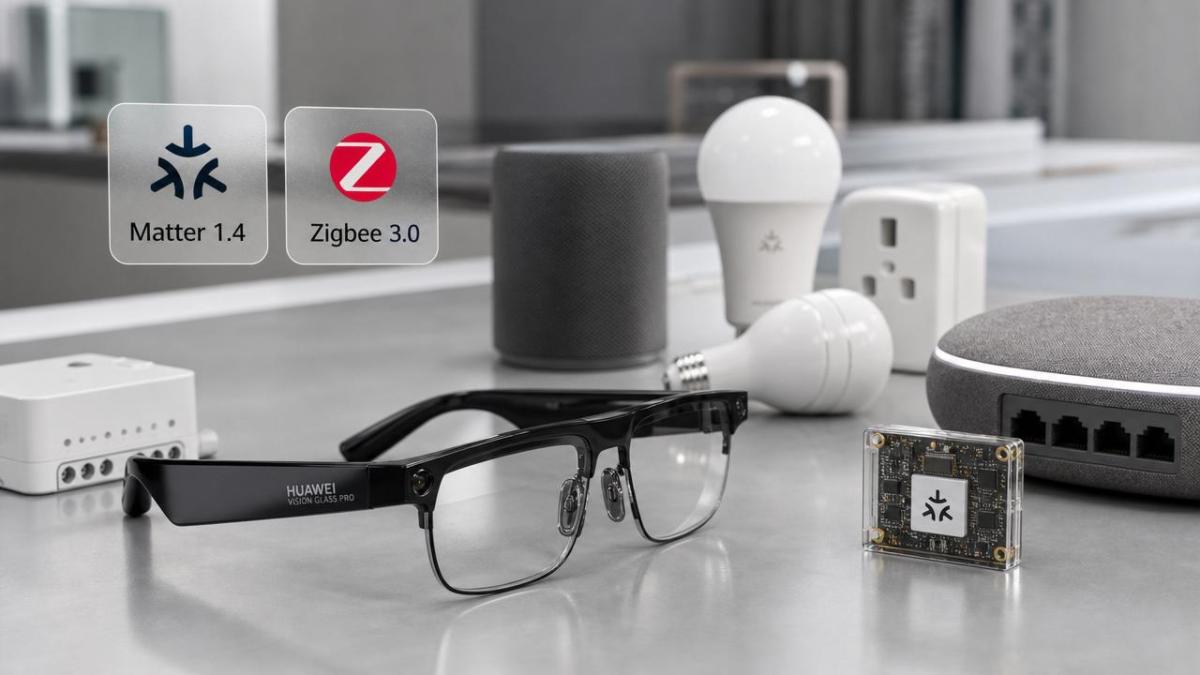
On May 18, 2026, Huawei unveiled its first mass-produced AI glasses — the HUAWEI Vision Glass Pro — priced from USD 2499. The device integrates a built-in Matter 1.4 controller and Zigbee 3.0 radio module, enabling local, cloud-independent control of smart home devices and cross-protocol bridging. This development signals potential shifts for smart home hardware manufacturers, interoperability solution providers, and IoT supply chain stakeholders — particularly those engaged in global certification, embedded systems integration, or Matter/Zigbee-enabled product development.
Event Overview
On May 18, 2026, Huawei officially launched the HUAWEI Vision Glass Pro, its first commercially available AI glasses. The product is priced starting at USD 2499. It features an integrated Matter 1.4 controller and Zigbee 3.0 RF module, supporting local (non-cloud-dependent) direct control of smart home devices and protocol bridging across Matter and Zigbee ecosystems. The device has passed CSA Matter certification and Zigbee Alliance interoperability testing.
Industries Affected
Smart Home Device Manufacturers
These companies may face renewed pressure to ensure Matter 1.4 and Zigbee 3.0 compatibility — especially for devices intended for local-control-first markets. The inclusion of both protocols in a consumer-facing wearable suggests growing demand for seamless, low-latency, offline-capable control interfaces — not just cloud-connected apps.
Embedded Systems & Module Suppliers
Suppliers of certified Matter controllers or Zigbee 3.0 SoCs and modules may see increased design-in opportunities, particularly for compact, power-constrained edge devices. The glasses’ dual-protocol integration sets a functional benchmark for coexistence and resource-efficient implementation in constrained form factors.
Certification & Interoperability Testing Services
Third-party labs accredited by CSA Group or Zigbee Alliance may experience higher demand for joint Matter–Zigbee validation — especially for hybrid controller implementations. Certification scope now extends beyond single-protocol compliance to multi-protocol coexistence and local execution assurance.
IoT Platform & Gateway Developers
Developers building Matter-compatible hubs or bridges must assess whether their architectures support direct command injection from external local controllers (e.g., via Matter over Thread or Zigbee 3.0 link-layer triggers). The glasses operate without cloud dependency — implying tighter requirements for deterministic local response timing and secure local commissioning workflows.
What Relevant Enterprises or Practitioners Should Monitor and Do Now
Track official Matter Working Group updates on controller-side certification criteria
The glasses’ Matter 1.4 controller implementation appears targeted at local control rather than full hub functionality. Observably, the Matter Working Group has not yet published formal certification paths for ‘controller-only’ or ‘wearable-class’ Matter devices. Enterprises should monitor upcoming Technical Steering Committee (TSC) proposals for such categories.
Review current product roadmaps for Zigbee 3.0 + Matter dual-stack readiness
Analysis shows that few consumer wearables currently embed both protocols natively. Companies developing next-gen remote interfaces (e.g., AR glasses, voice remotes, or smart rings) should audit firmware architecture for dual-protocol memory footprint, RF coexistence, and secure local commissioning support — especially if targeting China-export or EU/US markets with strong Matter adoption momentum.
Distinguish between certification signal and commercial deployment reality
While the glasses are certified and launched, actual end-user adoption of local control via wearables remains unproven at scale. Current more appropriate interpretation is that this represents a platform-level capability demonstration — not yet evidence of widespread market pull. Businesses should avoid premature retooling but begin feasibility assessments for hybrid controller integration.
Prepare for localized interoperability documentation and test case expansion
Manufacturers exporting to regions where Huawei’s ecosystem holds influence (e.g., parts of Asia, Middle East, Latin America) should consider adding local-control verification steps to their QA pipelines — specifically testing direct Zigbee 3.0 device binding and Matter-local command routing without internet connectivity.
Editorial Perspective / Industry Observation
Observably, this launch is less about immediate market disruption and more about signaling a technical inflection point: the convergence of AI-enabled wearables with certified, local-first smart home control. It does not introduce new standards, but it validates a specific architectural approach — embedding full protocol stacks directly into compact edge devices while maintaining certification compliance. From an industry perspective, this is best understood as a capability benchmark, not a de facto specification shift. Its significance lies in accelerating attention toward local execution reliability, low-power multi-protocol RF design, and controller-side security — all of which remain under-emphasized in many current IoT product strategies. Continuous observation is warranted, particularly regarding follow-up developer documentation, SDK availability, and third-party integration reports.
This announcement marks a step toward tighter integration between AI wearables and standardized local control frameworks — but its broader impact depends on whether other OEMs adopt similar dual-protocol, cloud-optional architectures in consumer-facing products. For now, it serves as a concrete reference for what certified local control can look like in next-generation edge devices.
Source: Official Huawei press release (May 18, 2026); CSA Group Matter Certification Database; Zigbee Alliance Interoperability Test Reports. Note: Ongoing observation is recommended regarding availability of developer APIs, regional regulatory filings, and real-world interoperability performance metrics — none of which have been publicly disclosed as of launch date.
Protocol_Architect
Dr. Thorne is a leading architect in IoT mesh protocols with 15+ years at NexusHome Intelligence. His research specializes in high-availability systems and sub-GHz propagation modeling.
Related Recommendations
- Dr. Sophia Carter (Medical IoT Specialist)AR Display Glasses for Field Service: Selection Criteria for Hands-Free Repair Work
- Dr. Sophia Carter (Medical IoT Specialist)Industrial AR Devices Cost: What Affects Pricing for Remote Support and Maintenance
- Dr. Sophia Carter (Medical IoT Specialist)Enamel Jewelry OEM Explained: Customization Options, MOQ, Lead Times, and Quality Checkpoints
- Dr. Sophia Carter (Medical IoT Specialist)Meta Launches $299 Smart Glasses Ahead of AR Race
- Dr. Sophia Carter (Medical IoT Specialist)Camping Glamping Tents for Eco Resorts: What to Compare Before You Buy
- Dr. Sophia Carter (Medical IoT Specialist)How to Vet an Iced Out Watches Wholesale Supplier: MOQ, Plating Quality, and Return Risks
- Dr. Sophia Carter (Medical IoT Specialist)Huawei Launches First AI Glasses with Local Matter & Zigbee Control
- Dr. Sophia Carter (Medical IoT Specialist)Huawei Launches First AI Glasses with Matter & Zigbee 3.0 Support
- Dr. Sophia Carter (Medical IoT Specialist)UL Updates SOH Certification for Smart Glasses Batteries
- Dr. Sophia Carter (Medical IoT Specialist)Huawei Launches First AI Glasses with Matter & Zigbee 3.0 Support
Analyst