
How to compare palletizing robot suppliers beyond unit price
author
For procurement teams in renewable energy operations, evaluating palletizing robot suppliers on unit price alone can create hidden costs in uptime, integration, and lifecycle performance. This guide explores how to compare suppliers through data-driven criteria such as reliability, compatibility, service capacity, and long-term ROI—helping buyers make decisions that support scalable, efficient, and resilient automation.
Why the comparison criteria for palletizing robot suppliers are changing
A clear shift is underway in renewable energy manufacturing and distribution. Warehouses handling solar modules, battery packs, inverters, heat pump components, smart relays, and climate-control hardware are under pressure to move faster, reduce labor risk, and protect fragile products. In this environment, procurement teams can no longer treat palletizing robots as isolated machines purchased on a lowest-bid basis. The real decision now is whether palletizing robot suppliers can support a broader automation system that remains stable under changing throughput, packaging formats, and digital integration requirements.
This change is especially relevant for organizations influenced by data-driven operating models. As NHI’s broader vision suggests, engineering truth matters more than marketing language. The same logic applies here: glossy claims about “high speed,” “smart vision,” or “easy integration” tell buyers very little unless suppliers can prove performance in real production conditions. For renewable energy businesses, where output planning, traceability, and uptime are tightly connected to margin and customer commitments, weak supplier selection can create downstream bottlenecks far more expensive than the initial purchase price.
In other words, the market is moving from price comparison to capability comparison. Procurement leaders evaluating palletizing robot suppliers must now assess which vendors are equipped to handle mixed-SKU loads, production variability, software integration, maintenance response, and lifecycle support across multiple facilities or regions.
The strongest trend signals shaping supplier evaluation
Several trend signals explain why comparison methods are evolving. First, renewable energy operations are scaling, but not always in a uniform way. A facility may add new battery lines, introduce a different carton size, or shift packaging density to reduce logistics cost. A palletizing cell that works well today may need to handle new stacking logic within months. That makes flexibility a commercial issue, not just an engineering preference.
Second, labor volatility continues to affect end-of-line operations. Palletizing has long been one of the most repetitive and injury-prone tasks in industrial environments. Suppliers that can demonstrate safer cell design, easier operator interaction, and stronger remote diagnostics increasingly stand out. Third, digitalization expectations are rising. Buyers want machine data, fault visibility, predictive maintenance inputs, and cleaner integration with manufacturing execution systems, warehouse systems, and plant energy management platforms.
Finally, procurement itself is becoming more cross-functional. The decision is no longer owned by purchasing alone. Engineering, operations, EHS, IT, and finance all influence how palletizing robot suppliers are shortlisted. This means suppliers are judged not just by quote value, but by their ability to satisfy technical validation, cyber requirements, commissioning discipline, and long-term service expectations.
What drives hidden cost beyond the quoted unit price
When buyers compare palletizing robot suppliers, the most common mistake is assuming that price variance reflects the full economic difference between options. In reality, lower-cost systems can carry hidden penalties in commissioning delays, unstable grippers, limited software openness, high unplanned downtime, or expensive future modifications. These costs often appear only after installation, when budget flexibility is lower and operational dependency is higher.
For renewable energy operations, these hidden costs are amplified by product sensitivity and throughput commitments. Battery-related goods may require careful handling because of weight distribution and safety standards. Solar and smart energy hardware often demands packaging integrity to avoid field returns and warranty issues. If a supplier cannot maintain consistent placement accuracy, stack stability, or smooth handoff to conveyors and wrappers, the price advantage on paper quickly disappears.
Another hidden cost is integration friction. Some palletizing robot suppliers provide an attractive base quote but rely on external integrators for vision systems, safety enclosures, line controls, or software customization. That fragmented model can work, but procurement teams need visibility into accountability. If a fault occurs during startup, who owns the root cause? If production expands, who validates the new recipe set? The cheapest supplier often becomes the most expensive if roles are unclear.
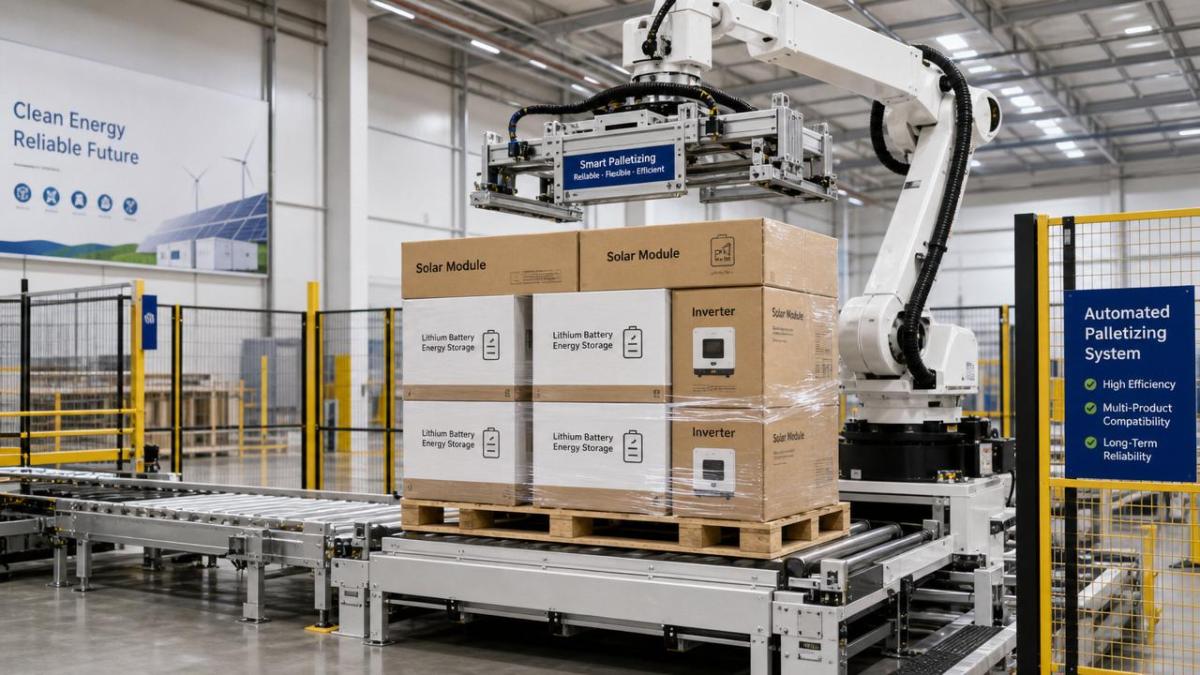
How renewable energy procurement teams should compare palletizing robot suppliers now
A stronger evaluation model starts with measured performance instead of brochure language. Procurement should ask palletizing robot suppliers for application-specific evidence: line speed under actual load conditions, case dimensions supported, payload stability, changeover time, recovery behavior after stoppages, and documented uptime in comparable industries. Suppliers that cannot translate general claims into scenario-based proof should be scored cautiously.
Reliability should be reviewed as a system attribute, not only as robot arm quality. The end effector, sensors, safety devices, conveyors, and control logic all influence real uptime. Buyers should request failure history by subsystem, preventive maintenance intervals, and details on critical spare parts. In fast-moving facilities, spare parts availability within the region may matter more than a slightly lower capex figure.
Compatibility is another decisive criterion. Many renewable energy plants are evolving toward more connected operations, and this makes open interfaces highly valuable. Palletizing robot suppliers should be able to explain how their systems communicate with PLCs, MES layers, traceability tools, and warehouse execution workflows. If the supplier’s architecture is closed or highly proprietary, future upgrades may become slower and more expensive.
Service capability deserves equal weight. A supplier with limited field support, weak training materials, or slow remote response can undermine the business case even if the machine performs well during acceptance testing. Buyers should check technician coverage, escalation process, software update policy, documentation quality, and multilingual support if operations span multiple regions.
A practical supplier scorecard
Which impacts are becoming more visible across the buying team
The shift in how buyers assess palletizing robot suppliers affects several stakeholders. Procurement teams need better decision frameworks, but they also need stronger technical inputs. Operations managers are looking for uptime, predictable throughput, and fast fault recovery. Engineers want cleaner integration, easier changeovers, and scalable control logic. Finance teams want ROI visibility built on realistic assumptions, not best-case projections. EHS leaders expect safer manual handling reduction without creating new automation risks.
This is why a supplier selection process based purely on quote comparison often breaks down. Different stakeholders define value differently, and modern procurement must convert those concerns into measurable scoring criteria. In renewable energy settings, where many product lines are still evolving, adaptability becomes a shared priority across departments.
Signals that a palletizing robot supplier is future-ready
Future-ready palletizing robot suppliers tend to show a few consistent strengths. They can discuss performance in terms of data, not generic capability. They understand application differences between heavy battery materials, fragile smart-home energy devices, and mixed-format distribution loads. They present service models clearly, including what is monitored remotely and what requires site intervention. They also explain upgrade pathways, which is critical as facilities expand or standardize across regions.
Another useful signal is whether the supplier supports validation discipline. Strong vendors typically offer FAT and SAT structures tied to measurable acceptance criteria, along with operator training and maintenance documentation. They are also more transparent about constraints. In many cases, honesty about limitations is a better predictor of successful delivery than aggressive promises made during the bidding stage.
For companies aligned with data-centric procurement principles, the best palletizing robot suppliers are those willing to be benchmarked. They do not resist comparative testing on cycle stability, unplanned stoppage behavior, energy consumption, or integration readiness. That willingness signals maturity and lowers the risk of post-purchase surprises.
How to respond to the trend: from quote review to evidence-based selection
The practical response is not to ignore price, but to reposition it. Unit price should remain one part of the model, not the model itself. Procurement teams should define weighted criteria before RFQ release, request structured evidence from palletizing robot suppliers, and involve operations and engineering early enough to challenge assumptions. Site references in adjacent sectors can be useful, but the closer the application match, the better.
It is also wise to compare scenario costs, not just purchase costs. What happens if product dimensions change? What if throughput rises 20 percent? What if a component fails during peak season? What if remote support is needed across time zones? These questions reveal which suppliers are pricing for short-term sale conversion and which are designed for long-term operational partnership.
In renewable energy logistics and manufacturing, resilience is becoming a procurement objective. That means buyers should favor palletizing robot suppliers that combine mechanical reliability, software openness, support responsiveness, and credible lifecycle economics. The goal is not merely to automate palletizing, but to strengthen the continuity and adaptability of the entire end-of-line process.
Final judgment points for procurement teams
If your business is reviewing palletizing robot suppliers, the most important question is not which supplier offers the lowest unit price today. The better question is which supplier can sustain production quality, protect uptime, integrate with your evolving systems, and support future packaging changes without costly disruption. That is the real trend in the market: supplier comparison is moving from transactional purchasing to operational risk management.
Before making a final decision, confirm five points: whether the supplier has proven application fit in comparable renewable energy environments; whether integration and data access are sufficiently open; whether service response is local, documented, and scalable; whether lifecycle cost assumptions are realistic; and whether the supplier can provide evidence instead of broad claims. Buyers who use these signals will compare palletizing robot suppliers more effectively and make automation investments that remain valuable long after the initial quote is forgotten.
Protocol_Architect
Dr. Thorne is a leading architect in IoT mesh protocols with 15+ years at NexusHome Intelligence. His research specializes in high-availability systems and sub-GHz propagation modeling.
Related Recommendations
- Lina Zhao(Security Analyst)EU CE-RED Update: Vision AI Cameras Must Pass 85ms End-to-End AI Latency Check
- Lina Zhao(Security Analyst)How to compare wholesale LiDAR sensors for AV range accuracy
- Lina Zhao(Security Analyst)EU CE-RED Update: 85ms AI Inference Latency Limit for Vision AI Cameras
- Lina Zhao(Security Analyst)How to judge factory support before choosing a cobot maker
- Lina Zhao(Security Analyst)Industrial cobot manufacturer China: what matters after install
- Lina Zhao(Security Analyst)How to spot weak after-sales terms in 6 axis robot arm deals
- Lina Zhao(Security Analyst)6 axis robot arm wholesale: what affects total landed cost
- Lina Zhao(Security Analyst)Where 10kg cobots lose speed before they hit payload limits
- Lina Zhao(Security Analyst)Is a 10kg collaborative robot enough for real production loads
- Lina Zhao(Security Analyst)The hidden maintenance tradeoffs of custom robotic end effectors
Analyst