
India Requires Third-Party Battery Capacity Checks from June 15
author
India’s latest compliance move on imported lithium batteries takes effect on June 15, 2026, and it matters well beyond testing alone. The change links customs clearance to third-party capacity verification and a CoC carrying an anti-counterfeit code, which means battery suppliers, module makers, brand owners, import teams, and delivery planners all need to treat documentation and BIS-related filings as an operational checkpoint rather than a routine formality.
What the new import requirement confirms
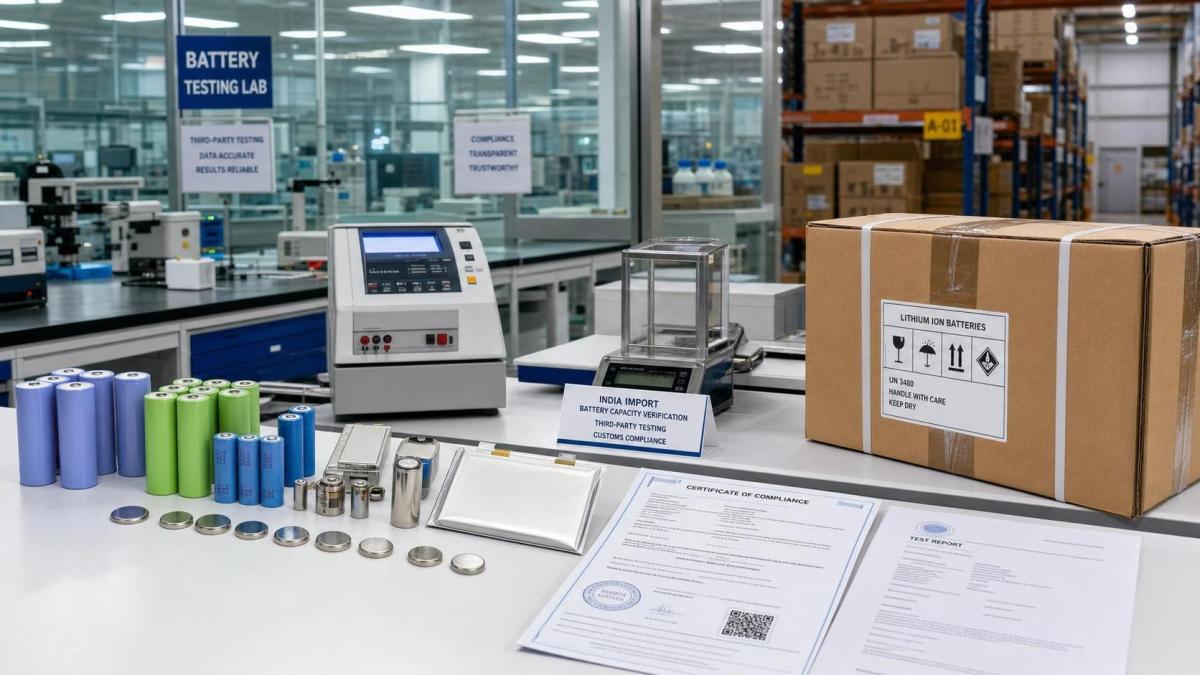
The Ministry of Electronics and Information Technology (MeitY) in India has announced that, from 2026-06-15, all imported lithium batteries must undergo actual capacity sampling verification through a BIS-recognized laboratory.
The requirement covers imported lithium batteries including button cells and pouch cells used in products such as smart locks, medical IoT devices, and fitness tracking sensors.
Importers must also submit a CoC certificate carrying an anti-counterfeit code. Where a valid certificate is not attached, the goods will be held at customs clearance, with an average delay of 7 to 12 working days.
The information provided also indicates that Chinese battery module manufacturers and end-brand owners need to update BIS registration and related test filings accordingly.
Where the disruption is most likely to appear
Battery and module shipments face a stricter pre-clearance burden
From an industry perspective, battery cell and module suppliers are likely to feel the change first because the new rule ties product entry to verified capacity results and certificate validity. The most immediate pressure is likely to appear in pre-shipment testing arrangements, document readiness, and alignment between product scope and BIS-related records.
Brand owners need closer coordination across product and compliance teams
For brands selling products that contain button cells or pouch cells, the issue is not limited to the battery component itself. Analysis shows that products such as smart locks, medical IoT devices, and fitness tracking sensors may face delivery risk if the battery documentation trail is incomplete or not updated in line with BIS registration and testing records.
Import, logistics, and delivery planning may need tighter buffers
For import operations and supply chain service providers, the stated customs hold and average 7 to 12 working day delay create a practical delivery concern. What deserves closer attention is not only the testing requirement, but also whether shipment scheduling, document submission timing, and clearance preparation are managed early enough to avoid avoidable detention.
Testing and certification workflows become a commercial checkpoint
For certification-related businesses and testing service participants, the rule points to a more formal role for BIS-recognized laboratory verification in import readiness. Observably, the commercial impact may extend to order release timing, supplier qualification review, and customer acceptance of compliance documentation.
What companies should review now
Check whether current filings still match shipped battery configurations
Companies should review whether existing BIS registration details and test filings remain consistent with the lithium batteries they plan to ship after 2026-06-15. This is especially relevant where the same end product may use different button cell or pouch cell configurations across batches or suppliers.
Verify certificate control before goods move
Analysis shows that the CoC with an anti-counterfeit code is becoming a gatekeeping document for clearance. Exporters, importers, and purchasing teams should therefore pay closer attention to document ownership, issuance timing, and internal checks before cargo departs.
Reassess lead times in procurement and delivery schedules
Where supply contracts or customer commitments are sensitive to customs timing, companies may need to recheck procurement windows and delivery promises against the possibility of certificate-related detention. This should be understood as a planning concern based on the stated average delay, not as a confirmed outcome for every shipment.
Watch for execution details rather than assuming a uniform market practice
The information provided confirms the rule direction, but it does not set out all operational details. Companies should continue watching for official wording, implementation practice, and any changes in how compliance records, test submissions, or related tender and procurement documents are handled in practice.
Why this looks like an execution signal
It is more appropriate to understand this development as an executed compliance signal rather than a general policy discussion, because the requirement is tied to a stated effective date, a named verification route through BIS-recognized laboratories, and a direct customs consequence where valid certification is missing.
At the same time, analysis shows that the market still needs to observe how consistently the requirement is applied across product categories and documentation scenarios. That is why companies should distinguish between the confirmed rule change and the still-emerging details of enforcement practice.
How the market may best read this change
The immediate significance of this update is that battery capacity claims for imported lithium batteries are no longer just a technical matter for product files; they are becoming part of import control and delivery execution. For affected suppliers and brands, the practical issue is less about broad policy interpretation and more about whether testing, certificates, and BIS-related filings are synchronized before shipment.
In that sense, the update is best read as a concrete compliance threshold with real trade-handling implications, while some execution details still merit continued monitoring.
Basis of this article and what still needs verification
This article is generated from the user-provided news title, event date, and event summary. The specific official source link was not provided in the input, so continued verification is still needed against source materials typically associated with this type of development, such as official notices, regulator releases, customs or trade authority information, industry association updates, standard-related documents, and reporting from authoritative media.
What still deserves ongoing attention includes any further policy detail, certification enforcement practice, BIS-related filing interpretation, changes in procurement or tender documentation, market feedback, and how affected companies implement the requirement in actual shipments.
Protocol_Architect
Dr. Thorne is a leading architect in IoT mesh protocols with 15+ years at NexusHome Intelligence. His research specializes in high-availability systems and sub-GHz propagation modeling.
Related Recommendations
- NHI Data Lab (Official Account)How Procurement Teams Can Build Clear Project Specifications for Renewable Energy RFQs
- NHI Data Lab (Official Account)What Affects Smart Rings Standby Time and How to Compare Battery Life Claims?
- NHI Data Lab (Official Account)How to Choose a High Payload AG Drone: Payload, Flight Time, and Spray Efficiency
- NHI Data Lab (Official Account)Vietnam Tightens Battery Clearance for Medical IoT
- NHI Data Lab (Official Account)Vietnam Tightens Battery Clearance for Medical IoT
- NHI Data Lab (Official Account)Vietnam Makes Dual Battery Reports Mandatory for Medical IoT Imports
- NHI Data Lab (Official Account)UL Sets Dual Standard Path for Solid-State Micro Batteries
- NHI Data Lab (Official Account)Fixed Wing Parachute Recovery: Key Design Trade-Offs for UAV Safety and Landing Reliability
- NHI Data Lab (Official Account)How to Choose Battery Packs With Protection Circuit for Solar Storage and Portable Energy Systems
- NHI Data Lab (Official Account)UL Solutions Opens Dual-Standard Battery Testing Track
Analyst