
EU Battery Rule Tightens for 2kWh+ Storage Units
author
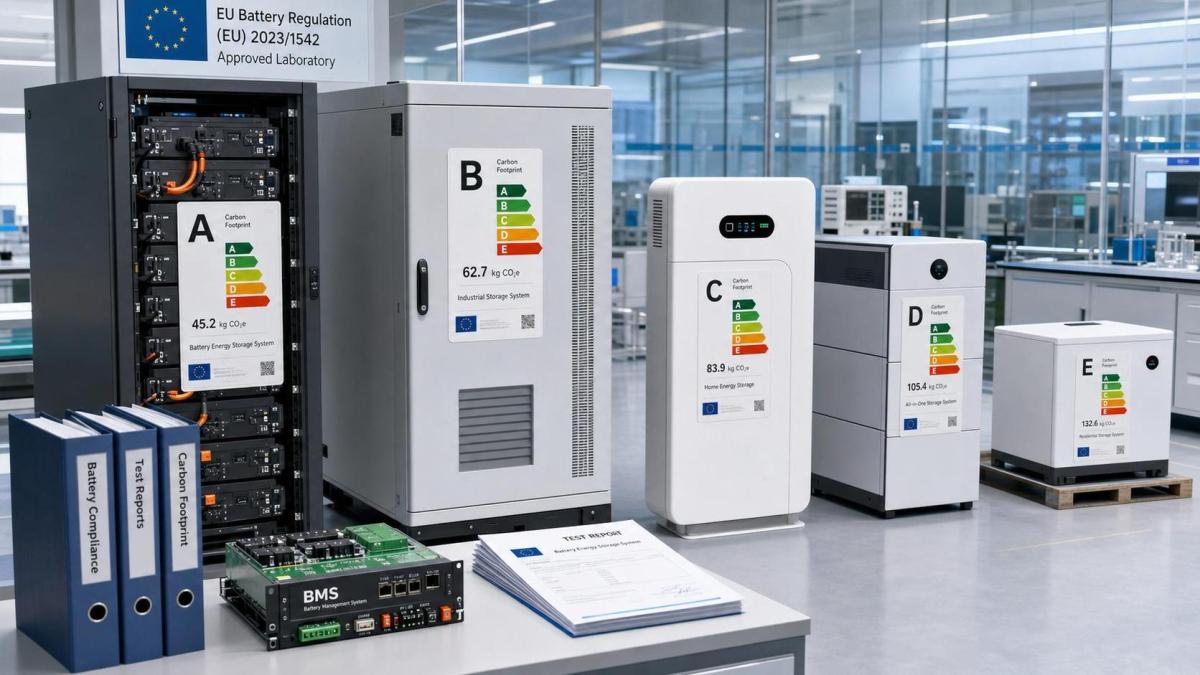
On August 18, 2026, the EU’s battery regulatory framework reaches a more operational stage: rechargeable industrial batteries above 2kWh, including energy storage BMS modules and integrated residential storage units, must carry an official carbon footprint performance label rated from A to E. For companies selling into Europe, this matters not only as a labeling requirement but as a market-access condition, because products that do not meet the requirement cannot complete EU declaration procedures or retain CE access.
What the rule now requires
According to a June 16, 2026 analysis by the International Institute of Green Finance at Central University of Finance and Economics, Regulation (EU) 2023/1542 on batteries and waste batteries has entered a key implementation phase. From August 18, 2026, all rechargeable industrial batteries with capacity above 2kWh must display the official carbon footprint performance label.
The scope described in the provided information includes energy storage BMS modules and integrated home energy storage system units. The label uses an A-to-E grading structure. The same information also states that products failing to meet the requirement will be unable to complete EU declaration procedures and will lose CE market-entry eligibility.
Where the pressure is likely to appear first
Export-facing battery and storage manufacturers
From an industry perspective, manufacturers serving the EU market are the most directly exposed because the requirement is tied to declaration and CE access. The immediate impact is likely to appear in product compliance review, labeling readiness, and shipment planning for covered products above 2kWh.
System integrators and module-level suppliers
Observably, the inclusion of energy storage BMS modules and integrated residential storage units means the issue is not limited to standalone battery cells or packs. Suppliers involved in module integration, system assembly, and product definition may need to pay closer attention to whether their products fall within the covered category and how compliance responsibilities are allocated across the supply chain.
Distributors, importers, and project buyers
For channels and procurement-side participants, the practical risk is not only technical compliance but delivery certainty. If a product cannot complete EU declaration procedures, the disruption may surface in sourcing decisions, order confirmation, documentation review, and acceptance planning for projects or resale in the European market.
What companies should watch now
Track the exact compliance wording and product scope
What deserves closer attention is the boundary between a broad policy signal and the exact products covered in daily business. Companies dealing with storage-related batteries, BMS modules, or integrated units should closely compare their product categories with the rule description in the provided information and monitor whether official wording or implementation details evolve further.
Check documentation readiness before shipment windows
Analysis shows the compliance issue is not only about attaching a label. Because the provided information links the requirement to EU declaration procedures and CE access, companies should pay attention to whether internal documentation, supplier materials, and customer-facing compliance files are aligned before delivery schedules become tight.
Prepare for customer and supplier communication
In practice, this type of rule often turns into a coordination issue across sales, compliance, procurement, and logistics. Based on the provided information, businesses should focus on confirming which party is responsible for compliance inputs, how product status is communicated to EU customers, and whether supply partners can support the required labeling path for covered products.
Separate immediate obligations from ongoing observation
It is more appropriate to understand this as an actionable compliance milestone rather than a distant policy headline. At the same time, companies should still distinguish between what is already stated in the current information and what may require further official clarification, especially where product definitions and execution details affect contract timing or market planning.
Why this matters beyond a label
Analysis shows this development signals that battery regulation in Europe is moving from framework language toward product-level execution. The notable point is that carbon footprint information is being attached to market access for a defined category of industrial rechargeable batteries, which raises the compliance importance for storage-related products already active in cross-border trade.
Observably, this is not yet a basis for broad claims about the entire market, but it is a concrete sign that affected businesses may need to treat carbon-footprint-related requirements as part of operational readiness, not only as a sustainability narrative.
How this update is best understood
At this stage, the development is best read as a near-term compliance change with longer-term regulatory signaling. The immediate fact is clear: from August 18, 2026, covered rechargeable industrial batteries above 2kWh must carry the official A-E carbon footprint label to avoid losing EU declaration completion and CE market access. The broader industry meaning, however, still needs to be judged through subsequent implementation practice and any further official clarification.
Basis of this article
This article is based on the user-provided news title, event date, and event summary concerning the implementation stage of Regulation (EU) 2023/1542 and the August 18, 2026 labeling requirement for rechargeable industrial batteries above 2kWh. The input does not provide a direct official source link, so the specific official publication path remains to be verified on an ongoing basis.
For this type of industry update, source verification would typically continue through official regulatory notices, company disclosures, industry association releases, authoritative media coverage, and standard-related documents where available. What still deserves follow-up is whether additional official clarification emerges on product scope, labeling execution, and supporting declaration requirements.
Protocol_Architect
Dr. Thorne is a leading architect in IoT mesh protocols with 15+ years at NexusHome Intelligence. His research specializes in high-availability systems and sub-GHz propagation modeling.
Related Recommendations
- NHI Data Lab (Official Account)How Procurement Teams Can Build Clear Project Specifications for Renewable Energy RFQs
- NHI Data Lab (Official Account)What Affects Smart Rings Standby Time and How to Compare Battery Life Claims?
- NHI Data Lab (Official Account)How to Choose a High Payload AG Drone: Payload, Flight Time, and Spray Efficiency
- NHI Data Lab (Official Account)Vietnam Tightens Battery Clearance for Medical IoT
- NHI Data Lab (Official Account)Vietnam Tightens Battery Clearance for Medical IoT
- NHI Data Lab (Official Account)Vietnam Makes Dual Battery Reports Mandatory for Medical IoT Imports
- NHI Data Lab (Official Account)UL Sets Dual Standard Path for Solid-State Micro Batteries
- NHI Data Lab (Official Account)Fixed Wing Parachute Recovery: Key Design Trade-Offs for UAV Safety and Landing Reliability
- NHI Data Lab (Official Account)How to Choose Battery Packs With Protection Circuit for Solar Storage and Portable Energy Systems
- NHI Data Lab (Official Account)UL Solutions Opens Dual-Standard Battery Testing Track
Analyst