
Supply Chain Expo Opens With New AI Zone
author
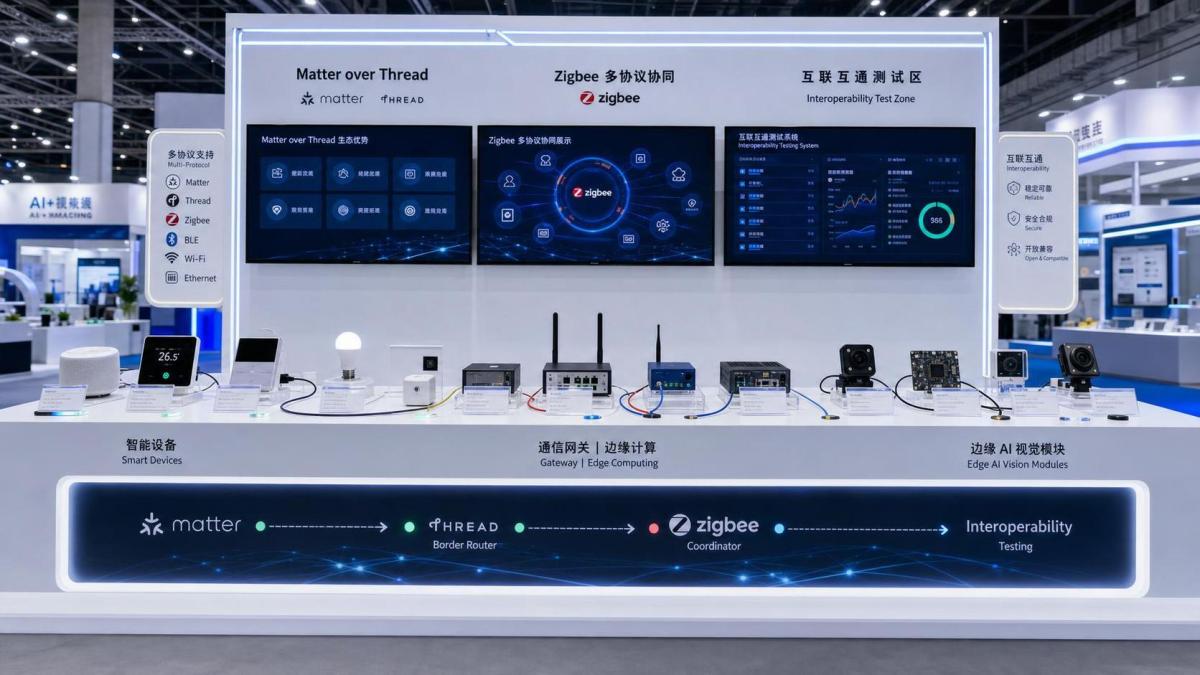
On June 22, 2026, the fourth Global Supply Chain Promotion Expo opened in Beijing with a newly introduced artificial intelligence zone that put cross-ecosystem implementation at the center of attention. For chip platform vendors, ODMs, device makers, and supply chain teams working around connected products, the most notable point is not only the presence of AI, but the way Matter over Thread, Zigbee 3.0 multi-protocol coordination, and edge AI vision modules were presented together in an interoperability and joint debugging setting.
What the Expo Put on Display
According to the provided event information, this year’s edition of the expo formally added an AI-focused exhibition area for the first time. The showcased solutions highlighted Matter over Thread, Zigbee 3.0 multi-protocol coordination, and edge AI vision modules as cross-ecosystem offerings.
The event also brought together Matter chip platform suppliers including Silicon Labs, NXP, and other named vendors, alongside leading Chinese ODM companies. On-site interoperability demonstrations and joint debugging services were part of the exhibition arrangement.
Why the Signal Matters Across the Value Chain
For chip and module suppliers, interoperability moves closer to commercial scrutiny
From an industry perspective, chip platform vendors and module suppliers may be affected because interoperability is being presented in a practical, test-oriented context rather than only as a specification-level discussion. The business impact is likely to center on reference design readiness, protocol coordination capability, and the ability to support field-level debugging with ecosystem partners.
What deserves closer attention is whether customers increasingly evaluate not just single-chip performance, but also the ease of integration across Matter, Thread, Zigbee 3.0, and edge AI use cases.
For ODM manufacturers, integration capability becomes a visible delivery factor
ODM companies may feel the impact in product definition, engineering coordination, and delivery preparation. When an exhibition setting emphasizes joint debugging, it suggests that practical integration work across platforms and protocols is becoming a visible part of the value proposition.
Analysis shows that ODM teams should watch for changes in customer expectations around protocol compatibility, demo stability, and cross-vendor collaboration during development and validation stages.
For downstream product companies and buyers, evaluation criteria may broaden
Terminal application companies and procurement teams may be affected because product selection could increasingly depend on ecosystem fit rather than a single technical feature. The relevant business links include supplier evaluation, solution selection, prototype verification, and communication with manufacturing partners.
Observably, buyers may need to pay closer attention to whether suppliers can support interoperability testing and coordinated troubleshooting when products involve multiple connectivity standards and edge AI functions.
What Companies Should Track Next
Watch the difference between demonstration and deployable readiness
Analysis shows that companies should distinguish between what is successfully demonstrated on site and what can be repeated under normal product development and delivery conditions. This matters especially for teams comparing platform choices or preparing near-term procurement decisions.
Review supplier support around joint debugging
Because the event explicitly mentions joint debugging services, a practical focus for companies is supplier support capability. Relevant questions include how efficiently vendors coordinate with ODMs, how issues are communicated during integration, and whether technical support can keep pace with delivery schedules.
Reassess protocol strategy in connected product planning
For companies already working with connected devices, the combination of Matter over Thread and Zigbee 3.0 multi-protocol coordination suggests that protocol planning should be reviewed at the product and portfolio level. The key issue is not adopting every protocol, but understanding where coexistence or coordination may affect product architecture and partner selection.
Keep customer communication aligned with actual validation progress
Service providers, manufacturers, and brand-side teams should be careful not to treat exhibition visibility as proof of full rollout maturity. What deserves closer attention is how validation progress, delivery timing, and integration boundaries are explained to customers and internal stakeholders.
A Practical Signal, Not a Final Outcome
As an editorial observation, this development is better understood as a practical industry signal rather than a confirmed market outcome. The introduction of an AI zone and the emphasis on Matter, Thread, Zigbee 3.0, and edge AI in one exhibition context indicate that cross-ecosystem coordination is becoming a more visible topic in supply chain conversations.
At the same time, the available information does not confirm how broadly these solutions have moved into scaled deployment. For that reason, it is more appropriate to read this as a sign of where technical collaboration and commercial attention are concentrating, while continuing to monitor how these demonstrations translate into repeatable delivery and purchasing decisions.
How to Read This Development Now
The most reasonable takeaway is that the expo highlights a shift in attention from isolated technology components toward implementation across protocols, platforms, and partners. That does not by itself establish a definitive market result, but it does suggest that interoperability support, coordinated debugging, and cross-ecosystem product readiness are becoming more relevant points of comparison in the connected device supply chain.
For industry participants, this is currently better understood as a medium-term signal worth tracking closely, especially for teams involved in chip selection, ODM coordination, and connected product delivery planning.
Source Context and Verification Notes
This article is generated from the user-provided news title, event date, and event summary. The factual basis used here is limited to the provided information about the June 22, 2026 opening of the fourth Global Supply Chain Promotion Expo in Beijing, the first-time AI zone, the highlighted technologies, the participating Matter chip platform vendors and Chinese ODM companies, and the on-site interoperability and joint debugging arrangements.
For this type of industry update, relevant source categories usually include official event announcements, company statements, industry association information, authoritative media reporting, and standards organization materials. A specific official source link was not provided in the input, so further verification is still needed. Continued observation should focus on subsequent official wording, follow-up disclosures from participating companies, and any clearer signals on how exhibition demonstrations translate into business deployment.
Protocol_Architect
Dr. Thorne is a leading architect in IoT mesh protocols with 15+ years at NexusHome Intelligence. His research specializes in high-availability systems and sub-GHz propagation modeling.
Related Recommendations
- Dr. Aris ThorneHow to Build a Voice-Enabled Smart Home Ecosystem That Works Across Brands
- Dr. Aris ThorneHow to Choose a Jewelry Pliers Set for Precision Wirework and Small Repairs
- Dr. Aris ThorneSupplier Capability Criteria for Renewable Energy Projects: A Procurement Checklist
- Dr. Aris ThorneCustom Printed Lanyards for Renewable Energy Sites: What Buyers Should Specify
- Dr. Aris ThorneSmart Home Protocol Analysis: How to Compare Matter, Zigbee, and Wi-Fi for Device Interoperability
- Dr. Aris ThorneMatter 1.4 Released as EU CE Rules Add Mandatory Thread/Zigbee Interoperability Tests
- Dr. Aris ThorneNorth America Property Technology: Market Opportunities, Adoption Drivers, and Key Challenges
- Dr. Aris Thorne7075 vs 6061 Aluminum in Europe: Which Alloy Fits Renewable Energy Structures?
- Dr. Aris ThorneMatter Compatibility Certification: What Device Makers Need to Pass Testing
- Dr. Aris ThorneEU EN 303 647 v2.1.1 Makes New EMC Tests Mandatory
Analyst