
EU CE-RED Rule Takes Effect for Matter Devices
author
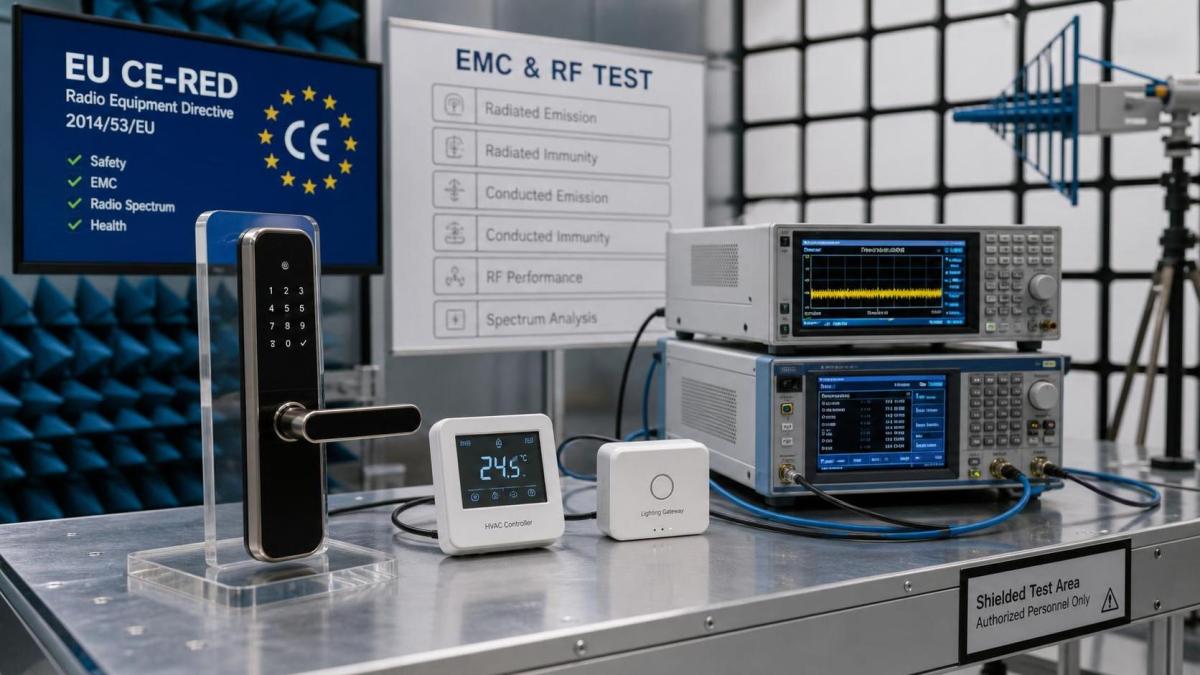
As of July 23, 2026, a new compliance threshold has taken effect in the EU for smart devices built around Matter interoperability. Under the updated implementing rules of the Radio Equipment Directive (RED), relevant products seeking CE marking must complete full EMC immunity and RF emission testing and provide a declaration of conformity issued by an EU Notified Body. For exporters, OEM/ODM manufacturers, testing partners, and buyers involved in smart locks, HVAC controllers, lighting gateways, and similar terminals, this is worth close attention because it changes how compliance preparation links directly to market access and delivery timing.
What the rule now requires for Matter-based terminals
The confirmed change is tied to July 23, 2026, when the EU formally began applying updated implementing rules under the RED framework. The requirement applies to smart terminal products that use the Matter protocol as a core basis for interoperability, including examples such as smart locks, HVAC controllers, and lighting gateways.
Under this change, such products must, for CE marking purposes, complete full EMC immunity testing and full RF emission testing. They must also provide a declaration of conformity issued by an EU Notified Body. The change directly affects the compliance route and time to market for Matter ecosystem products exported from Chinese OEM/ODM manufacturers to Europe.
Where the pressure is likely to appear first
Export programs tied to CE launch timing
From an industry perspective, exporters of Matter-based smart terminals are likely to feel the effect first in launch scheduling and shipment readiness. The reason is straightforward: the compliance path now explicitly includes full EMC and RF testing together with documentation issued through an EU Notified Body. In practice, this means export teams need to pay closer attention to whether CE-related files, declarations, and supporting test materials are complete before products are booked for European delivery.
OEM and ODM project execution
For OEM/ODM manufacturers, the impact is likely to concentrate in product validation, project handoff, and customer delivery commitments. Where a product roadmap previously focused mainly on protocol interoperability or buyer specification alignment, the rule change makes regulatory testing and conformity documentation a front-end condition for EU market entry. What deserves closer attention is whether engineering, certification, and commercial teams are working to the same milestone assumptions.
Testing and certification coordination
Certification-related service providers and internal compliance teams may also see a more visible role in the transaction chain. The requirement for full EMC immunity and RF emission testing, together with a declaration of conformity from an EU Notified Body, means that test planning, documentation review, and submission coordination become more consequential to order execution. For buyers and supply-chain service firms, this raises the importance of checking not only product specifications but also the status of the required conformity records.
Procurement and delivery risk control
For procurement teams, distributors, and downstream project operators, the main issue is not only whether a product supports Matter, but whether it can be placed on the EU market under the revised RED implementation path. Analysis shows that sourcing decisions may need to include additional checks on compliance documents, testing progress, and supplier readiness, particularly where delivery windows are tight or products are being supplied into contract-based projects.
What companies should review now
Recheck the certification file set
Companies involved in EU-bound Matter products should review whether existing CE documentation is sufficient under the new rule environment. The core point is not to assume that protocol-based product positioning alone is enough; the required EMC immunity and RF emission testing, along with the declaration of conformity issued by an EU Notified Body, now sit closer to the center of compliance review.
Reset timeline assumptions for Europe-bound projects
Observably, one of the most practical issues is timing. Because the confirmed information states that the change affects compliance pathways and listing cycles for Chinese OEM/ODM exports to Europe, companies should review internal milestones tied to sample approval, testing completion, documentation sign-off, and shipment planning. This should be treated as a delivery-management issue as much as a regulatory one.
Screen product categories with direct exposure
Products explicitly referenced in the event summary, such as smart locks, HVAC controllers, and lighting gateways, deserve immediate review. Companies with broader smart-device portfolios may also need to identify which terminals rely on Matter as a core interoperability protocol, since those products are closest to the confirmed scope of the rule change.
Watch for execution language in commercial documents
Where tenders, purchase orders, distribution contracts, or technical files relate to CE access for Europe, businesses should pay attention to how compliance responsibilities are described. Since the input does not provide more detailed enforcement language, it would be premature to state a settled market practice. Still, it is reasonable to monitor whether customers, channel partners, and certification counterparties begin updating document requirements around testing evidence and conformity declarations.
How this change is best understood at this stage
Analysis shows that this is better understood as an already effective compliance change rather than a distant policy signal. The effective date is explicit, and the compliance elements named in the event summary are concrete. At the same time, it is more appropriate to understand the market impact as still unfolding in execution, because the input does not provide detailed information on implementation rhythm, category-by-category interpretation, or how commercial counterparties will apply the requirement in practice.
From an industry perspective, the key point is that Matter-based interoperability no longer sits only in the product-function discussion; it is now directly tied to a more defined CE compliance pathway for the products covered by the rule description provided. That is why the event matters beyond regulation alone: it influences planning, documentation, and delivery coordination across the supply chain.
A practical reading for the market
The significance of this development lies in its direct connection between EU market access and a more explicit testing and conformity process for Matter-based smart terminals. It does not justify exaggerated conclusions, but it does signal that exporters and supply-chain participants should treat compliance preparation as an operational requirement, not a late-stage formality. At present, this is most appropriately understood as a rule that has taken effect, with its full execution consequences still needing close market observation.
Basis of this article and what still needs verification
This article is based on the user-provided news title, event date, and event summary. For developments of this kind, commonly relevant source types may include official regulatory notices, publications from supervisory authorities, trade or customs-related releases, industry association updates, standards organization documents, and reporting by authoritative media. No specific official source link was provided in the input, so the underlying official publication path and any later interpretive materials still need continued verification.
Observably, the areas that still require follow-up include detailed implementation language, certification enforcement practice, possible changes in tender or procurement documents, industry feedback, and how affected companies adjust execution timelines and compliance workflows after the rule takes effect.
Protocol_Architect
Dr. Thorne is a leading architect in IoT mesh protocols with 15+ years at NexusHome Intelligence. His research specializes in high-availability systems and sub-GHz propagation modeling.
Related Recommendations
- Dr. Aris ThorneMatter 1.6.1 Reaches First Platforms as Open-Source SDK Adds Full Support
- Dr. Aris ThorneHow to Build a Voice-Enabled Smart Home Ecosystem That Works Across Brands
- Dr. Aris ThorneHow to Choose a Jewelry Pliers Set for Precision Wirework and Small Repairs
- Dr. Aris ThorneSupplier Capability Criteria for Renewable Energy Projects: A Procurement Checklist
- Dr. Aris ThorneCustom Printed Lanyards for Renewable Energy Sites: What Buyers Should Specify
- Dr. Aris ThorneSmart Home Protocol Analysis: How to Compare Matter, Zigbee, and Wi-Fi for Device Interoperability
- Dr. Aris ThorneMatter 1.4 Released as EU CE Rules Add Mandatory Thread/Zigbee Interoperability Tests
- Dr. Aris ThorneNorth America Property Technology: Market Opportunities, Adoption Drivers, and Key Challenges
- Dr. Aris Thorne7075 vs 6061 Aluminum in Europe: Which Alloy Fits Renewable Energy Structures?
- Dr. Aris ThorneMatter Compatibility Certification: What Device Makers Need to Pass Testing
Analyst