
Matter Compatibility Certification: What Device Makers Need to Pass Testing
author
For technical evaluators in renewable energy and connected infrastructure, Matter compatibility certification is more than a label—it is proof that a device can perform reliably across fragmented ecosystems. As smart energy assets, building controls, and IoT endpoints converge, passing certification demands measurable protocol compliance, stable interoperability, and validated performance under real deployment conditions. This guide outlines what device makers must prepare to meet testing requirements with confidence.
Why Matter certification now matters beyond consumer smart home
Matter was introduced to reduce interoperability friction across connected devices, but its relevance has moved well beyond residential lighting and voice assistants. In renewable energy and building infrastructure, the same fragmentation problem appears in smart thermostats, EV charging control, battery energy storage interfaces, occupancy sensors, load management devices, and distributed edge controllers. Technical evaluators are no longer asking whether a device “supports Matter” in marketing terms. They are asking whether the implementation is certifiable, maintainable, and robust enough for mixed-protocol, multi-vendor environments.
That distinction is important. A device may demonstrate partial interoperability in a lab demo and still fail formal certification testing. It may also pass a narrow functional check yet create deployment risk if timing, network behavior, power management, or software update pathways are unstable. For manufacturers targeting commercial buildings or energy-aware smart infrastructure, Matter compatibility certification is increasingly part of a broader trust chain that includes electrical safety, cybersecurity, radio compliance, and lifecycle support.
From an evaluation standpoint, certification is not only about standards adherence. It is about reducing integration uncertainty. Every failed commissioning event, every unstable pairing sequence, and every edge case in multi-admin operation translates into higher field service cost and slower adoption.
What certification actually verifies
Matter certification is administered within the Connectivity Standards Alliance ecosystem. Device makers should rely on the latest official CSA documentation for exact procedural requirements, test cases, and program rules, because these evolve with specification releases. At a practical level, certification validates that an implementation conforms to the Matter specification for its declared device type, supported clusters, transport behavior, security model, and commissioning procedures.
Technical teams often underestimate how broad that validation is. Testing is not limited to whether a device can join a network and respond to a few commands. Certification may examine:
- Device attestation and onboarding behavior
- Correct implementation of mandatory and optional clusters for the claimed device category
- Attribute reporting, command handling, and state consistency
- Commissioning flows over the supported transport
- Operational stability across fabrics, controllers, and ecosystem interactions
- Security primitives, certificates, and cryptographic handling
- Behavior under expected error conditions
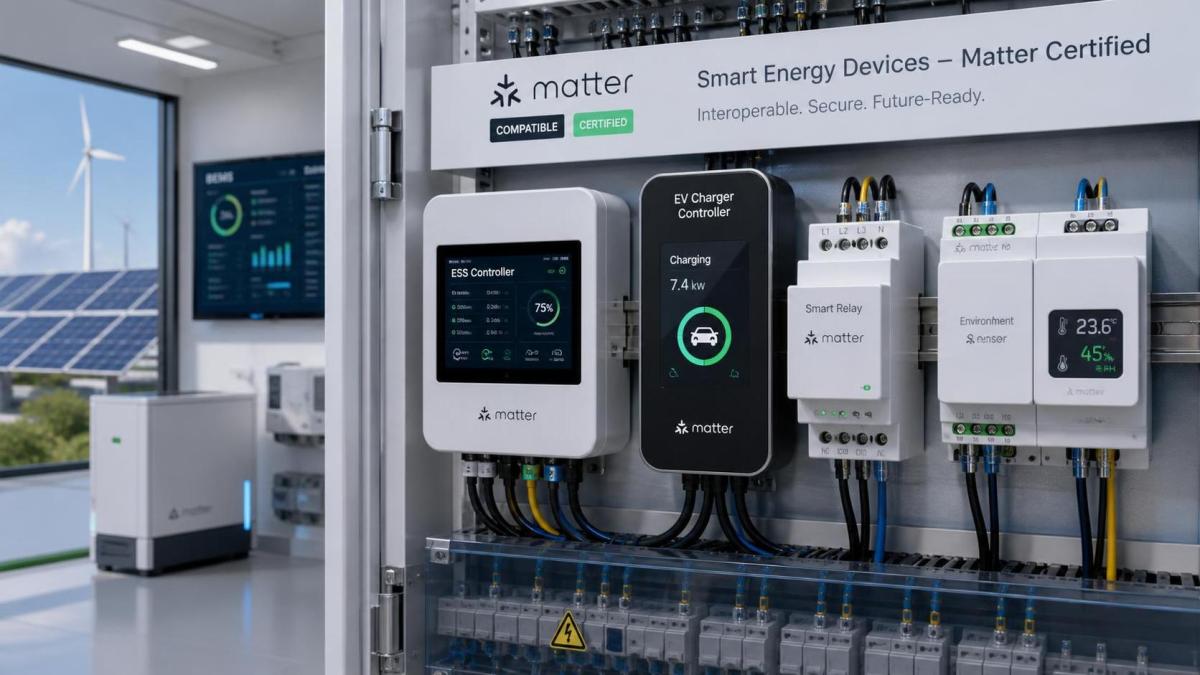
For energy-related devices, this becomes especially relevant when the product is expected to work inside larger automation logic. A smart relay used for load shedding, for example, may look simple at the endpoint level. But if its reported state, timing behavior, or recovery logic diverges from the Matter model, downstream control systems can behave unpredictably.
The first decision: is your product category and feature set aligned with Matter scope?
Not every connected energy or infrastructure device is equally ready for Matter certification. Before allocating engineering effort, manufacturers need to confirm whether the product’s intended function maps cleanly to a defined Matter device type and cluster model. This is often where timelines slip.
A common mistake is to treat Matter as a wrapper that can simply sit on top of proprietary logic. In reality, certification favors products whose exposed data model and behavior fit the standard cleanly. If the device relies heavily on vendor-specific semantics, undocumented control states, or custom telemetry structures, the implementation burden increases.
Technical evaluators should examine three questions early:
- Does the product fit an existing Matter device type without awkward abstraction?
- Are the mandatory clusters and attributes technically feasible within the current firmware and hardware architecture?
- Will the Matter interface expose enough function for the target use case without relying excessively on proprietary extensions?
This is particularly relevant in renewable energy adjacencies. Devices such as smart plugs, thermostats, blinds, sensors, and certain control interfaces map relatively well. More specialized assets—such as inverters, battery management gateways, or advanced demand response controllers—may face scope limitations depending on current specification support. In such cases, “Matter-ready” may be commercially attractive language, but certification feasibility depends on what the standard actually covers today.
Passing starts with the data model, not the radio
Many teams focus first on transport selection: Wi-Fi, Ethernet, or Thread. That matters, but certification failures frequently begin higher in the stack. The data model must be correct before network performance becomes meaningful.
In practice, this means the device descriptor, endpoint structure, cluster implementation, attribute access rules, event behavior, and state transitions all need to align with specification expectations. If the product exposes a function as on/off control but internally operates through delayed, conditional, or multi-stage state logic, that mismatch must be carefully handled. Otherwise, test scripts may catch inconsistent reporting or command response behavior.
For technical evaluators, one of the most useful pre-certification exercises is a clause-by-clause implementation matrix. Map every claimed feature to:
- Relevant Matter device type requirements
- Mandatory clusters and attributes
- Optional clusters that are being declared
- Known deviations, limitations, or vendor-specific handling
- Expected user-visible behavior under normal and fault conditions
This exercise exposes gaps long before formal lab testing. It also prevents a recurring industry problem: products shipping with broad ecosystem claims while the engineering team has only validated a small subset of real command paths.
Commissioning and security are frequent failure points
Matter’s onboarding model is one of its strongest value propositions, but it is also an area where device makers run into avoidable failures. Device attestation credentials, onboarding payload generation, QR code data, commissioning flow handling, and operational certificate management all need to be correct.
A technical evaluator should not assume that passing internal pairing tests with one controller proves certification readiness. Matter certification is intended to confirm standards-based interoperability, not controller-specific tuning. Problems often appear when devices are tested against different commissioners, fabrics, or reset/rejoin scenarios.
Security-related issues deserve even more scrutiny. Manufacturers need to verify:
- Correct provisioning and management of device attestation credentials
- Secure key storage appropriate to the hardware platform
- Reliable factory reset behavior without residual trust artifacts
- Certificate chain validity and process control in manufacturing
- Alignment between firmware update strategy and post-certification compliance obligations
In connected energy infrastructure, insecure implementation is not just a certification concern. It becomes an operational risk when devices influence loads, occupancy-driven automation, or environmental control.
Interoperability testing should reflect deployment reality, not only conformance scripts
Formal certification confirms compliance, but buyers and technical reviewers increasingly expect evidence that the device behaves well in practical ecosystems. A manufacturer that prepares only for scripted lab tests may still face rejection during customer validation.
That is why serious pre-certification programs combine conformance readiness with scenario testing. For example:
- Repeated commissioning and decommissioning cycles
- Multi-admin behavior across different ecosystems
- Attribute reporting stability under intermittent connectivity
- Recovery after power interruption
- Thread border router changes where relevant
- Latency variation during network congestion
- Firmware update behavior without breaking fabric state
For renewable energy and smart building applications, power events matter more than they do in typical consumer deployments. Brownouts, relay switching noise, edge gateway reboots, and temporary backhaul disruptions are common field conditions. A certifiable device that becomes unreliable during these events may still be a poor procurement choice.
That is why technical evaluators should treat Matter certification as necessary but not sufficient. It proves standards alignment, not total field resilience.
Thread, Wi-Fi, and power design choices influence certification readiness
Although Matter is application-layer focused, the underlying transport and hardware design still shape test outcomes. Devices using Thread must demonstrate stable participation in a mesh environment and predictable interaction with border routers. Devices using Wi-Fi face different concerns, such as onboarding reliability, reconnection behavior, and standby power implications.
Energy-conscious products face a balancing act here. Battery-powered sensors or controllers may satisfy functional requirements in short certification sessions but struggle with real power budgets once reporting frequency, secure sessions, and network maintenance overhead are considered. Conversely, mains-powered devices used in energy automation may pass radio tests but create thermal or standby consumption penalties that undermine their market fit.
For manufacturers, it is worth validating:
- Sleep and wake behavior against reporting obligations
- Connection persistence under realistic signal conditions
- Memory headroom for certification builds and future updates
- Processing overhead from cryptographic operations
- Impact of diagnostic logging on performance and power draw
These are not side issues. They often determine whether a product remains certifiable after feature expansion or cost-down redesign.
Documentation discipline is part of the technical work
One reason certification projects stall is that engineering readiness and documentation readiness do not progress at the same pace. Test labs and certification processes depend on precise product declarations: supported device types, cluster lists, firmware versions, transport options, onboarding methods, and implementation constraints.
Inconsistent documentation creates two risks. The obvious one is procedural delay. The less obvious one is architectural confusion inside the product team, where support, firmware, QA, and compliance functions may each be working from different assumptions about what the product actually claims.
Strong device makers prepare a controlled certification package that includes:
- Feature declaration tied to exact firmware build
- Traceable bill of materials where security or radio components are relevant
- Test evidence from internal pre-validation
- Known limitations and unsupported scenarios
- Manufacturing controls for credentials and provisioning
- Post-certification change management rules
For OEM and ODM supply chains, this is even more important. A product that passes once can fall out of compliance if the radio module, secure element, firmware branch, or provisioning workflow changes without adequate review.
What technical evaluators should look for when assessing a certified or certification-bound device
For buyers, integrators, and engineering reviewers, the right question is not simply “Is it certified?” It is “What exactly has been certified, and how stable is that certification basis?”
When reviewing a device, look beyond the badge and verify:
- The exact product variant and firmware version covered
- The declared Matter device type and supported functions
- Whether interoperability has been tested across target ecosystems, not just one app environment
- How the vendor handles firmware updates that may affect compliance
- Whether manufacturing-scale credential provisioning is controlled and auditable
- How the device behaves during power loss, network loss, and recommissioning
This matters in global sourcing. Some suppliers are strong at producing a demo-ready reference implementation but weak in lifecycle control. Others may be slower to market but far more reliable in maintaining certifiable consistency across batches and software revisions. For technical procurement, the second profile is usually the safer long-term choice.
The strategic takeaway for device makers
Matter compatibility certification is gradually becoming a market access filter for connected devices that need trust across ecosystems. In renewable energy and intelligent infrastructure, that trust is not created by feature lists. It is earned through repeatable protocol behavior, sound security implementation, and disciplined product change control.
Manufacturers that approach certification as a final checkbox often discover expensive late-stage issues: data model mismatches, unstable commissioning, undocumented deviations, or hardware constraints that only appear under realistic test conditions. Those that treat certification as an architectural requirement from the beginning usually move faster and with fewer field problems.
For technical evaluators, the most useful lens is simple: a certifiable Matter device is not just one that can pass a lab sequence once. It is one whose hardware, firmware, provisioning process, and update strategy remain aligned with the standard as the product scales. That is the threshold that turns certification from a marketing claim into real infrastructure confidence.
Protocol_Architect
Dr. Thorne is a leading architect in IoT mesh protocols with 15+ years at NexusHome Intelligence. His research specializes in high-availability systems and sub-GHz propagation modeling.
Related Recommendations
- Dr. Aris ThorneHow to Build a Voice-Enabled Smart Home Ecosystem That Works Across Brands
- Dr. Aris ThorneHow to Choose a Jewelry Pliers Set for Precision Wirework and Small Repairs
- Dr. Aris ThorneSupplier Capability Criteria for Renewable Energy Projects: A Procurement Checklist
- Dr. Aris ThorneCustom Printed Lanyards for Renewable Energy Sites: What Buyers Should Specify
- Dr. Aris ThorneSmart Home Protocol Analysis: How to Compare Matter, Zigbee, and Wi-Fi for Device Interoperability
- Dr. Aris ThorneMatter 1.4 Released as EU CE Rules Add Mandatory Thread/Zigbee Interoperability Tests
- Dr. Aris ThorneNorth America Property Technology: Market Opportunities, Adoption Drivers, and Key Challenges
- Dr. Aris Thorne7075 vs 6061 Aluminum in Europe: Which Alloy Fits Renewable Energy Structures?
- Dr. Aris ThorneMatter Compatibility Certification: What Device Makers Need to Pass Testing
- Dr. Aris ThorneEU EN 303 647 v2.1.1 Makes New EMC Tests Mandatory
Analyst