
How Should You Compare Thread Latency Results from Different Labs?
author
How Should You Compare Thread Latency Results from Different Labs?
How do I compare Thread protocol latency results from different labs? Start by checking whether they measured the same communication path under comparable conditions—not simply which report lists the lowest milliseconds. Mesh topology, firmware, interference, and sleepy-device behavior can change the result enough to reverse an apparent ranking.
For renewable energy monitoring and building demand-response systems, the useful question is more specific: will the selected hardware deliver a measurement or command within your operating deadline, reliably, at an acceptable power cost? A clean laboratory result can help answer that question, but only when its boundaries are visible.
Define what the stopwatch actually measures
“Thread latency” is not a complete measurement definition. Thread provides an IPv6-based mesh network over IEEE 802.15.4; Matter is an application-layer technology that can use that network. A Thread packet round trip and a Matter command response therefore measure different things.
One lab might time an ICMPv6 echo request and reply between two devices. Another might measure from a controller issuing a Matter command to receiving its response. A third might stop the clock only when a relay contact physically changes. All three can be useful, but they cannot share a leaderboard without qualification.
Before comparing results, write a one-sentence definition for each: “From event X at location A to event Y at location B, including components Z.” If the reports do not allow that sentence to be completed, request the missing method before judging the hardware.
Draw the path before comparing the numbers
A controller communicating directly within a Thread mesh is not equivalent to a controller on Ethernet reaching a Thread device through a border router. The latter path includes additional interfaces, queues, and processing. If a mobile app or cloud service is involved, those delays also need to be identified rather than attributed to Thread.
Request a topology drawing showing the controller, border routers, routers, end devices, and observed forwarding path. Record hop count in each direction where possible. Physical separation alone proves little: a nearby device can select an indirect path, while a carefully arranged bench can maintain a favorable direct link.
Also distinguish configured topology from observed topology. A test intended to exercise several mesh hops is unconvincing if no trace or routing evidence confirms that traffic used them. Routes can change during a run, particularly under disturbance.
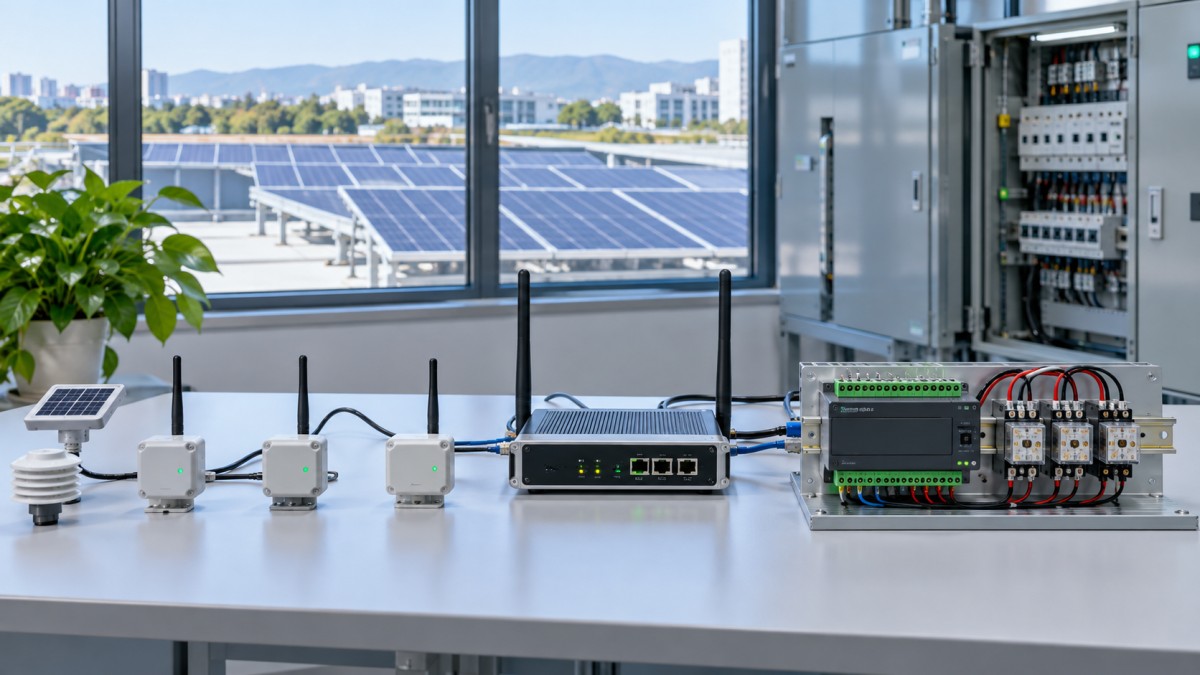
For a solar-equipped commercial building, this distinction matters. A plant-room energy monitor behind metal equipment and a controller in an office network may face a very different path from two development boards on an open bench. The bench result remains useful as a baseline—not as a building-wide performance guarantee.
Build a comparison sheet around the variables that change behavior
Ask both labs for the hardware revision, radio chipset, antenna arrangement, transmit-power configuration, Thread stack version, application firmware, and border-router software. Where Matter is involved, record its implementation version too. “Same product” is insufficient if firmware or power settings differ.
Then align the workload. Payload size, message frequency, device count, and traffic direction affect queueing and radio use. Confirm whether commands are unicast or multicast, whether they require application responses, and whether retries are included in the elapsed time. A small ping cannot stand in for every application transaction.
- Radio environment: Record the Thread channel, nearby Wi-Fi activity, interference conditions, and any shielding or attenuation.
- Network loading: Separate idle-network testing from background telemetry and simultaneous command bursts.
- Connection state: Identify established-session tests separately from session setup, attachment, or recovery.
- Instrumentation: Record timestamp locations, clock accuracy, logging overhead, and whether packet capture was used.
“Office environment” is not a reproducible interference specification. Neither is “heavy traffic” without traffic rates and patterns. When exact replication is impractical, document the mismatch and narrow the conclusion. Do not subtract an estimated interference penalty to manufacture a supposedly normalized score.
Treat sleepy-device timing as a design choice, not a defect
Battery-operated Thread devices may spend much of their time with the radio asleep. Downlink delivery can depend on when the device checks with its parent, with behavior varying by device type and supported features. That waiting time can dominate an otherwise short exchange.
Compare device role, polling configuration, active periods, and any supported synchronized sleepy-device operation. Do not assume every Thread device implements the same sleep behavior. For Matter devices, check whether intermittently connected device behavior introduces additional availability constraints.
Message direction is especially important. A battery sensor waking to send a measurement may show prompt uplink delivery while responding much more slowly to an unsolicited downlink command. Combining those results into one average conceals the operating trade-off.
In renewable energy installations, a low-maintenance temperature sensor and a mains-powered load controller have different priorities. Faster polling may improve responsiveness while increasing energy consumption. Ask for latency and power measurements under the same configuration; quoting the best result from separate operating modes creates an unrealistic specification.
Read the distribution together with failures
An average answers only part of the question. Request the median, relevant upper percentiles such as p95 and p99, sample count, run duration, and repeated-run results. Percentiles describe the measured distribution; they do not guarantee a deadline for future traffic.
The most important clarification is often whether failed transactions disappeared from the calculation. A report can look fast because it includes only successful replies. Require the number of attempted transactions, successes, timeouts, retries, and late completions, with the timeout threshold stated explicitly.
For control applications, a useful project metric is the proportion of all issued commands that complete before the required deadline. Keep that beside successful-response latency rather than replacing one with the other. It makes a missed command visible instead of allowing it to improve the latency average.
Be cautious with p99 values derived from short runs: very few observations may determine the tail. Request raw transaction timestamps or an exportable distribution when the purchasing decision depends on rare delays. Repeated independent runs also reveal variability hidden by one favorable session.
For one-way measurements across separate devices, check clock synchronization and its uncertainty. A precisely displayed millisecond value is not necessarily an accurately measured one. Round-trip timing avoids cross-device clock synchronization, but still includes processing at the responder.
Translate the benchmark into an energy-system requirement
A demand-response command, an HVAC adjustment, and a photovoltaic dashboard update should not inherit the same acceptance threshold. Set the deadline from the function being performed, including gateway processing, application decisions, and actuator response—not from the fastest number a supplier publishes.
For monitoring, data age may matter more than packet transit time. A measurement buffered before transmission can arrive with low network latency yet already be too old for the intended decision. Request sampling-to-use timing when freshness is the actual requirement.
For coordinated load changes, test the expected burst pattern. Sequential commands to one endpoint do not demonstrate how a populated network behaves when many controllers or devices communicate together. Likewise, steady-state results do not establish recovery performance after a router disappears or a border router restarts.
Do not use ordinary Thread latency benchmarks to justify protection-critical functions such as inverter protection or emergency shutdown. Those require a separate system-level safety and compliance assessment; a favorable latency percentile is not evidence of deterministic delivery.
Decide whether to compare, qualify, or retest
Direct comparison is reasonable when measurement endpoints, workloads, device behavior, topology, and reporting rules align closely. When differences are documented but material, use the reports as separate scenario evidence. When the communication path or failure accounting is unknown, do not rank the products.
This follows NexusHome Intelligence’s data-driven approach: replace broad interoperability claims with inspectable methods and evidence. A certification claim can support a compatibility discussion, but it does not establish performance in your particular radio environment or energy-control workflow.
If the decision remains uncertain, commission a shared retest specification. Define the transaction, physical setup, firmware, sleep settings, interference profile, workload, deadline, timeout handling, and required raw output before testing begins. Include both a controlled baseline and a representative deployment condition. Choose on demonstrated performance against that specification—not on which laboratory produced the smallest isolated number.
Protocol_Architect
Dr. Thorne is a leading architect in IoT mesh protocols with 15+ years at NexusHome Intelligence. His research specializes in high-availability systems and sub-GHz propagation modeling.
Related Recommendations
- Dr. Aris ThorneRobotic Polishing for Aerospace Parts: Controlling Surface Finish and Accuracy
- Dr. Aris ThorneST Launches MatterConnect to Simplify Smart Home Device Credential Provisioning
- Dr. Aris ThorneRobot Arm Ingress Testing: Verifying IP Ratings for Solar Cleaning
- Dr. Aris ThorneUgreen Delays HomeAgent Again to Refine Matter Support and Local AI
- Dr. Aris ThorneMatter 1.6.1 Reaches First Platforms as Open-Source SDK Adds Full Support
- Dr. Aris ThorneHow Should You Compare Thread Latency Results from Different Labs?
- Dr. Aris ThorneHow Can You Test Thread Border Router Failover Before Deployment?
- Dr. Aris ThorneHow to verify Matter certification for solar-aware smart plugs
- Dr. Aris ThorneHow to Build a Voice-Enabled Smart Home Ecosystem That Works Across Brands
- Dr. Aris ThorneHow to Choose a Jewelry Pliers Set for Precision Wirework and Small Repairs
Analyst