
GSHE 2026 Opens With Matter/Zigbee Sourcing Track
author
On June 24, 2026, the 12th Shenzhen International Smart Home Exhibition (GSHE 2026) opens a new point of focus for the smart home supply chain: a dedicated Matter & Zigbee dual-certified zone paired with a B2B sourcing channel. For manufacturers in PCBA solutions, smart lighting, and HVAC automation, as well as overseas buyers and supply-chain service providers, the development is worth watching because it links protocol certification more directly with procurement access and technical screening.
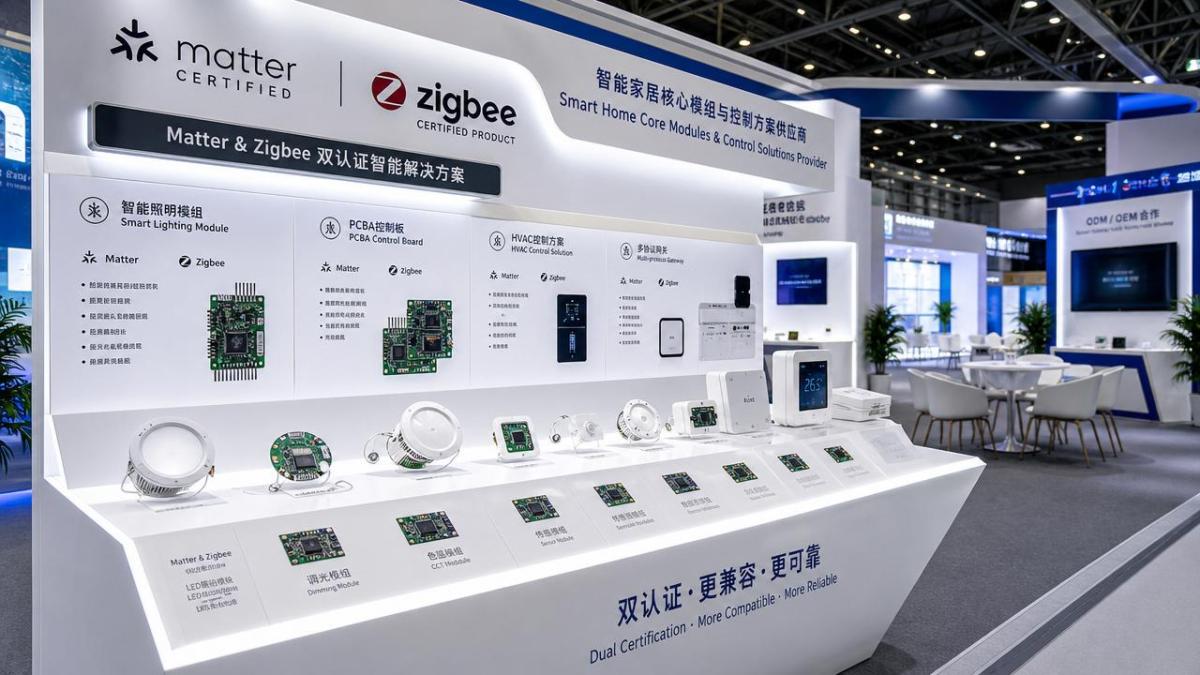
What GSHE 2026 Is Confirmed to Launch
According to the provided event information, GSHE 2026 takes place from June 24 to 26 at the Shenzhen Convention and Exhibition Center. This edition will, for the first time, introduce a Matter & Zigbee Dual-Certified Zone.
The zone is organized in cooperation with CSA, the Zigbee Alliance, and TÜV Rheinland. It is intended for Chinese suppliers in PCBA solutions, smart lighting, and HVAC automation that have obtained dual certification under Matter 1.3 and Zigbee 3.0.
The event also includes a B2B procurement matching system. After overseas buyers submit sourcing requirements, the platform is set to provide, within 48 hours, a whitelist of certified Chinese suppliers together with tested data packages covering latency, throughput, and power-consumption curves.
Where the Impact May Be Felt First
Certified manufacturers gain a more visible procurement entry point
From an industry perspective, the most immediate impact may be on manufacturers already holding both Matter 1.3 and Zigbee 3.0 certification. The reason is straightforward: the exhibition format does not only showcase products, but also connects certification status with buyer-facing visibility and structured matching. The business effect, if it materializes, is most likely to appear in lead generation, technical pre-screening, and buyer qualification stages.
What deserves closer attention is whether dual certification becomes a stronger filter in initial supplier selection, especially for vendors in PCBA solutions, smart lighting, and HVAC automation that want to shorten overseas customer evaluation cycles.
Overseas buyers receive a more standardized comparison process
For procurement teams, the new matching channel may affect how supplier discovery and technical comparison are handled. Analysis shows that the inclusion of tested data packages, such as latency, throughput, and power-consumption curves, could shift early discussions away from broad capability claims and toward more comparable technical evidence.
The key business link here is not only supplier outreach, but also pre-qualification efficiency. Buyers should watch how consistently the whitelist and data package format support cross-vendor comparison in actual sourcing workflows.
Service providers may need to adapt around documentation and coordination
Supply-chain and trade service providers may also be affected, because a procurement path tied to certification and test data usually increases the importance of document readiness, specification alignment, and communication accuracy. Observably, if buyers begin with whitelist-based screening, supporting firms may need to respond faster on materials related to certification scope, technical records, and delivery coordination.
What Companies Should Track Now
Pay close attention to the exact operating rules of the matching system
Companies should focus on how sourcing requests are collected, how the whitelist is filtered, and how the 48-hour response process is implemented in practice. The event summary confirms the mechanism exists, but actual participation requirements, data presentation details, and matching criteria remain the points businesses will need to verify through official event-side communication.
Prepare technical materials that match buyer review logic
Because the platform is described as providing tested data packages including latency, throughput, and power-consumption curves, suppliers should pay particular attention to whether their technical materials are complete, consistent, and ready for buyer review. In practical terms, this concerns communication quality at the pre-sales stage rather than general brand exposure.
Check whether certification status aligns with target product categories
For firms in PCBA solutions, smart lighting, and HVAC automation, an important practical issue is whether current certified products align with the categories and project needs likely to appear in overseas demand submissions. Analysis shows that having certification and having category-fit are related but not identical matters in procurement conversion.
Separate exhibition visibility from immediate order certainty
What deserves closer attention is the difference between a new sourcing channel and confirmed transaction outcomes. Companies should avoid treating exhibition inclusion or whitelist access as a guaranteed commercial result, and instead prepare for follow-up work in quotation, technical clarification, fulfillment timing, and customer communication.
Why This Looks More Like a Procurement Signal Than a Finished Market Shift
Observably, this development can be read as a signal that protocol compliance, testing transparency, and buyer matching are being placed closer together in one exhibition setting. That is meaningful for the smart home ecosystem because it moves certification from a background credential toward a more visible procurement reference point.
At the same time, it is more appropriate to understand this as an industry signal rather than a confirmed market outcome. The provided information confirms the zone, the participating institutional cooperation, the eligible supplier categories, and the matching mechanism, but it does not by itself prove how many transactions, partnerships, or sourcing conversions will follow.
For that reason, the industry still needs to observe execution details, buyer participation quality, and whether the technical data package becomes a recurring requirement in future sourcing conversations.
How the Industry May Best Read This Development
In practical terms, GSHE 2026 is introducing a more structured link between dual-protocol certification and procurement access. For manufacturers, buyers, and service providers, the main significance lies in how certification, test evidence, and supplier discovery are being brought into the same workflow.
A neutral reading is that this is a short-term operational change at the exhibition level with potential longer-term signaling value for supplier selection standards. It should not yet be overstated as a completed shift in market structure, but it clearly deserves continued attention from businesses involved in smart home sourcing, technical validation, and overseas customer development.
Basis of This Article and What Still Needs Verification
This article is generated based on the user-provided news title, event date, and event summary. The confirmed information used here is limited to the announced timing of GSHE 2026, the launch of the Matter & Zigbee Dual-Certified Zone, the named cooperating organizations, the eligible supplier categories, and the described B2B procurement matching process.
For this type of industry update, commonly relevant source categories would include official exhibition announcements, company notices, industry association information, authoritative media reports, and standard-organization documents. A specific official source link was not provided in the input, so further verification is still needed. Follow-up attention should focus on any official clarification regarding participation rules, whitelist criteria, and the practical operation of the 48-hour matching process.
Protocol_Architect
Dr. Thorne is a leading architect in IoT mesh protocols with 15+ years at NexusHome Intelligence. His research specializes in high-availability systems and sub-GHz propagation modeling.
Related Recommendations
- Dr. Aris ThorneUgreen Delays HomeAgent Again to Refine Matter Support and Local AI
- Dr. Aris ThorneMatter 1.6.1 Reaches First Platforms as Open-Source SDK Adds Full Support
- Dr. Aris ThorneHow to Build a Voice-Enabled Smart Home Ecosystem That Works Across Brands
- Dr. Aris ThorneHow to Choose a Jewelry Pliers Set for Precision Wirework and Small Repairs
- Dr. Aris ThorneSupplier Capability Criteria for Renewable Energy Projects: A Procurement Checklist
- Dr. Aris ThorneCustom Printed Lanyards for Renewable Energy Sites: What Buyers Should Specify
- Dr. Aris ThorneSmart Home Protocol Analysis: How to Compare Matter, Zigbee, and Wi-Fi for Device Interoperability
- Dr. Aris ThorneMatter 1.4 Released as EU CE Rules Add Mandatory Thread/Zigbee Interoperability Tests
- Dr. Aris ThorneNorth America Property Technology: Market Opportunities, Adoption Drivers, and Key Challenges
- Dr. Aris Thorne7075 vs 6061 Aluminum in Europe: Which Alloy Fits Renewable Energy Structures?
Analyst