
Commercial Drone Payload Capacity Benchmarks That Mislead Buyers
author
For technical evaluators in renewable energy operations, a commercial drone payload capacity benchmark can be more misleading than useful when stripped of flight time, wind tolerance, sensor weight, and mission context. This article examines how inflated payload claims distort procurement decisions and why data-driven testing matters more than headline specs when selecting drones for inspection, mapping, and infrastructure monitoring.
Why a checklist-based review is the safest way to judge payload claims
In renewable energy, drones are not bought for abstract lifting performance. They are bought to inspect wind blades, map solar farms, monitor substations, assess transmission corridors, and collect reliable data under time pressure. That is why a commercial drone payload capacity benchmark, taken alone, often creates a false sense of technical fit. A drone may lift a quoted payload for a short hover in calm air, yet fail the actual mission once a thermal camera, RTK module, protective mount, and higher wind load are added.
For technical evaluators, the better method is a structured review that connects payload to endurance, stability, sensing accuracy, environmental tolerance, and operating economics. This is especially important in renewable energy, where assets are geographically distributed, weather exposed, and often expensive to revisit. A checklist reduces the risk of selecting aircraft based on brochure language instead of measurable field performance.
First-pass checklist: what to confirm before comparing any benchmark
Before accepting any commercial drone payload capacity benchmark, technical teams should validate the test conditions behind the number. The fastest way to filter weak claims is to ask the following questions first.
- Was the payload measured in hover only, or in a full mission profile that includes climb, cruise, orbit, and return?
- What was the usable flight time at that payload, not just the maximum takeoff capacity?
- Which battery condition was used: fresh cells, nominal temperature, and what reserve percentage remained at landing?
- Was wind speed disclosed, and did the aircraft maintain stable sensor data quality under gusts?
- Did the benchmark include gimbal, wiring, mounting brackets, and data links, or sensor mass only?
- How did payload affect positioning accuracy, vibration levels, and image sharpness?
- Was the benchmark performed at sea level, or adjusted for altitude and high-temperature sites common in utility-scale installations?
If a vendor cannot answer these points clearly, the commercial drone payload capacity benchmark is not a decision-grade input. It is only a marketing data point.
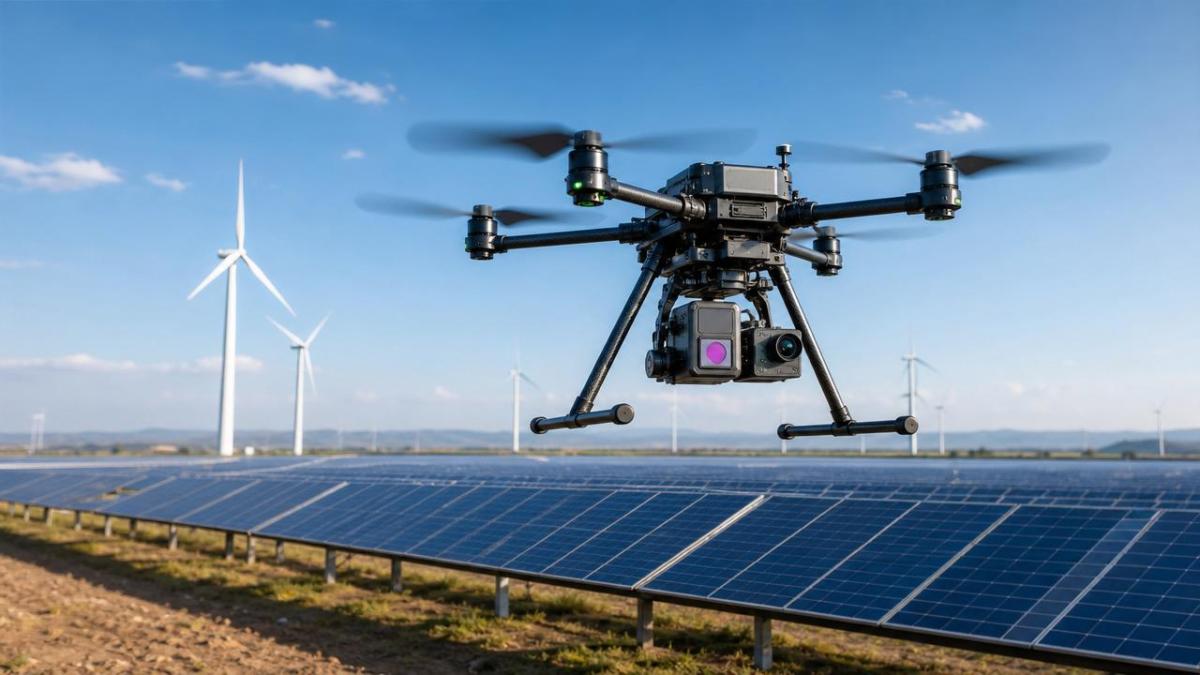
Core evaluation standard: pair payload with the metrics that actually decide mission success
A useful commercial drone payload capacity benchmark should never be read in isolation. In renewable energy operations, it must be interpreted together with five linked performance dimensions.
1. Payload-to-endurance ratio
A drone that lifts more but loses 40% of its flight time may be less productive than a smaller platform with a balanced payload profile. For solar farm thermography or wind turbine inspection, endurance directly affects route completion, battery swaps, crew size, and total inspection hours. Ask for endurance at 25%, 50%, 75%, and 100% of claimed payload capacity.
2. Payload-to-data-quality ratio
Heavier payloads can increase vibration, reduce gimbal response, and degrade image or LiDAR accuracy. For renewable energy, low-quality data means repeat flights, uncertain defect classification, and weaker maintenance planning. Benchmarking must include image blur rates, thermal calibration stability, point-cloud consistency, and georeferencing accuracy under payload load.
3. Payload under wind and turbulence
Wind farms, substations, and open-field solar assets rarely offer calm conditions. A commercial drone payload capacity benchmark without wind data is often misleading because the true limit in field operations is not lift alone, but controllability and measurement stability. Payload performance should be tested in crosswinds and gusts representative of the asset environment.
4. Payload and energy efficiency
Extra kilograms increase power draw and battery cycling stress. For teams managing frequent inspections across large renewable portfolios, battery replacement costs and charging logistics matter. Technical evaluators should compare watt-hours consumed per mission kilometer or per inspected megawatt of installed capacity.
5. Payload and regulatory envelope
A benchmark may be technically valid yet commercially unusable if the loaded aircraft crosses local operating thresholds, such as weight classes, waiver requirements, or pilot credential rules. Payload capacity must be checked against the legal framework in each target market.
A practical comparison table for technical evaluators
Use the table below to judge whether a commercial drone payload capacity benchmark supports a real procurement decision or merely advertises a peak number.
Scenario-specific checks for renewable energy missions
Wind turbine inspection
Here, payload is usually secondary to gust resistance, close-structure control, and optical stability. A vendor may promote a strong commercial drone payload capacity benchmark, but if the aircraft struggles in turbulent air near blade surfaces, the practical value is low. Prioritize hover precision, obstacle sensing behavior, and image clarity at standoff distance.
Solar farm thermography
Thermal surveys depend on flight duration, consistent overlap, and calibrated sensing. If heavier payload reduces endurance too sharply, operators may need more sorties and create inconsistent thermal windows across the site. In this case, the best commercial drone payload capacity benchmark is the one that preserves mission continuity, not maximum lift.
Transmission and substation monitoring
These missions often combine zoom optics, thermal payloads, and positional precision. Technical evaluators should assess electromagnetic resilience, control-link stability, and sensor switching performance. A payload benchmark that ignores RF congestion or metal-rich environments can mislead buyers into underestimating field complexity.
Topographic mapping for project development
For pre-construction renewable projects, LiDAR or multispectral payloads can be useful, but weight quickly affects route efficiency. Here the benchmark should include ground sample distance, strip overlap reliability, and processing-grade data output. Maximum payload means little if the final dataset requires correction or recollection.
Common buyer mistakes that make payload benchmarks look better than they are
- Comparing payload numbers across vendors without checking battery reserve assumptions.
- Using bare sensor weight instead of integrated payload weight.
- Ignoring altitude and ambient temperature, especially for mountainous wind sites or high-heat solar regions.
- Treating hover time as equivalent to productive mission time.
- Failing to connect payload with downstream data usability, which is the true business output.
- Selecting oversized platforms that raise compliance burden and operating cost without improving inspection results.
Execution guide: how to run a decision-grade benchmark
If your organization is preparing a drone shortlist, convert the commercial drone payload capacity benchmark into a standard test protocol. This keeps all suppliers accountable to the same evidence threshold and aligns technical review with operational reality.
- Define the exact mission type: blade inspection, thermal scan, corridor patrol, or mapping.
- Document the full payload stack including mounts, batteries, comms, and protective accessories.
- Set minimum acceptable outputs such as image sharpness, thermal accuracy, or point-cloud density.
- Test under representative wind, temperature, and altitude conditions.
- Measure endurance, control stability, and data quality at multiple payload levels.
- Calculate cost per completed mission, not cost per aircraft alone.
- Record failure modes, maintenance demand, and battery degradation over repeated cycles.
Why data-driven verification matters more than brochure language
This is where the evaluation philosophy used by data-driven technical organizations such as NexusHome Intelligence becomes highly relevant. In complex hardware categories, marketing terms rarely solve engineering uncertainty. Benchmarking should expose real latency, endurance loss, power draw, and environmental failure points instead of repeating vague promises. Although NHI is rooted in connected hardware verification, the same principle applies directly to drone procurement in renewable energy: trust measured performance, not polished claims.
A credible commercial drone payload capacity benchmark should therefore function as part of a larger technical evidence package. It should tell evaluators how the platform behaves under stress, what trade-offs appear when sensors are added, and whether mission outputs remain decision-grade when weather and site conditions become less than ideal.
FAQ for technical evaluators
Is a higher payload benchmark always better for renewable energy inspections?
No. In many cases, the better aircraft is the one that carries the required sensor package with stable data quality and sufficient endurance. The highest commercial drone payload capacity benchmark may belong to a platform that is heavier, less efficient, or harder to deploy.
What is the most overlooked factor when comparing payload capacity?
Integrated payload mass and wind performance. Buyers often compare sensor weights without accounting for all mounting hardware, then discover the field configuration performs far worse than expected.
Should payload benchmarks be tested for each mission type?
Yes. A commercial drone payload capacity benchmark relevant to thermography may not predict performance for LiDAR mapping or close-proximity turbine inspections. Mission context changes the acceptable trade-off between lift, endurance, and stability.
Final decision checklist and next-step questions
Before moving to procurement, confirm that the chosen commercial drone payload capacity benchmark is supported by mission-level evidence. At minimum, your team should have verified loaded endurance, site-condition tolerance, data-quality retention, regulatory fit, and life-cycle operating cost. If any of these remain unclear, the benchmark is not yet decision ready.
If you need to move the evaluation forward, prioritize discussions around the exact payload stack, target renewable asset type, acceptable weather envelope, required data outputs, maintenance intervals, battery replacement assumptions, software compatibility, project timeline, and budget range. Those are the questions that turn a headline number into a reliable deployment decision.
Protocol_Architect
Dr. Thorne is a leading architect in IoT mesh protocols with 15+ years at NexusHome Intelligence. His research specializes in high-availability systems and sub-GHz propagation modeling.
Related Recommendations
- Dr. Sophia Carter (Medical IoT Specialist)How to Read a Commercial Drone Payload Capacity Benchmark
- Dr. Sophia Carter (Medical IoT Specialist)Commercial Drone Payload Capacity Benchmarks That Mislead Buyers
- Dr. Sophia Carter (Medical IoT Specialist)How to use a drone payload benchmark before fleet expansion
- Dr. Sophia Carter (Medical IoT Specialist)Commercial drone payload capacity benchmark by use case
- Dr. Sophia Carter (Medical IoT Specialist)AR Hardware Benchmarks That Expose Real Limits
- Dr. Sophia Carter (Medical IoT Specialist)Why smart glasses testing often misses comfort issues
- Dr. Sophia Carter (Medical IoT Specialist)AR hardware benchmarks that actually help decisions
- Dr. Sophia Carter (Medical IoT Specialist)What smart glasses buyers should ask about sensors
- Dr. Sophia Carter (Medical IoT Specialist)Radar sensor for traffic monitoring — how Doppler ambiguity skews vehicle count during rush hour
- Dr. Sophia Carter (Medical IoT Specialist)Smart Glasses & AR Devices: What IoT Hardware Benchmarking Reveals About Real-Time Matter Latency
Analyst