
Machine vision for defect detection on reflective metal surfaces
author
For renewable energy manufacturers, machine vision for defect detection on reflective metal surfaces is becoming essential to improve yield, traceability, and operational reliability. By combining machine vision for defect detection, sensor fusion lidar and camera, and edge ai for smart manufacturing, teams can inspect glare-prone parts with greater accuracy, reduce false rejects, and build data-driven quality systems that support procurement, production, and long-term asset performance.
Why reflective metal inspection has become a quality bottleneck in renewable energy production
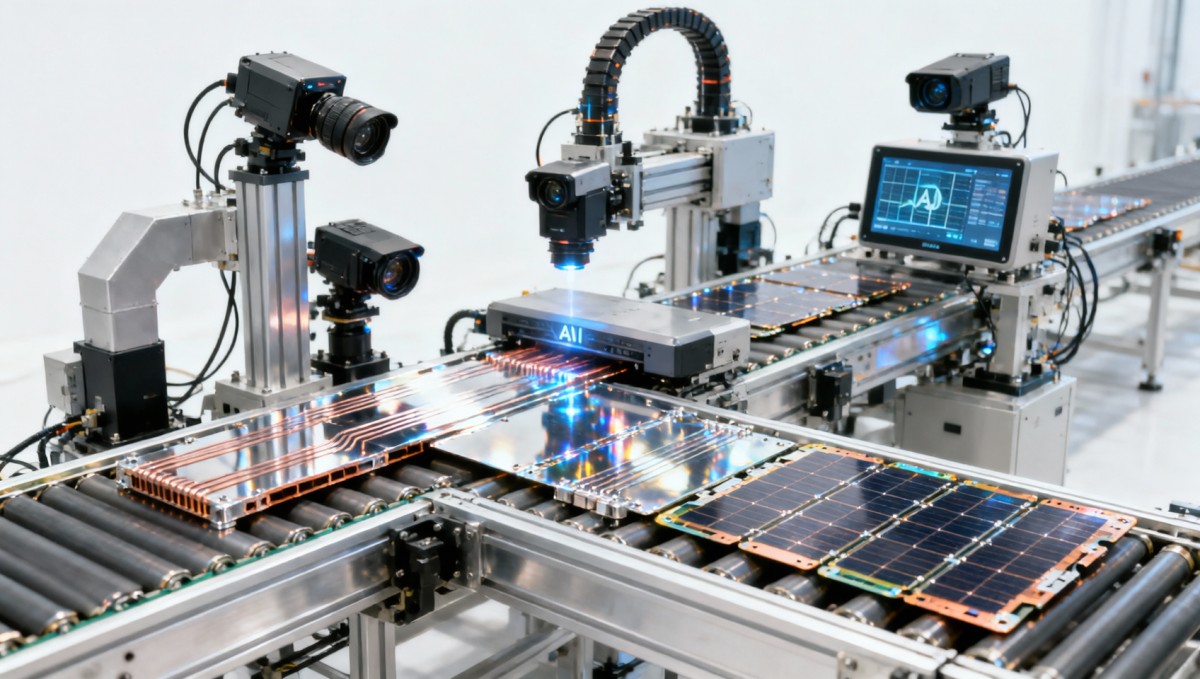
In renewable energy manufacturing, reflective metal surfaces are everywhere: battery tabs, busbars, inverter housings, aluminum frames, stainless brackets, heat sinks, and coated connector parts. These components often move at medium to high line speeds, while their mirror-like or semi-gloss finishes create unstable highlights, shadow bands, and low-contrast defect boundaries. For operators, that means difficult setup. For procurement teams, it means high uncertainty when comparing inspection systems. For decision-makers, it means hidden quality costs that may only appear after shipment or field deployment.
The challenge is not simply “seeing defects.” It is distinguishing true defects from optical artifacts in conditions that change every 2–8 hours across shifts, material lots, and ambient light conditions. Scratches, dents, micro-pits, coating voids, weld inconsistencies, and contamination marks may all appear differently depending on viewing angle and illumination geometry. A system that performs well on matte steel can fail on polished aluminum. This is why machine vision for defect detection on reflective metal surfaces requires a more disciplined engineering approach than standard surface inspection.
NexusHome Intelligence (NHI) approaches this problem from a data-first perspective. In fragmented industrial ecosystems, claims such as “high accuracy” or “AI-ready” are not enough. Renewable energy manufacturers need measurable verification across lighting repeatability, latency, edge processing stability, sensor interoperability, and defect classification consistency. That aligns with NHI’s broader mission: bridging ecosystems through data, not marketing language, and translating hardware capability into procurement-ready evidence.
For information researchers, the core question is usually technical feasibility. For users and line operators, the concern is whether the system can run continuously for 8–24 hours with manageable recalibration effort. For buyers, the concern is total lifecycle cost rather than camera price alone. For enterprise leaders, the priority is whether inspection data can support traceability, quality governance, and future smart factory integration across multiple plants.
What makes reflective surfaces harder than ordinary visual inspection?
Reflective parts behave like moving optical mirrors. Small changes in angle, part flatness, or lamp position can cause large changes in brightness. That creates three common failure modes: missed defects because glare hides them, false rejects because harmless reflections look like scratches, and unstable models because image features shift from batch to batch. In sectors such as solar module hardware or energy storage assembly, even a low false reject rate can slow output when throughput targets are tight.
- Specular reflection can saturate pixels, erasing useful texture and reducing defect contrast.
- Curved or stamped metal surfaces change reflection behavior across a single part, so one lighting angle rarely fits all areas.
- Surface treatments such as anodizing, brushing, plating, or coating can make normal variation look similar to actual defects.
- High-speed lines may leave inspection windows of less than 300–800 ms per part, limiting image capture options.
The practical implication is clear: a camera alone is rarely the full answer. Good results typically come from the combination of optics, multi-angle lighting, controlled fixturing, synchronized triggering, and increasingly, sensor fusion lidar and camera when height variation or geometric distortion affects the inspection result.
Which technical architecture works best for machine vision for defect detection?
A strong inspection architecture for reflective metal surfaces usually combines three layers: image acquisition, perception logic, and edge execution. Image acquisition includes cameras, lenses, filters, lighting, encoders, and triggers. Perception logic covers rule-based vision, deep learning classification, segmentation, and anomaly detection. Edge execution handles inference speed, storage, communication, and response to PLC or MES systems. In renewable energy plants, these layers must work together with minimal latency and high repeatability over long production cycles.
For many applications, edge ai for smart manufacturing is especially valuable because it reduces dependency on remote servers and allows sub-second pass/fail decisions close to the line. This matters when a reject gate, robot, or marking station must respond within 100–500 ms. Local processing also supports data governance and easier deployment in facilities where network segmentation, cybersecurity controls, or bandwidth limits make cloud-only inspection impractical.
Sensor fusion lidar and camera can further improve robustness. A 2D image may struggle to separate a reflection pattern from a true surface deformation. A depth-aware sensor can add geometric context, helping the model distinguish a shallow dent, warped edge, or raised burr from harmless brightness variation. In renewable energy components, where flatness, weld bead shape, or tab alignment can influence downstream assembly, this combination often improves decision confidence.
The table below summarizes practical architecture choices by inspection objective. It helps buyers avoid overbuying complex systems for simple cases, while preventing under-specification in high-value lines such as battery module assembly or power electronics enclosure manufacturing.
The main lesson is that architecture must follow defect physics, not brochure claims. A lower-cost 2D system may be ideal for stable parts under fixed lighting. A more advanced fused system becomes justified when the line processes multiple SKUs, material finishes vary by supplier lot, or defect costs are high because failures can propagate into packs, cabinets, or field installations.
Three performance indicators that matter more than marketing terms
1. Detection stability over production shifts
Do not evaluate only on a short demo. Ask whether performance remains stable across at least 2–3 material lots, multiple shift periods, and real production speeds. Reflective parts often behave differently in the morning, afternoon, and night due to environmental changes and part handling variation.
2. Decision latency at the edge
In many lines, acceptable end-to-end latency must remain within 100–500 ms depending on conveyor spacing and reject mechanism timing. If inference is fast but image transfer or PLC response is slow, the line still suffers. NHI’s benchmarking mindset is useful here: measure the full chain, not an isolated algorithm score.
3. Data traceability and protocol compatibility
A renewable energy plant may need to connect inspection results to MES, SCADA, historian systems, or quality dashboards. Output format, edge storage policy, event logs, and integration with industrial communication layers can be as important as detection accuracy. This is especially true for enterprises standardizing quality data across several sites or suppliers.
How do applications differ across solar, battery, and power electronics manufacturing?
Although the core technology is similar, machine vision for defect detection must be tuned to different renewable energy manufacturing contexts. A solar hardware line may focus on frame scratches, mounting bracket deformation, or connector shell defects. A battery line may prioritize tab welding consistency, busbar flatness, contamination, and micro-surface damage. Power electronics production may require enclosure, heat sink, and terminal inspection where dimensional context and reflective behavior interact.
This matters because procurement teams often compare solutions without matching them to actual defect modes. The best system for coated aluminum frame inspection may be inefficient for shiny copper busbars. Likewise, a setup designed for cosmetic inspection may underperform when the true requirement is process control, such as identifying forming defects before joining or coating.
The table below maps common scenarios to inspection priorities, helping cross-functional teams align engineering goals with budget and line design. It is also useful in RFQ preparation because it converts a vague requirement into a structured application statement.
Across these segments, inspection success usually depends on whether the project team defines defects in operational terms. For example, “scratch” is too broad. A better definition specifies visibility threshold, affected area, location sensitivity, and pass/fail logic for the next process step. That reduces disputes between quality teams, suppliers, and system integrators later in the deployment.
Application planning checklist before pilot deployment
- Collect defect samples from at least 3 categories: true rejects, borderline samples, and accepted parts with natural finish variation.
- Confirm cycle time, line speed, trigger position, and mechanical repeatability over a normal 8-hour shift.
- Define whether the task is cosmetic inspection, functional defect detection, process monitoring, or all three.
- Decide which systems must receive data: PLC, MES, SPC platform, local historian, or cloud dashboard.
These four steps often prevent the most common pilot failure: an attractive demo that cannot survive real production variability. For buyers, a disciplined pilot reduces rework costs. For operators, it avoids systems that require constant manual override. For executives, it improves the likelihood that machine vision becomes a scalable quality asset rather than a single isolated project.
What should procurement teams compare before selecting a supplier or solution?
Procurement decisions in this area are often distorted by one of two errors. The first is buying on camera specifications alone. The second is buying on demo videos without asking for process fit, integration depth, or long-run stability. In renewable energy manufacturing, the more useful evaluation model includes technical suitability, implementation risk, service responsiveness, and the ability to generate reliable quality data over time.
NHI’s perspective is especially relevant here because industrial ecosystems are fragmented. One vendor may be strong in optics but weak in industrial protocol integration. Another may offer capable AI models but limited support for traceability architecture or local edge deployment. Procurement should therefore score solutions across at least 5 dimensions rather than reducing the choice to initial capital expenditure.
The comparison table below provides a practical RFQ framework. It can be adapted for system integrators, machine vision component suppliers, or full-station solution providers. Teams using a common checklist usually make faster decisions within 2–4 weeks because technical and commercial questions are clarified earlier.
A good procurement process should also compare total operating burden. A lower-cost system that needs frequent lighting adjustment, manual image review, or repeated retraining may become more expensive within 6–12 months than a higher-quality solution with stronger edge stability and easier maintenance.
Common sourcing mistakes to avoid
- Using only perfect sample parts during vendor evaluation and ignoring real process variation.
- Requesting “AI inspection” without defining defect taxonomy, acceptance criteria, or required response time.
- Separating machine vision purchase from factory data strategy, which weakens traceability value.
- Treating sensor fusion lidar and camera as mandatory for all cases, even when a well-designed 2D optical setup is sufficient.
The right choice is rarely the most complex system. It is the system with the clearest fit between defect type, line speed, plant architecture, and long-term maintainability.
Implementation, compliance, and the role of data-driven verification
Once a solution is selected, implementation should move in controlled stages rather than direct full-line expansion. A common path involves 3 phases: feasibility assessment, pilot validation, and scaled deployment. Depending on sample readiness, line access, and integration complexity, this may take roughly 4–12 weeks. Shorter projects are possible, but reflective metal inspection usually benefits from more than one validation cycle because edge cases are common.
During implementation, teams should document not only defect detection performance but also environmental and operational conditions. These include illumination configuration, lens position, trigger timing, material finish range, cleaning intervals, and model version history. This documentation is vital for repeatability, operator handover, and internal audit readiness. It also supports quality claims when customers or upstream partners request evidence of controlled inspection processes.
From a compliance perspective, the exact standards vary by equipment type and region, but manufacturers commonly need to align with machine safety practice, electrical compliance for industrial equipment, data handling policy, and customer-specific quality management requirements. If images or defect data are stored, retention rules, access control, and export logic should be defined early. This is especially important when inspection data feeds enterprise systems across multiple sites.
NHI’s value in this phase is not limited to product comparison. Because the company emphasizes verifiable data, protocol behavior, edge computing performance, and hardware transparency, it can help teams avoid a common trap: accepting fragmented subsystem claims without validating end-to-end production fitness. In smart manufacturing, reliable outcomes come from measured interoperability, not isolated component promises.
FAQ for researchers, operators, buyers, and decision-makers
How do I know if sensor fusion lidar and camera is necessary?
Use it when defect interpretation depends on height, warp, edge shape, or shallow surface deformation. If the task is mainly stain, scratch, or cosmetic inconsistency on stable parts, a well-designed 2D system may be enough. If line variation is high or false positives from glare are costly, fusion becomes more attractive.
What is a realistic pilot sample size?
There is no single universal number, but pilots are stronger when they include multiple defect classes, natural finish variation, and borderline samples from at least 2–3 production lots. A pilot built only on clean samples rarely predicts plant performance accurately.
Can edge AI for smart manufacturing reduce infrastructure cost?
It can reduce network dependency, central server load, and response delay. However, savings depend on architecture. If plants still require centralized archives or cross-site analytics, edge and central systems should be planned together rather than treated as competing models.
What should operators monitor after go-live?
At minimum, monitor image quality drift, reject trend changes, lighting cleanliness, trigger synchronization, and model update records. Weekly review is common in early deployment, then monthly once the process stabilizes. This keeps the system reliable without excessive manual intervention.
Why work with a data-driven partner, and what should you discuss next?
Machine vision for defect detection on reflective metal surfaces is no longer a niche automation topic in renewable energy. It has become part of broader quality assurance, traceability, and smart manufacturing strategy. The most successful projects are not driven by buzzwords. They are built on measurable lighting behavior, realistic pilot data, integration planning, and clear business outcomes such as fewer escapes, lower false rejects, and better process visibility.
That is where NHI’s methodology stands out. By focusing on hard data, protocol transparency, edge performance, and engineering-fit validation, NHI helps manufacturers and procurement teams cut through fragmented supplier claims. The goal is not to push one generic solution. It is to identify what configuration, data path, and implementation logic fit your actual line conditions and quality risks.
If you are evaluating machine vision for defect detection, the most useful next step is a structured technical discussion. You can prepare part images, defect definitions, throughput targets, required latency, integration points, and any known certification or audit constraints. With that information, it becomes easier to narrow choices between 2D vision, sensor fusion lidar and camera, and edge ai for smart manufacturing architectures.
Contact us to discuss specific topics such as parameter confirmation, solution selection, pilot sample planning, delivery timing, edge deployment options, protocol compatibility, data traceability design, certification considerations, sample support, and quotation communication. For renewable energy manufacturers facing reflective metal inspection challenges, a precise conversation at the start often saves weeks of trial-and-error later.
Protocol_Architect
Dr. Thorne is a leading architect in IoT mesh protocols with 15+ years at NexusHome Intelligence. His research specializes in high-availability systems and sub-GHz propagation modeling.
Related Recommendations
- Lina Zhao(Security Analyst)Vision AI Edge Cameras: What to Look For
- Lina Zhao(Security Analyst)Starlight Night Vision Lux Rating: How Low Is Good
- Lina Zhao(Security Analyst)4K PTZ Camera Bit Rate: How Much Is Enough
- Lina Zhao(Security Analyst)Edge AI for smart manufacturing without sending data to the cloud
- Lina Zhao(Security Analyst)Machine vision for defect detection on reflective metal surfaces
- Lina Zhao(Security Analyst)Lidar for autonomous driving vehicles in short-range blind spots
- Lina Zhao(Security Analyst)Machine vision lens distortion test and its impact on measurement
- Lina Zhao(Security Analyst)Lidar field of view comparison for corners, ramps and dock doors
- Lina Zhao(Security Analyst)Can 5-axis CNC for aerospace impellers handle Inconel 718 without premature tool wear?
- Lina Zhao(Security Analyst)Sensor fusion lidar and camera — when temporal misalignment causes false obstacle rejection
Analyst