
Smart Home PCB Assembly Compliance: What to Verify
author
In renewable-energy-driven smart buildings, smart home PCB assembly compliance is no longer optional—it is the basis of safe, scalable deployment. This guide explains what to verify across IoT hardware benchmarking, Matter standard compatibility, and hardware root of trust, helping procurement teams, engineers, and decision-makers reduce risk through trusted smart home factories, verified IoT manufacturers, and data-backed IoT supply chain audit practices.
For renewable energy projects, the PCB assembly inside a smart thermostat, relay, gateway, inverter monitor, or battery-room sensor directly affects uptime, cyber resilience, and energy efficiency. A board that passes a basic functional test may still fail in the field when exposed to heat cycling, electrical noise from solar inverters, or dense multi-protocol traffic in commercial buildings.
That is why compliance must be treated as a verification discipline, not a checkbox. In the NHI view, real trust comes from measurable assembly quality, protocol behavior under stress, and a supply chain that can document process control from SMT placement to final traceability.
Why PCB Assembly Compliance Matters in Renewable-Energy Smart Buildings
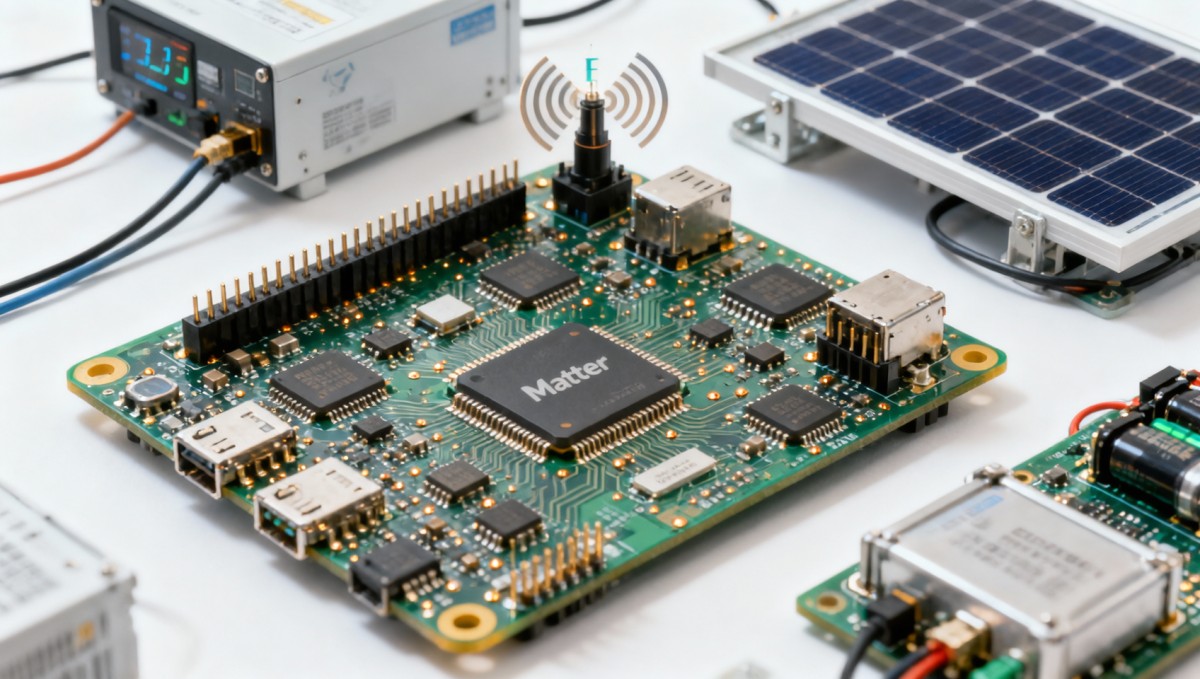
In smart buildings connected to solar PV, energy storage, heat pumps, and demand-response systems, IoT hardware operates in a harsher environment than typical consumer smart homes. Electrical transients, temperature swings of -10°C to 60°C in service spaces, and 24/7 communication loads can expose weaknesses in solder joints, shielding, and component selection within 3 to 12 months of deployment.
Compliance at the PCB assembly level reduces three business risks at once. First, it lowers field failure rates that disrupt energy-saving automation. Second, it supports regulatory and procurement due diligence for commercial and public-sector projects. Third, it protects the long lifecycle expected in renewable-energy assets, where controls and sensors often need to remain stable for 5 to 10 years.
For procurement teams, the challenge is that many suppliers still present broad claims such as “industrial-grade” or “Matter-ready” without evidence. In practice, a compliant smart home PCB assembly should show repeatable manufacturing records, protocol validation, and environmental robustness aligned with real deployment scenarios such as rooftop solar monitoring, microgrid load balancing, and occupancy-based HVAC control.
Operators also feel the downstream impact. A poorly assembled PCB can trigger intermittent relay behavior, unstable sensor reporting, or packet loss across Zigbee, Thread, BLE, and Wi-Fi links. In an energy optimization workflow, even a 1% to 2% measurement drift in current sensing or temperature feedback can lead to poor scheduling decisions and avoidable energy waste.
The Compliance Lens for Different Stakeholders
Researchers and technical evaluators usually focus on benchmark evidence: signal integrity, standby draw, and firmware security posture. Operators prioritize reliability in live facilities, where service visits may cost more than the board itself. Purchasing teams look for supplier consistency, lot traceability, and acceptable defect thresholds. Enterprise decision-makers care about risk concentration, service continuity, and whether a factory can support scaling from pilot volumes of 500 units to annual runs above 50,000 units.
- For engineers: verify assembly process capability, reflow control, AOI/X-ray records, and EMC behavior near inverters and motor drives.
- For procurement: confirm process documentation, lot coding, component source transparency, and corrective-action timing within 24 to 72 hours.
- For operators: request environmental stress data, field-replaceability guidance, and firmware update procedures that do not interrupt energy assets.
- For executives: assess whether the supplier can sustain quality across 2 to 3 production sites without protocol or BOM inconsistency.
What to Verify on the Factory Floor and in PCBA Documentation
A trusted smart home factory should be able to prove more than final functionality. PCB assembly compliance starts with process discipline: stencil control, solder paste inspection, component moisture handling, reflow profile validation, in-circuit or functional testing, and post-assembly traceability. In renewable-energy applications, where smart devices may be mounted close to switchboards, batteries, and metering equipment, poor manufacturing control often appears as latent failures rather than immediate defects.
At the SMT stage, placement accuracy and thermal profile stability are especially important for dense wireless modules and fine-pitch MCUs. A factory should be able to state its inspection flow and acceptable process windows, such as reflow profile tolerance bands, AOI coverage rates, and whether X-ray is used for BGA or bottom-terminated components. If these answers remain vague, the supplier may not be suitable for long-life energy-control deployments.
Documentation matters just as much as hardware. Procurement teams should ask for BOM revision control, component substitution policy, ESD handling procedures, and lot-level serial traceability. In the event of a field issue affecting 2% of a batch, rapid containment depends on whether the manufacturer can isolate affected production windows within hours instead of weeks.
The table below summarizes what should be verified before approving a verified IoT manufacturer for renewable-energy smart building programs.
The key takeaway is simple: for smart home PCB assembly compliance, final test alone is not enough. A reliable supplier should demonstrate process evidence across at least 4 layers—assembly, inspection, traceability, and stress validation—before a buyer relies on the product in solar-powered or grid-interactive buildings.
Practical Audit Questions for Procurement Teams
- Can the factory identify every critical component lot used in a shipment within 24 hours?
- What is the standard burn-in or stress-screening duration for communication boards and relays?
- How are engineering changes managed across pilot, EVT/DVT, and mass production phases?
- Does the supplier provide failure analysis reports with root cause and corrective action timing?
Protocol Compliance, Matter Compatibility, and Real-World IoT Benchmarking
In fragmented smart building environments, board-level compliance is inseparable from protocol performance. A smart relay or gateway may be electrically sound yet still fail project requirements if Matter commissioning is unstable, Thread routing collapses under interference, or Zigbee mesh performance degrades in concrete-heavy mechanical rooms. For renewable-energy operations, that translates into unreliable load control, delayed alarm propagation, and weak coordination between energy devices.
NHI’s data-driven perspective is especially relevant here: “Works with Matter” should never be accepted as a marketing statement without scenario-based validation. Buyers should ask for commissioning success rate, latency behavior across multi-node paths, packet loss under interference, and fallback behavior when an internet connection is unavailable. In energy-critical use cases, local resilience can be more important than peak cloud features.
Matter standard compatibility should also be interpreted carefully. Compliance is not only about joining an ecosystem; it is about consistent behavior after 1,000 command cycles, after firmware updates, and during mixed-network operation with Wi-Fi, Thread, BLE, and legacy devices. Buildings undergoing energy retrofits often contain mixed generations of hardware, which makes interoperability testing far more valuable than a single lab demo.
The following table helps benchmark protocol verification priorities for smart building and renewable-energy scenarios.
The table shows that protocol compliance should be measured as a system property, not a logo claim. In practice, procurement specifications should include at least 3 test conditions: normal traffic, congested RF conditions, and degraded network recovery. That approach gives enterprise buyers a clearer view of operational risk before full rollout.
Common Mistakes in Compatibility Validation
Testing only in clean lab conditions
Renewable-energy buildings rarely behave like clean labs. Variable-frequency drives, battery systems, and metal enclosures can distort performance. Validation should include realistic spacing, interference sources, and mixed-vendor traffic.
Ignoring firmware update behavior
A board that passes initial Matter pairing but fails after OTA updates is not compliant enough for energy assets. Ask for rollback logic, update integrity checks, and expected maintenance windows such as 15 to 30 minutes per fleet segment.
Security Verification: Hardware Root of Trust and Supply Chain Audit Controls
In renewable-energy infrastructure, smart home devices often become part of a larger operational network that touches energy metering, building controls, and access systems. That expands the attack surface. Security verification must therefore begin on the PCB, where secure elements, trusted boot paths, debug-port policy, and key provisioning practices determine whether the hardware can resist tampering or counterfeit insertion.
A hardware root of trust is especially relevant for devices that control loads, collect occupancy data, or connect with local energy management systems. At minimum, buyers should verify whether the device supports secure boot, signed firmware validation, protected key storage, and production-time identity provisioning. If these controls are absent, protocol-level encryption alone may not protect the deployment.
The supply chain dimension is equally important. Data-backed IoT supply chain audit practices should cover component authenticity, approved vendor lists, software build custody, and factory access control. For organizations managing 10 buildings or more, even a small percentage of inconsistent devices can create substantial maintenance and cyber exposure over time.
Below is a practical view of security checks that matter before onboarding a verified IoT manufacturer.
- Confirm whether debug interfaces are disabled, restricted, or cryptographically controlled after production.
- Ask how unique device identities are provisioned and whether secrets are injected in a controlled station.
- Verify that firmware images are signed and that failed authenticity checks block boot.
- Review how the factory handles RMA returns so extracted components cannot re-enter the supply chain.
- Check whether software and hardware version mapping remains traceable across at least 2 product generations.
What Decision-Makers Should Require in Vendor Review
Decision-makers do not need to inspect every circuit detail, but they should require a clear vendor response in five areas: secure hardware architecture, authenticated update path, production control, vulnerability response time, and incident traceability. A practical response window for critical issues is often 24 to 72 hours for acknowledgement and 7 to 30 days for remediation planning, depending on severity.
This is also where NHI’s engineering-filter mindset adds value. Security is not a brochure promise. It becomes credible only when the factory can map each security claim to a physical control, software mechanism, and audit trail that survives procurement review.
Environmental Reliability, Energy Accuracy, and Acceptance Criteria Before Purchase
For renewable-energy deployments, a compliant smart home PCB assembly must be validated against environmental and energy-performance expectations, not only communications and security. Boards used in HVAC zoning, smart relays, battery monitoring, or room sensors may face daily temperature variation, intermittent condensation risk, and continuous power exposure. These stresses accelerate failure in weak solder joints, poorly selected passives, or unstable analog front ends.
Energy-related accuracy is another overlooked point. If a smart meter accessory, CT interface, or control board reports values with drift beyond acceptable ranges, analytics and peak-load shifting strategies can underperform. In many commercial applications, buyers should request test evidence for calibration stability, standby consumption, and repeatability after power cycling. Even a standby difference of a few hundred milliwatts can become significant when multiplied across 2,000 to 10,000 nodes.
Acceptance criteria should be agreed before sampling. That avoids disputes later, especially when moving from pilot to scaled deployment. The most effective approach is to define pass/fail thresholds tied to the building’s energy goals and maintenance model.
The table below can be used as a starting framework for renewable-energy-oriented incoming quality and pre-deployment acceptance.
The main lesson is that compliance should translate into operational acceptance criteria. When buyers define temperature, power, communication, and accuracy thresholds early, they gain stronger leverage over quality, warranty interpretation, and rollout timing.
A 5-Step Qualification Flow
- Review factory process evidence and traceability controls.
- Test sample boards in protocol and interference scenarios relevant to the building.
- Verify hardware security architecture and firmware update governance.
- Run environmental and power-cycle validation for 2 to 4 representative use cases.
- Lock acceptance criteria before PO release and define corrective-action responsibilities.
FAQ: Buyer Questions Before Selecting a Smart Home PCB Assembly Partner
How should buyers compare two factories that both claim Matter readiness?
Compare them using scenario evidence, not brochures. Ask for commissioning stability, latency across at least 2 to 3 hops, OTA recovery behavior, and mixed-network test results. If one supplier can show repeatable results under interference while the other only shows a clean demo, the first is usually the stronger long-term partner.
What defect or response indicators are reasonable to discuss during sourcing?
Without forcing unrealistic promises, buyers can ask for process yield trends, burn-in coverage, RMA analysis workflow, and corrective-action timing. A professional supplier should explain how they detect issues, isolate lots, and respond within defined windows such as 24 to 72 hours for initial containment.
Is smart home PCB assembly compliance relevant for small pilots, or only mass deployment?
It is relevant from the pilot stage. Small pilots often hide quality variation because sample sizes are too narrow. A pilot of 100 to 300 units should still include process review, protocol validation, and environmental screening, especially if the next phase could scale to multiple buildings.
Which teams should be involved in approval?
The strongest decisions are cross-functional. Engineering validates protocol, PCB, and security design. Operations confirms serviceability and deployment workflow. Procurement reviews traceability, change control, and supplier responsiveness. Business leaders align acceptance thresholds with energy goals, risk tolerance, and lifecycle cost.
Smart home PCB assembly compliance is the bridge between product claims and renewable-energy building performance. When buyers verify assembly discipline, protocol behavior, hardware root of trust, and environmental reliability together, they reduce deployment risk and improve the long-term value of smart controls across solar-integrated, storage-enabled, and energy-optimized properties.
NexusHome Intelligence advocates a data-first path: benchmark the board, audit the process, and validate the device in the environment where it will actually operate. If you are assessing trusted smart home factories, verified IoT manufacturers, or planning a stricter IoT supply chain audit for renewable-energy projects, now is the right time to define your compliance checklist and qualification workflow.
Contact us to discuss your evaluation criteria, request a tailored verification framework, or explore more solutions for resilient smart building hardware procurement.
Protocol_Architect
Dr. Thorne is a leading architect in IoT mesh protocols with 15+ years at NexusHome Intelligence. His research specializes in high-availability systems and sub-GHz propagation modeling.
Related Recommendations
- NHI Data Lab (Official Account)How to Reduce Quality Risk in IoT PCBA Sourcing
- NHI Data Lab (Official Account)PCBA Supplier Directory vs Audit: Which Should You Trust
- NHI Data Lab (Official Account)Smart Home PCB Assembly Compliance: What to Verify
- NHI Data Lab (Official Account)How to Find a Reliable IoT PCBA Manufacturer
- NHI Data Lab (Official Account)Canton Fair 2026 Day 1: Zigbee 3.0 + Matter Dual-Mode PCBA Orders Surge
- NHI Data Lab (Official Account)2026 Shanghai Fastener Show to Host Matter/Zigbee PCBA Sourcing Event
- NHI Data Lab (Official Account)IoT supply chain metrics that expose hidden risk
- NHI Data Lab (Official Account)How to use an IoT supply chain audit before switching
- NHI Data Lab (Official Account)IoT OEM compliance roster: useful list or false comfort?
- NHI Data Lab (Official Account)Verified IoT manufacturers: what proof should you ask for?
Analyst