
Lithium Battery for IoT: Runtime vs Safety Tradeoffs
author
In the race to extend lithium battery for IoT runtime, safety can’t be treated as a secondary spec. For engineers, buyers, and decision-makers navigating the IoT supply chain, real answers come from IoT hardware benchmarking, Matter protocol data, and smart home hardware testing—not marketing claims. This article examines how battery chemistry, device load, and compliance realities shape safer, longer-lasting IoT deployments.
In renewable energy environments, the battery question is even more critical. IoT nodes support solar inverters, HVAC optimization, energy metering, demand response, occupancy sensing, leak detection, and distributed building controls. A battery that lasts 5 years on paper but degrades after 18 months in a hot electrical room can break maintenance budgets, reduce data continuity, and create avoidable safety exposure.
For NHI’s audience—research teams, field operators, procurement managers, and enterprise decision-makers—the right choice is rarely the cell with the highest nominal capacity. It is the battery-device system that balances runtime, pulse current behavior, temperature resilience, recharge profile where applicable, and transport and compliance requirements across fragmented IoT protocols and smart building deployments.
Why Runtime and Safety Must Be Evaluated Together in Renewable Energy IoT
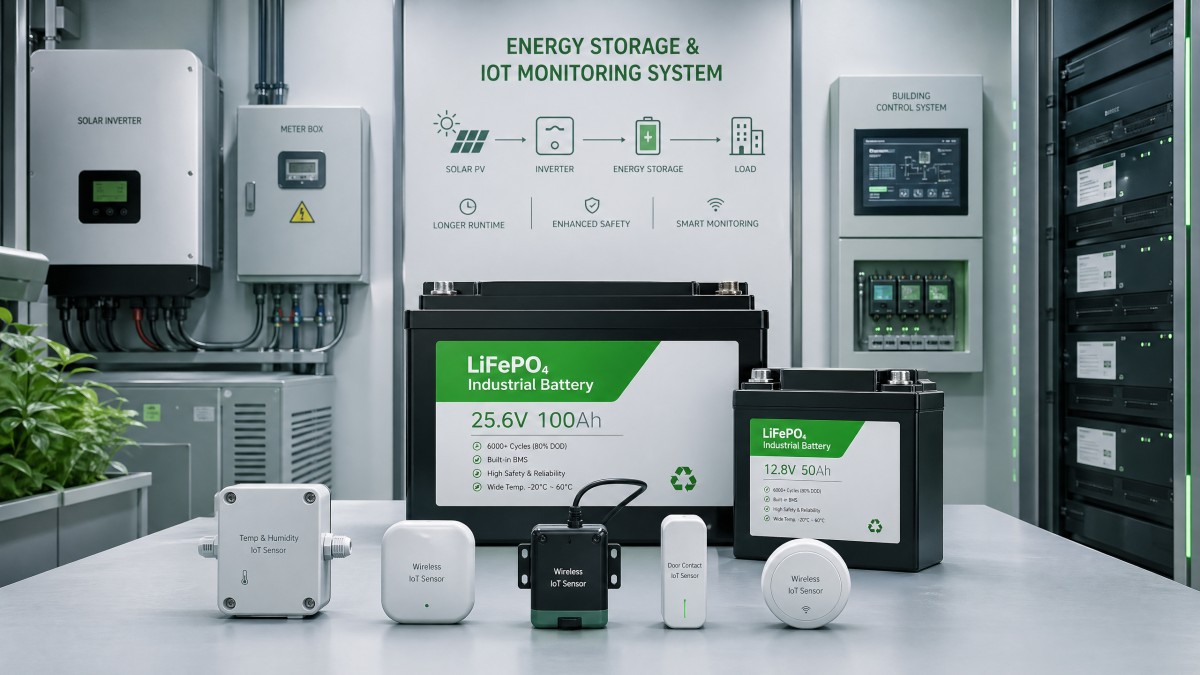
In smart energy and building automation, lithium battery for IoT selection affects more than maintenance intervals. It shapes sensor uptime, alarm reliability, meter reporting frequency, and the stability of control loops tied to energy efficiency targets. A wireless temperature sensor on a low-duty cycle may draw only microamps in sleep mode, yet still demand pulse currents of 20–80 mA during transmission. If the battery cannot support those pulses across temperature swings, runtime calculations become misleading.
Safety tradeoffs appear when buyers push for maximum energy density without matching the chemistry to the deployment profile. A high-capacity cell may look attractive for a 7–10 year design life, but if the device is installed near rooftop solar equipment, enclosed lighting drivers, or utility cabinets operating at 45°C to 60°C, accelerated aging and swelling risks rise. In renewable energy infrastructure, thermal exposure is not an edge case; it is often normal operating reality.
Another issue is protocol behavior. Matter over Thread, Zigbee, BLE, and sub-GHz systems do not consume power in the same way. Mesh routing, rejoin attempts, over-the-air updates, and poor link quality can add hidden energy loads. A battery sized for one packet every 15 minutes in a clean RF lab may perform very differently when packet retries double or triple in a dense commercial building.
For renewable energy projects, battery failure also has a sustainability cost. Replacing thousands of cells every 2 years instead of every 5 years increases labor, transport, downtime, and waste. That is why runtime and safety should be scored as a combined engineering metric, not as isolated line items in a procurement sheet.
Common field conditions that distort battery assumptions
- Ambient temperature drift from 0°C in winter service zones to 55°C in sealed utility spaces.
- Unexpected transmission retries caused by metal enclosures, reinforced concrete, or competing 2.4 GHz traffic.
- Higher sampling intervals during alarms, firmware updates, or commissioning periods.
- Long storage periods of 6–12 months before installation, reducing usable shelf life.
These conditions explain why independent battery benchmarking matters. Runtime claims must be connected to load profile, radio behavior, thermal envelope, and installation method if procurement teams want reliable total-cost projections.
Battery Chemistry Choices: What Changes in Real IoT Duty Cycles
Not all lithium batteries behave the same under renewable energy IoT workloads. Primary lithium chemistries such as lithium thionyl chloride are often selected for long-life sensors because of high energy density and low self-discharge, commonly below 1% per year under typical storage conditions. Rechargeable lithium-ion and lithium iron phosphate options may suit devices with energy harvesting or serviceable recharge cycles, but they introduce different thermal and charging constraints.
For low-average-current devices, capacity alone is an incomplete metric. Pulse capability, voltage stability, and passivation behavior can determine whether a node remains operational. A nominal 2400 mAh cell may still struggle if a radio burst exceeds what the chemistry can deliver at low temperature. In practice, designers often need a capacitor buffer or a hybrid power architecture when pulse loads exceed the battery’s preferred discharge profile.
Rechargeable chemistries are attractive in solar-assisted devices such as remote environmental sensors, but the safety envelope depends on the charging circuit, enclosure heat, and depth-of-discharge strategy. Repeated cycling between 100% and very low state of charge can shorten lifespan. In many field deployments, limiting charge ceilings and maintaining moderate cycling depth can extend effective service life from roughly 300 cycles to 500 cycles or more, depending on chemistry and environmental exposure.
The table below compares common options used in IoT hardware associated with renewable energy management, smart buildings, and distributed sensing.
For procurement, the key conclusion is simple: match chemistry to duty cycle and thermal environment first, then compare nominal capacity. In many commercial energy deployments, a safer chemistry with lower theoretical density produces lower lifecycle cost because it avoids premature replacement and field failures.
H4-level checkpoints for battery qualification
Pulse load validation
Test battery voltage sag during real transmission events, not only steady-state drain. A device that averages 50 µA may still fail if 100 ms bursts repeatedly drive voltage below the radio or MCU threshold.
Temperature mapping
Run discharge tests at at least three points, such as 0°C, 25°C, and 50°C. For rooftop or cabinet-mounted devices, a fourth point near 60°C is often justified.
Storage-to-installation delay
If channel inventory may sit for 6–9 months, battery planning should include warehousing time, not just active field life.
How Device Load, Protocol Behavior, and Renewable Energy Use Cases Change Runtime
The phrase “ultra-low power” is often detached from operational context. In smart energy projects, one IoT node may report every 60 minutes, while another sends data every 30 seconds during peak-load events. The difference is not incremental; it can reduce battery life by a factor of 5 or more depending on radio overhead, sleep current, and sensor warm-up behavior.
Matter, Thread, Zigbee, and BLE also have different network-side consequences. A sleepy end device in a well-planned Thread network can be efficient, but poor parent selection, frequent wake windows, or unstable border router behavior can raise consumption. In solar-plus-storage monitoring, where data freshness may tighten during grid events, the runtime estimate must include worst-case reporting intervals, not only nominal ones.
Sensor type matters as much as protocol. Gas sensing, vibration analysis, and certain optical measurements can dominate power demand. By contrast, simple contact or temperature sensing may spend most of their life in deep sleep. For operators, this means two devices using the same battery format can have service intervals of 18 months and 7 years respectively.
The table below outlines how typical renewable energy IoT use cases differ in battery stress profile.
A practical way to estimate runtime is to model four states: sleep current, sensing current, transmit current, and fault or update mode. Teams that benchmark only average current often miss battery drain caused by 1% of device time spent in repeated join attempts or firmware maintenance. That 1% can materially affect a 3-year service plan.
A simple 4-step runtime modeling method
- Measure current in sleep, wake, transmit, and recovery states using real firmware, not engineering samples alone.
- Assign duty-cycle percentages for normal mode and high-event mode, such as daily reporting versus alarm conditions.
- Add a reserve margin of 15%–25% for RF retries, firmware updates, and aging.
- Recalculate at multiple temperatures and after expected storage time.
This approach gives buyers a more defensible service-life estimate and helps operators avoid underestimating replacement labor in distributed renewable energy estates.
Safety, Compliance, and Supply Chain Risk: What Procurement Teams Should Verify
For enterprise procurement, battery safety extends beyond the cell itself. The real risk sits in the system: mechanical housing, charging logic where relevant, temperature cutoff behavior, connector integrity, and supplier traceability. A battery pack used in an indoor gateway has a different exposure profile from a sealed outdoor sensor mounted near power electronics. Decision-makers should treat battery sourcing as a component-and-application assessment, not a commodity purchase.
Transport and compliance also influence project timelines. Lithium batteries may trigger packaging, handling, and shipping restrictions that affect lead times by 1–3 weeks depending on route and pack type. For international renewable energy rollouts, that delay can become a commissioning issue if spares strategy was not planned in advance.
NHI’s data-driven perspective is especially useful here. Claims such as “industrial grade” or “long-life battery” have limited procurement value unless backed by discharge curves, thermal test data, and failure-mode screening. Buyers should ask for evidence that reflects real use: elevated temperature operation, pulse-load tests, storage aging, and behavior under low-voltage cutoff conditions.
The following checklist can be used during RFQ or supplier qualification for lithium battery for IoT programs in smart energy and building systems.
The most important procurement insight is that a slightly higher unit price can be justified if it reduces truck rolls, battery replacements, and system faults over a 3–7 year deployment horizon. For renewable energy portfolios, the lifetime operating impact usually outweighs the lowest initial battery quote.
Common procurement mistakes
- Comparing only rated mAh without checking discharge cut-off voltage and pulse conditions.
- Ignoring warehouse dwell time before installation in multi-country distribution programs.
- Assuming one chemistry fits both indoor HVAC nodes and outdoor solar monitoring devices.
- Approving samples tested at room temperature only.
Each of these mistakes can shorten field life, raise service calls, and weaken confidence in the broader IoT platform.
Implementation Guidance: From Lab Validation to Long-Term Field Performance
The strongest battery strategy combines component verification, firmware tuning, and deployment discipline. Engineering teams should validate batteries on final PCB assemblies, because quiescent current, sensor power gating, and RF firmware all change the real consumption profile. A cell that performs well in bench tests may behave differently once integrated with always-on peripherals or unstable radio stacks.
Field implementation should also segment devices by mission criticality. A leak sensor protecting a battery room or inverter enclosure may justify a larger reserve margin than a comfort-only temperature node. In many renewable energy projects, a 20% design margin on critical alert devices is more valuable than squeezing out the last month of theoretical runtime.
Operational teams benefit from a defined maintenance policy. Rather than replacing batteries only after device failure, many operators use threshold-based service windows, such as replacement when reported voltage or estimated state of health crosses a preset limit. In portfolios with 500 or 5,000 nodes, preventive grouping can cut site visits and reduce labor fragmentation.
Finally, post-deployment telemetry should feed back into sourcing decisions. If one battery chemistry shows elevated winter failures, or one enclosure design traps too much heat in summer, that data should influence the next procurement cycle. This is exactly where independent benchmarking and field performance analysis create value across the IoT supply chain.
Recommended implementation workflow
- Define use-case load profile, target service life, and acceptable replacement cycle.
- Shortlist 2–3 chemistries or pack types based on thermal and electrical fit.
- Run integrated testing across at least 3 temperature points and one stressed RF scenario.
- Validate shipping, storage, and installation timing with supply teams.
- Deploy pilot batches and review telemetry after 60–90 days before scaling.
FAQ for buyers and technical teams
How should buyers compare batteries when vendors use different test methods?
Ask for comparable discharge conditions: same temperature, same cut-off voltage, same pulse pattern, and similar reporting interval assumptions. Without those four controls, rated capacity numbers are not decision-grade.
Is rechargeable always better for sustainability?
Not necessarily. In ultra-low-power sensors designed for 5–10 years, a stable primary lithium solution can create less field waste and fewer service trips than a rechargeable design that cycles poorly or needs earlier replacement.
What runtime reserve is reasonable in commercial energy deployments?
A practical reserve margin is often 15%–25%, with higher margins for alarm devices, harsh outdoor nodes, and installations with difficult access or seasonal service constraints.
How long should pilot validation last before volume rollout?
For many IoT deployments, 60–90 days is a useful minimum for confirming reporting stability, battery behavior, and RF retries. For extreme climates, a longer seasonal validation window may be justified.
Choosing the right lithium battery for IoT is not a question of chasing the highest capacity label. In renewable energy and smart building systems, durable performance comes from matching chemistry, duty cycle, protocol behavior, and environmental exposure while verifying safety and supply chain fit with hard test data. That approach reduces service costs, supports more reliable automation, and protects long-term deployment value.
NexusHome Intelligence focuses on exactly this type of engineering-first evaluation: protocol benchmarking, hardware stress testing, and practical verification that helps buyers and operators see beyond marketing claims. If you are evaluating IoT hardware, battery-backed sensors, or protocol-driven energy devices, contact us to discuss your application, request a tailored benchmarking perspective, or explore a more reliable sourcing strategy.
Protocol_Architect
Dr. Thorne is a leading architect in IoT mesh protocols with 15+ years at NexusHome Intelligence. His research specializes in high-availability systems and sub-GHz propagation modeling.
Related Recommendations
- NHI Data Lab (Official Account)Lithium Battery for IoT: Runtime vs Safety Tradeoffs
- NHI Data Lab (Official Account)LFP Button Battery Prices Drop 12% for Medical IoT Devices
- NHI Data Lab (Official Account)LFP Button Battery Prices Drop 12% for Medical IoT
- NHI Data Lab (Official Account)Global Micro-LiFePO4 Button Battery Prices Drop 12%
- NHI Data Lab (Official Account)Global Micro-LiFePO4 Button Battery Prices Drop 12% for Medical IoT
- NHI Data Lab (Official Account)Lithium battery for IoT: where cycle life claims break down
- NHI Data Lab (Official Account)Global Micro-LiFePO4 Button Battery Prices Drop 12%
- NHI Data Lab (Official Account)Battery Choices That Hurt IoT Hardware Reliability
- NHI Data Lab (Official Account)Global LFP Button Battery Prices Drop 12% for Medical IoT
- NHI Data Lab (Official Account)Battery Safety for IoT Hardware: What Gets Overlooked
Analyst