
Why Zigbee smart plugs drop offline under load
author
When a Zigbee smart plug drops offline under load, the issue is rarely random—it points to deeper weaknesses in power design, Zigbee mesh capacity, and protocol latency benchmark performance. For operators, buyers, and evaluators in renewable energy and smart building projects, this NHI analysis turns a common failure into actionable IoT engineering truth backed by smart home hardware testing and Matter protocol data.
Why do Zigbee smart plugs go offline when connected loads increase?
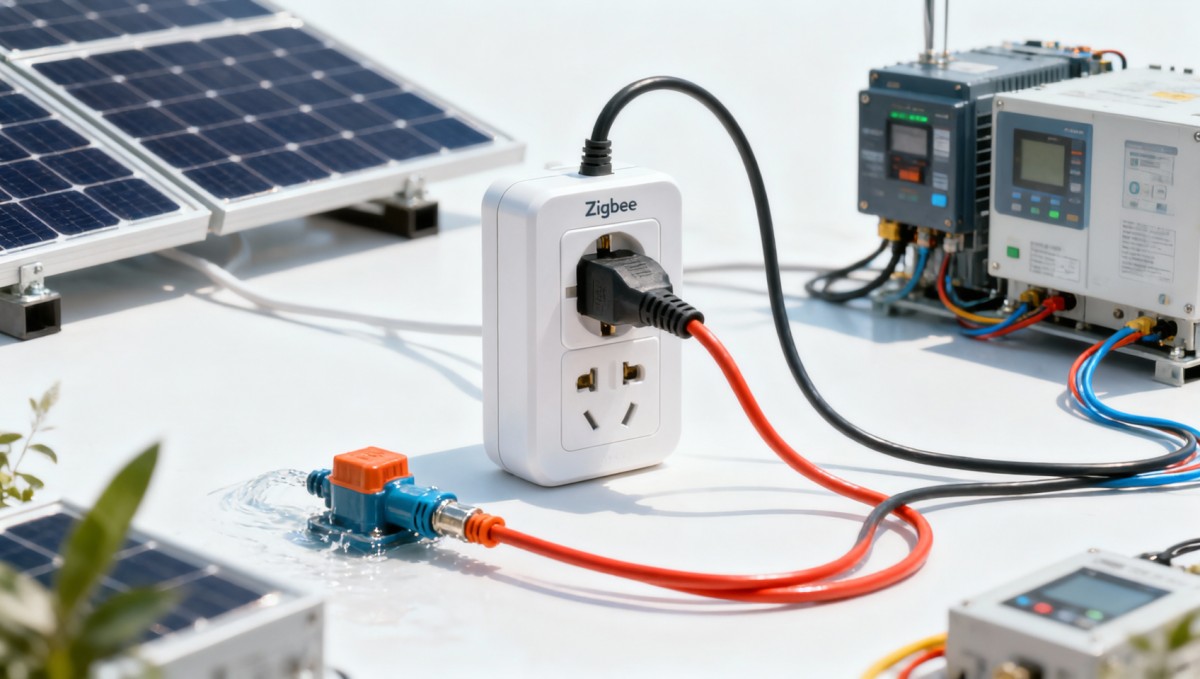
In renewable energy deployments, a Zigbee smart plug is often asked to do more than switch a lamp. It may be controlling space heaters during solar surplus windows, cycling water pumps, powering battery charging accessories, or participating in demand response logic inside a microgrid-aware building. Under these conditions, “offline under load” usually means the plug is suffering from thermal stress, internal power rail instability, relay arcing, or RF performance degradation at the exact moment current rises.
For operators, the visible symptom is simple: the device disappears from the Zigbee network for 30 seconds, 2 minutes, or longer. For procurement teams, the real problem is hidden. A plug can pass a light-load demo at 50W–200W and still fail in field use at 1kW–2.5kW, especially when ambient temperature is already elevated in plant rooms, inverter cabinets, or sun-exposed service spaces. The load event becomes the trigger, but the root cause is normally design margin.
NHI approaches this issue as an engineering verification problem, not a marketing claim. A plug that says it supports Zigbee 3.0 is not automatically suitable for energy management in distributed renewable environments. What matters is how its radio behaves near switching noise, how stable its internal DC conversion remains during relay transitions, and how packet latency changes across 3–8 mesh hops when neighboring devices are also active.
In many commercial sites, the offline event happens at the intersection of three layers: electrical load, network congestion, and installation environment. A heater starting at 1.5kW can raise internal temperature; a weak router path can add retransmissions; and metal enclosures or inverter noise can reduce link quality. None of these alone guarantees failure, but in combination they create the exact field conditions where weaker devices collapse first.
The 4 most common engineering causes
For most B2B buyers, it helps to separate the failure into four categories rather than treating it as a vague connectivity issue. This creates a clearer path for selection, testing, and corrective action before volume purchase.
- Power supply weakness inside the plug: under relay switching or high current, the internal low-voltage rail can dip briefly, causing MCU reset or radio brownout.
- Thermal rise: when continuous load approaches rated limits for 2–6 hours, component temperature can increase enough to affect relay stability, capacitor life, and RF consistency.
- Mesh routing overload: if the plug is also acting as a Zigbee router, heavy network traffic plus marginal signal strength can increase retransmissions and timeout events.
- EMI from connected equipment: chargers, motors, pumps, and switching power supplies can inject noise that degrades both switching reliability and 2.4GHz communication quality.
For renewable energy sites, the highest-risk combinations usually involve inductive or thermally demanding loads. Portable heaters, circulation pumps, battery maintenance tools, and compact power supplies often create more stress than simple resistive lamps. This is why field validation should include at least 3 load types, not only nameplate wattage.
Why the renewable energy context makes the problem worse
Buildings with rooftop solar, battery storage, and dynamic load scheduling tend to switch devices more frequently than ordinary residential setups. Instead of 1–2 manual switching events per day, an automation rule may trigger 10–30 events based on tariff windows, PV output, occupancy, or thermal balancing. This higher duty cycle amplifies every small hardware weakness.
In addition, renewable sites often use mixed ecosystems. A Zigbee smart plug may report to one platform, while upstream optimization logic is driven by Matter bridges, cloud EMS dashboards, or BMS-linked controls. If the plug briefly drops, the entire control chain can become inconsistent. The problem is no longer a single device outage; it becomes a data trust issue affecting energy scheduling, operator decisions, and ROI calculations.
What should buyers and evaluators test before approving a Zigbee smart plug?
If your procurement process still relies on rated current printed on packaging, you are not testing the conditions that actually cause Zigbee smart plugs to drop offline under load. For business evaluators and sourcing teams, the better approach is to request a structured pre-purchase validation covering thermal endurance, radio stability, and protocol behavior under realistic network density. A 4-step evaluation usually reveals far more risk than a spec sheet comparison alone.
At minimum, the test plan should include continuous load operation for 2–4 hours, repeated switching cycles, interference exposure, and mesh routing observation. In renewable energy projects, it is also useful to test during periods when nearby inverters, chargers, or HVAC controls are active. The objective is not to “break” the device, but to see how much performance margin exists before the plug resets, overheats, or stops routing reliably.
The table below summarizes practical evaluation points for operators, procurement teams, and technical reviewers. These are not brand-specific claims. They are field-oriented checkpoints that reduce the chance of selecting a Zigbee plug that looks acceptable in pilot use but fails after rollout across 50, 200, or 500 nodes.
This framework also improves commercial decision-making. When a supplier can only confirm “works with Zigbee hub” but cannot describe endurance windows, switching repeatability, or routing behavior, buyers should treat that as a visibility gap. NHI’s methodology is built around measurable engineering evidence because glossy claims do not help when a building automation chain starts dropping load-control endpoints during peak usage.
A practical 4-step pre-procurement checklist
Before issuing a larger RFQ, teams can use a simple but effective pre-approval checklist. This is particularly useful for procurement staff who must balance budget, lead time, and field reliability within one review cycle.
- Confirm whether the rated current is intended for continuous load or only maximum short-term switching.
- Request a sample batch and test at least 3 common load profiles: resistive, inductive, and switch-mode power supply loads.
- Validate reconnection behavior after power disturbance, router loss, or coordinator restart within a 24-hour observation window.
- Check if the plug exposes useful event data for energy management platforms, not just on/off status.
This kind of shortlisting process may add 7–15 days before purchase approval, but it usually saves much more time later. Replacing unstable Zigbee plugs after deployment is costly because the real expense includes technician visits, re-pairing, route rebuilding, and stakeholder loss of confidence in the automation program.
Which technical indicators separate a robust plug from a risky one?
A reliable Zigbee smart plug should be judged as a small power-and-radio system, not as a commodity accessory. In renewable energy applications, the important indicators are not only switching capacity but also temperature control, standby behavior, routing consistency, and protocol responsiveness during busy operating windows. Buyers who look at only one parameter usually miss the reason devices fail under load.
The strongest candidates generally show balance across 5 core areas: power stage margin, relay quality, RF front-end stability, firmware recovery logic, and telemetry usefulness. If one area is weak, the whole product can become operationally risky. For example, a plug may have acceptable radio range at idle, but if its internal power supply sags during switching, the network advantage disappears the moment the connected appliance turns on.
The following comparison table helps technical and commercial teams align around meaningful indicators. It is especially useful when multiple vendors offer similar rated current and similar pricing, but actual field robustness may differ significantly.
For commercial reviewers, one of the most useful questions is this: what happens after 90 days of normal cycling in a warm equipment space? Many weak plugs survive initial acceptance but degrade under repeated thermal expansion, relay wear, and RF stress. This is why NHI emphasizes benchmark logic over brochure language. A product suitable for single-room consumer use may not be suitable for distributed load management across a renewable-enabled site.
How Matter and mixed-protocol environments affect the decision
Even if the smart plug itself is Zigbee, buyers increasingly operate within Matter-aware ecosystems. That matters because the decision is no longer about a single radio module. It is about end-to-end control reliability across bridges, coordinators, gateways, and supervisory software. If Zigbee devices drop offline under load, Matter dashboards and energy orchestration layers receive delayed or missing states, which can distort automation logic.
For mixed deployments, teams should evaluate not only local switching but also state synchronization delays. In practice, a few hundred milliseconds of extra latency may be acceptable for lighting, but repeated uncertainty across 20–100 controllable sockets can become a problem for peak-load shifting, backup-power prioritization, or occupancy-linked energy scheduling. Protocol silos do not disappear by label alone; they need measured interoperability behavior.
What are the most common procurement mistakes and field misconceptions?
A recurring mistake in Zigbee smart plug sourcing is assuming that an offline event under load is mainly a hub issue. Hubs can certainly contribute, but many failures begin inside the endpoint. When procurement teams optimize for unit cost only, they often select products with insufficient thermal margin, limited diagnostic feedback, and vague load ratings. The result is a lower invoice but a higher operational burden over the next 6–18 months.
Another misconception is that “rated for 16A” means appropriate for every 16A condition. In reality, the connected load profile matters. A resistive heater, a motor-driven pump, and a charger with inrush current do not stress the plug in the same way. For renewable energy projects, where switching may be automated and frequent, this distinction becomes even more important than in ordinary consumer settings.
There is also a network planning misconception: installers may assume every mains-powered Zigbee device automatically improves the mesh. That is not always true in practice. A poorly designed router under thermal or electrical stress can degrade the mesh by becoming intermittently available. Instead of strengthening the network, it introduces instability into routing paths that other endpoints depend on.
From an evaluation standpoint, the safest approach is to define acceptance criteria before commercial negotiation. If buyers wait until after price approval to ask about endurance, latency under interference, or reconnection time, leverage is reduced. Better results come from aligning engineering checks with procurement milestones in the first 2 review stages.
FAQ for operators, buyers, and business reviewers
How do I know if load, mesh quality, or firmware is the main problem?
Start by isolating variables over a 24–72 hour test window. Run the same plug at low load and high load, then compare behavior in the same physical location. If disconnects appear only above a certain power level or after 1–2 hours of operation, thermal or power-stage weakness is likely. If failures appear regardless of load but worsen at network distance, mesh quality is the stronger suspect. If recovery is inconsistent after resets, firmware robustness should be reviewed.
Are Zigbee smart plugs suitable for renewable energy load shifting?
Yes, but only for suitable loads and only after validation. They can work well for controllable small appliances, localized demand response, or non-critical automation within solar self-consumption strategies. They are less suitable when the load is safety-critical, highly inductive, or central to backup-power continuity. In those cases, industrial relays, DIN-rail controllers, or dedicated energy control hardware may be more appropriate alternatives.
What delivery and testing timeline is realistic for B2B sourcing?
For a structured decision, a common timeline is 1–2 weeks for sample acquisition, 1–2 weeks for bench and pilot testing, and another 1 week for commercial review and approval. If certification review, firmware adaptation, or integration checks are required, the cycle can extend to 4–6 weeks. Shorter timelines are possible, but only if the evaluation scope is deliberately narrow and the risk is understood.
What standards or compliance topics should buyers ask about?
Ask about electrical safety compliance relevant to the target market, EMC behavior, Zigbee protocol compatibility, and any energy-monitoring accuracy claims if metering is part of the application. For commercial buildings and renewable energy-linked controls, documentation quality also matters. A supplier should be able to explain installation limits, load categories, and operational cautions in clear technical language rather than generic sales phrases.
Why work with NHI before final selection, pilot rollout, or supplier comparison?
NexusHome Intelligence exists to bridge ecosystems through data, especially where protocol silos and marketing noise make sourcing harder than it should be. For teams evaluating Zigbee smart plugs in renewable energy environments, the challenge is not finding a product page. The challenge is determining whether the device can maintain network integrity, load stability, and useful telemetry when deployed in real operating conditions rather than showroom demos.
Our value is practical and specific. We focus on measurable verification across connectivity, energy behavior, hardware quality, and cross-ecosystem integration logic. That means helping your team compare options not only by claimed compatibility, but by the indicators that affect real procurement outcomes: switching behavior, mesh resilience, thermal margin, latency risk, and deployment fit across mixed smart building systems.
If you are preparing a pilot, replacing unstable devices, or building a sourcing shortlist, we can support the decision process with structured evaluation criteria. Typical consultation topics include 3 categories: parameter confirmation for expected loads, product selection for Zigbee versus alternative control hardware, and rollout planning for sample validation, delivery rhythm, and integration checkpoints.
Contact NHI if you need help reviewing rated load assumptions, comparing plug candidates for renewable energy use cases, mapping protocol risks in mixed Zigbee and Matter environments, or clarifying what to request from suppliers before issuing an RFQ. We can also help define sample test scope, discuss certification and compliance questions, and structure quotation discussions around engineering evidence instead of brochure claims.
Protocol_Architect
Dr. Thorne is a leading architect in IoT mesh protocols with 15+ years at NexusHome Intelligence. His research specializes in high-availability systems and sub-GHz propagation modeling.
Related Recommendations
- Dr. Aris ThorneEN 303 647 V2.1.1 Mandatory for Zigbee/BLE Smart Devices in EU from Apr 2026
- Dr. Aris ThorneWhy Zigbee smart plugs drop offline under load
- Dr. Aris ThorneWhat to know before a Zigbee smart plug test
- Dr. Aris ThorneZigbee mesh capacity: how many nodes is too many?
- Dr. Aris ThorneWhat Affects Zigbee TRV Battery Life Most
- Dr. Aris ThorneHow to Source Zigbee Radiator Valve TRVs
- Dr. Aris ThorneHow to Compare Zigbee Motion Sensor Suppliers
- Dr. Aris ThorneThread vs Zigbee Mesh Range: Which Wins
- Dr. Aris ThorneHow Many Devices Can Zigbee 3.0 Handle
- Dr. Aris ThorneSmart Home Supplier Directory: Are You Filtering by Test-Verified Latency or Just Marketing Claims?
Analyst