
What to know before a Zigbee smart plug test
author
Before a Zigbee smart plug test, buyers and operators need more than vendor claims—they need protocol latency benchmark data, IoT power monitoring accuracy, and clear Matter standard compatibility evidence. At NexusHome Intelligence, we frame smart home hardware testing around real-world performance, helping procurement and evaluation teams separate verified IoT manufacturers from marketing noise.
In renewable energy environments, that requirement becomes even more urgent. A Zigbee smart plug is no longer just a consumer convenience device; it can act as a measurement point for distributed loads, a control node for solar self-consumption strategies, or a switching endpoint in building-level demand response programs. When an operator tests one, the real question is not whether the plug turns on and off, but whether its radio stability, metering accuracy, standby consumption, and interoperability remain reliable under energy-management conditions.
For procurement teams, the challenge is practical. A unit that looks acceptable in a brochure may fail under 2.4 GHz interference, misreport wattage by more than 3%, or lose coordination with an energy gateway after repeated network events. For business evaluators, those small technical gaps can lead to larger commercial risks: inaccurate load balancing, failed pilot projects, and higher service costs over a 12- to 24-month deployment cycle.
This article explains what to review before a Zigbee smart plug test when the deployment context involves renewable energy, smart buildings, or low-carbon operations. It focuses on what users, operators, procurement specialists, and commercial reviewers need to verify before they compare suppliers or approve a trial batch.
Why Zigbee smart plug testing matters in renewable energy systems
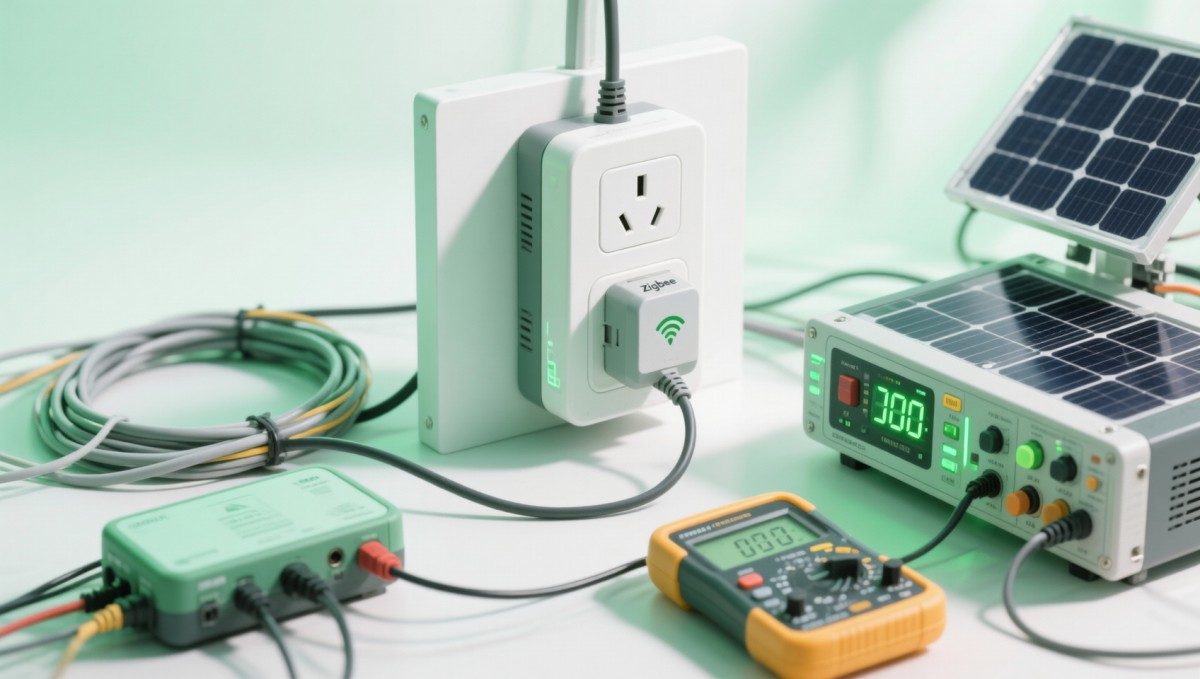
In a conventional smart home, a smart plug often controls a lamp, a fan, or a coffee machine. In a renewable energy setting, the same device may support a more strategic role. It may switch non-critical loads during high photovoltaic output, provide localized energy data for a home energy management system, or help a facility operator reduce peak demand between 17:00 and 21:00. That shift changes the test standard entirely.
A Zigbee smart plug test should therefore evaluate more than basic connectivity. For solar-linked residential applications, operators often need metering intervals of 1–5 seconds, on/off response times below 500 milliseconds in stable mesh conditions, and standby power consumption low enough to avoid offsetting energy savings. In multi-unit buildings, the plug also needs to perform in denser radio environments where 20–60 Zigbee nodes may coexist on one floor.
Another key reason testing matters is that renewable energy projects increasingly depend on distributed, granular control. Instead of one central switch, building operators may manage water heaters, portable storage chargers, ventilation loads, and appliance groups independently. If a smart plug misreads a 1.5 kW load as 1.3 kW, the resulting optimization logic becomes less reliable, especially when multiplied across dozens of endpoints.
For this reason, NHI treats a Zigbee smart plug as both a communications endpoint and an energy data device. A credible pre-test review should include protocol behavior, electrical tolerance, relay durability, and integration readiness with broader ecosystem standards such as Matter bridges or energy dashboards.
Core renewable-energy use cases behind the test
- Residential solar self-consumption optimization, where smart plugs shift flexible loads to daylight production windows.
- Small commercial peak shaving, where plug-level switching supports non-critical equipment control during tariff spikes.
- Retrofit energy audits, where plug-level metering helps operators identify standby waste or irregular load signatures.
- Hybrid systems with battery storage, where plug data contributes to discharge prioritization and appliance scheduling.
What changes when the plug is part of an energy workflow
When the device is tied to renewable energy management, the acceptable margin for error narrows. In a convenience-only deployment, a brief delay or small power reading deviation may be tolerable. In energy automation, however, 2–3 seconds of delay during load shedding or a persistent 4% metering error can undermine tariff optimization, battery scheduling, and reporting credibility.
The following table outlines how test priorities change when a Zigbee smart plug moves from basic smart home control to renewable energy operations.
The main takeaway is simple: if the project involves carbon reduction, energy monitoring, or load orchestration, a Zigbee smart plug test must be designed around energy outcomes, not just app-level functionality.
Technical checkpoints to review before the test starts
A useful test begins before the first device is powered on. Operators should define what they are trying to validate, under what network conditions, and against which acceptance thresholds. At minimum, a pre-test checklist should cover four categories: radio performance, metering quality, electrical safety margins, and platform interoperability.
For radio performance, Zigbee 3.0 support should not be accepted as a marketing phrase alone. Evaluators should ask whether the device has been tested in single-hop and multi-hop mesh conditions, how many neighboring nodes were present, and whether latency remains stable under Wi-Fi channel congestion in the 2.4 GHz band. In practical terms, it is useful to compare response time at 1 node, 10 nodes, and 30 nodes rather than relying on one ideal lab result.
For metering, the most important question is not whether energy monitoring exists, but what the error range looks like across low and high loads. A plug may read reasonably at 1000 W but drift at 15 W standby loads, which matters in energy-saving programs. Procurement teams should request test points such as 10 W, 100 W, 500 W, and 1500 W, with deviation ranges shown for each point.
Electrical tolerance is equally important. The relay should be tested near the rated load, not just at light loads, and thermal rise should be observed over at least 2–4 hours of continuous operation. If the plug is intended for renewable energy retrofits in warm utility rooms or enclosed cabinets, ambient conditions of 35°C to 45°C are more relevant than a mild office environment.
Interoperability has become a decisive factor. Many buyers now operate mixed ecosystems with Zigbee gateways, local energy hubs, and Matter-exposed control layers. A smart plug does not need to implement every protocol directly, but it should have documented compatibility behavior through the target gateway stack. “Matter-ready” without a verified bridge path is not enough for procurement sign-off.
Pre-test checklist for users, operators, and buyers
- Define the load profile: standby loads below 20 W, medium loads around 300–800 W, and high loads up to the plug’s rated limit.
- Define the network profile: single room, whole home, or multi-zone building with 10, 20, or 50 Zigbee devices.
- Confirm the gateway path: native Zigbee control, cloud-connected gateway, or Matter bridge integration.
- Set acceptance thresholds: latency, metering error, packet loss tolerance, and reconnection time after power cycling.
- Record environmental conditions: temperature, interference sources, and installation spacing.
Recommended benchmark thresholds before supplier comparison
The ranges below are not universal pass/fail laws, but they are practical screening points that help commercial evaluators avoid weak candidates early in the process.
These thresholds are especially useful during vendor shortlisting. If a supplier cannot explain how the device behaves at multiple loads, over repeated switching cycles, and across realistic network densities, that is usually a stronger signal than any feature list.
How to evaluate latency, metering accuracy, and Matter compatibility
The three issues most often overlooked before a Zigbee smart plug test are protocol latency, energy data quality, and true cross-ecosystem compatibility. In renewable energy use cases, these three are closely connected. A low-latency device with poor metering can still distort optimization. A precise metering plug with weak gateway translation can become operationally isolated.
Latency should be evaluated in a repeatable structure. A good method is to run at least 30 trigger events per scenario and compare average, 95th percentile, and worst-case response time. Testing should include direct gateway proximity, one relay hop, and a busy network condition with other 2.4 GHz traffic present. For operators running solar-linked automations, the 95th percentile often matters more than the best-case average.
Metering accuracy should be reviewed across current, voltage, power, and cumulative energy reporting. The priority metric depends on the project. If the plug is used for appliance scheduling, real-time power accuracy is critical. If it is used for tenant billing support or energy reports, cumulative kWh drift over 24 hours or 7 days becomes more important. Buyers should also ask whether calibration changes with temperature or prolonged high load.
Matter compatibility deserves careful wording. In many deployments, the plug is not a native Matter endpoint but is exposed through a gateway or bridge. That is not automatically a problem, but procurement teams should know the exact chain: Zigbee device to gateway, gateway to Matter fabric, Matter fabric to energy management application. Each handoff can affect attribute mapping, update frequency, and command consistency.
Questions to ask vendors before compatibility claims are accepted
- Is the smart plug directly certified for the claimed Zigbee profile, or only tested internally?
- When connected through a Matter bridge, which functions are preserved: on/off, power, energy, scheduling, or only basic control?
- At what reporting interval is power data exposed to the upper platform: 1 second, 5 seconds, 30 seconds, or event-based only?
- Does the bridge introduce measurable delay compared with native Zigbee operation?
- What happens after router reset, gateway reboot, or brief grid interruption?
A practical test design for commercial reviewers
A strong evaluation plan usually includes three stages. Stage 1 is bench validation with 3–5 devices under controlled loads. Stage 2 is mesh validation with 10–20 nodes in a realistic indoor layout. Stage 3 is pilot deployment over 2–4 weeks in the target energy scenario, such as solar-load shifting or after-hours load control. This staged approach reveals whether initial performance survives operational complexity.
Commercially, this matters because many problems do not appear in the first 24 hours. Meter drift may emerge after thermal stress. Network instability may appear when neighboring channels become busy. Gateway mapping issues may surface only after firmware updates. A supplier that supports transparent staged testing is usually better prepared for long-term B2B cooperation.
Procurement risks, cost drivers, and supplier selection criteria
For procurement professionals, the real cost of a Zigbee smart plug is not the unit price alone. Total project cost includes commissioning time, gateway compatibility work, support tickets, field replacements, firmware coordination, and the business impact of inaccurate energy data. In renewable energy programs, even a low-cost device can become expensive if it weakens reporting credibility or delays automation rollout.
One common mistake is to compare suppliers only on radio protocol labels and nominal power rating. That approach overlooks the issues that often generate downstream cost: relay endurance, calibration consistency, quality control variation between batches, and update policy after deployment. If 5% of units require field replacement across a 500-unit project, the labor cost can exceed the original price difference between vendors.
Buyers should also consider sourcing transparency. A supplier may advertise broad ecosystem support but provide little detail on chipset generation, firmware maintenance window, or test documentation. For NHI, reliable supply chain evaluation means asking whether engineering evidence exists, not whether marketing material looks polished. In fragmented IoT markets, hidden technical weakness often appears at scale, not in the sample box.
The most effective procurement model is usually a weighted scorecard. Instead of using a single pass/fail decision, assign values to protocol performance, metering fidelity, documentation depth, thermal behavior, and post-sale technical support. This gives business evaluators a clearer basis for comparing two or three finalists.
Sample supplier evaluation matrix
The table below shows a practical screening structure for renewable energy-oriented smart plug sourcing. Teams can adjust the weight percentages according to project goals, but the categories help prevent an overfocus on unit cost.
This kind of matrix helps business reviewers translate technical evidence into sourcing decisions. It also creates a more defensible approval process when multiple teams, including operations and finance, are involved.
Common procurement mistakes to avoid
- Approving a sample after only basic app control checks and no metering validation.
- Ignoring standby consumption when the project goal is energy savings and carbon reduction.
- Accepting “Matter compatible” claims without a documented bridge path and function map.
- Testing in a low-interference office instead of the actual building or energy cabinet environment.
- Failing to compare sample performance against later batch consistency.
Implementation workflow, field validation, and FAQ
Once a supplier passes pre-test screening, the next step is structured implementation. For renewable energy applications, the deployment process should not begin with mass installation. It should move through a staged workflow that validates operational fit, energy data trustworthiness, and support responsiveness. This reduces the chance of discovering system weaknesses after installation labor has already been committed.
A practical workflow usually includes sample qualification, pilot deployment, data review, and scale-up approval. In many B2B projects, the pilot phase runs for 14–30 days so the team can observe weekday and weekend patterns, tariff windows, solar generation fluctuation, and recovery after at least one planned power cycle. Shorter pilots often miss edge cases that matter in real building operations.
Operators should also define maintenance expectations early. A good supplier relationship includes firmware update policy, issue escalation route, replacement handling for failed units, and guidance on gateway firmware compatibility. In mixed-protocol environments, even a small update can affect reporting intervals or attribute availability, so change control is part of technical quality.
Below is a simple implementation sequence that aligns technical testing with procurement governance and energy-management objectives.
Suggested 5-step rollout model
- Laboratory screening of 3–5 units for latency, metering, and thermal behavior.
- Mesh simulation with 10–20 devices in a representative radio environment.
- Pilot deployment in 1–3 target zones such as solar-linked homes, EV-adjacent loads, or office retrofit circuits.
- Review of data quality over 2–4 weeks, including event logs, power trends, and recovery behavior.
- Commercial approval with batch verification and post-installation support plan.
FAQ: what buyers and operators often ask
How accurate should a Zigbee smart plug be for renewable energy monitoring?
For practical energy management, many teams look for power measurement deviation within about ±1% to ±3% across the main operating range. The acceptable value depends on whether the plug is used for control logic, reporting, or cost allocation. The key is consistency across low, medium, and high loads rather than one favorable measurement point.
Is Zigbee still suitable when Matter adoption is increasing?
Yes, especially when the deployment already uses Zigbee infrastructure and the gateway offers reliable exposure to higher-level platforms. The decision should be based on measured bridge behavior, not assumptions. In many commercial retrofits, Zigbee remains attractive because of mature device availability, low-power networking, and manageable mesh scaling.
How long should a serious pilot test last?
A meaningful pilot is typically at least 14 days, and 21–30 days is often better for commercial evaluation. That duration helps capture repeated schedules, varying generation conditions, and recovery after resets or firmware events. One-day demos are useful for sales conversations, but they rarely support procurement-grade conclusions.
What is the biggest hidden risk before purchase?
The biggest hidden risk is often the gap between declared compatibility and verified operational behavior. A plug may technically connect, yet still fail to deliver stable energy data, acceptable latency, or dependable recovery in a mixed ecosystem. That is why benchmark evidence matters more than marketing language.
For renewable energy projects, a Zigbee smart plug test should be treated as a performance validation exercise, not a simple device demonstration. Buyers and operators need evidence on latency, metering precision, standby consumption, thermal stability, and bridge-level compatibility before approving deployment. Those factors directly affect energy savings, operational reliability, and long-term support cost.
NexusHome Intelligence approaches this process as an engineering filter for global procurement and evaluation teams. By focusing on measurable behavior rather than protocol slogans, NHI helps organizations identify suppliers that can perform in real low-carbon buildings, smart energy retrofits, and distributed IoT environments. If you are planning a Zigbee smart plug benchmark, pilot, or sourcing review, contact us to discuss a tailored evaluation framework, compare test priorities, or explore broader connected energy solutions.
Protocol_Architect
Dr. Thorne is a leading architect in IoT mesh protocols with 15+ years at NexusHome Intelligence. His research specializes in high-availability systems and sub-GHz propagation modeling.
Related Recommendations
- Dr. Aris ThorneEN 303 647 V2.1.1 Mandatory for Zigbee/BLE Smart Devices in EU from Apr 2026
- Dr. Aris ThorneWhat to know before a Zigbee smart plug test
- Dr. Aris ThorneZigbee mesh capacity: how many nodes is too many?
- Dr. Aris ThorneWhat Affects Zigbee TRV Battery Life Most
- Dr. Aris ThorneHow to Source Zigbee Radiator Valve TRVs
- Dr. Aris ThorneHow to Compare Zigbee Motion Sensor Suppliers
- Dr. Aris ThorneThread vs Zigbee Mesh Range: Which Wins
- Dr. Aris ThorneHow Many Devices Can Zigbee 3.0 Handle
- Dr. Aris ThorneSmart Home Supplier Directory: Are You Filtering by Test-Verified Latency or Just Marketing Claims?
- Dr. Aris ThorneSmart Home Hardware Testing: Why Lab Benchmarks Don’t Predict Real-World Zigbee Mesh Stability
Analyst