
Vietnam Expands Food Safety List to Smart Health IoT
author
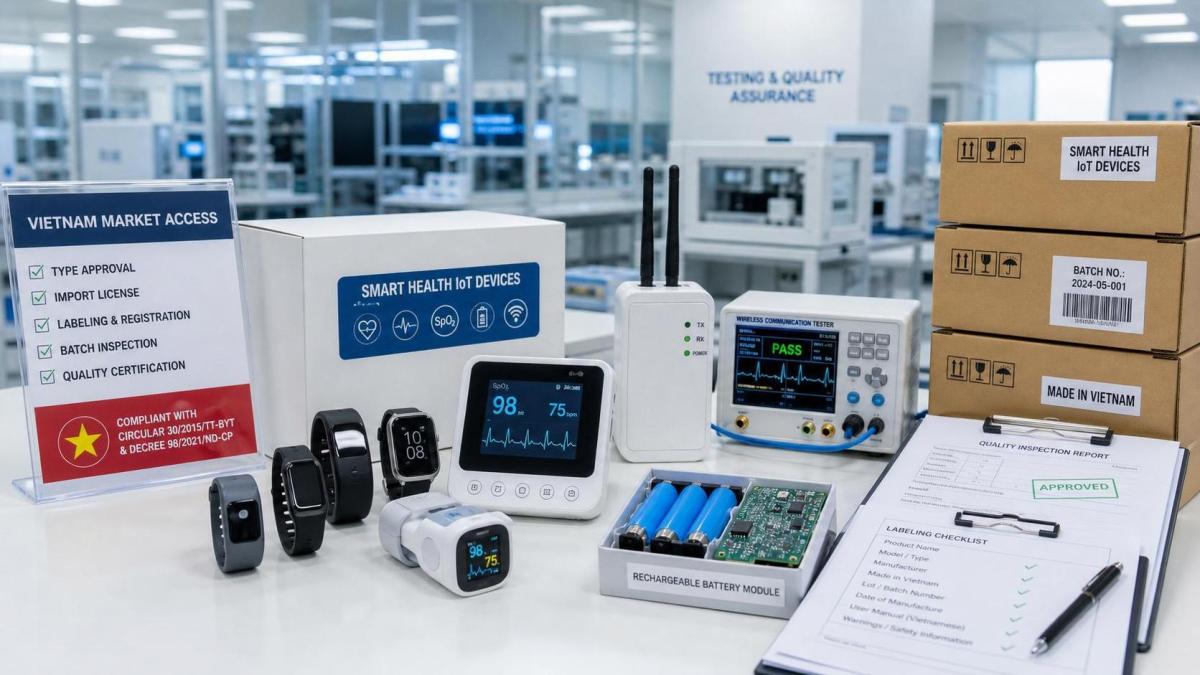
From July 17, 2026, Vietnam will implement a new food safety inspection list that now reaches certain smart health devices with biosensors, rechargeable batteries, and wireless communication modules. For companies involved in Fitness Tracking Sensors, Medical IoT, and some Biometric Sensors products, this development deserves attention because it affects not only product scope, but also labeling, local representation, and batch-level documentation tied to market access.
What the new Vietnam notice confirms
The confirmed event is the implementation of Circular No. 28/2026/TT-BCT issued by Vietnam’s Ministry of Industry and Trade, effective on July 17, 2026. Under this notice, smart health devices containing biosensors such as SpO2 and ECG modules, as well as rechargeable batteries and wireless communication modules, are newly brought under mandatory food safety inspection.
The listed scope covers Fitness Tracking Sensors, Medical IoT, and certain Biometric Sensors categories. The notice also requires Vietnamese-language labeling, local agent registration, and batch inspection reports.
Where the operational impact is likely to appear first
Product exporters may face a narrower documentation margin
From an industry perspective, companies shipping affected smart health devices into Vietnam may be directly influenced because the notice links product entry to mandatory inspection and supporting compliance materials. The main pressure point is likely to be at the pre-shipment and import-document stage, where classification, labeling, and batch records become more sensitive.
Manufacturers of sensor-based devices need closer product scope checks
Manufacturing businesses working with SpO2 modules, ECG modules, rechargeable batteries, or wireless functions may need to pay closer attention to whether their device configuration falls within the newly covered categories. The likely impact is not only on the finished product, but also on how product specifications and supporting files are prepared for downstream trade and registration processes.
Importers and local market coordinators may see added execution work
Businesses responsible for Vietnam market entry, local representation, or in-country compliance coordination may be affected through local agent filing and Vietnamese-language labeling requirements. What deserves closer attention is whether internal ownership of these steps is already clear, because delays can arise even when product supply is otherwise ready.
Supply chain service providers may need to adjust timing assumptions
Observably, logistics, customs, and compliance support providers may need to watch for changes in document readiness and batch inspection handling. The practical effect may show up in delivery planning, handover timing, and communication between exporters, importers, and local representatives.
What companies should watch in practice
Check whether product features trigger the new scope
Companies should first focus on whether devices include the specific elements named in the notice, including biosensors such as SpO2 and ECG modules, rechargeable batteries, and wireless communication modules. In practice, this is important because coverage appears to be tied to both product category and technical composition.
Prepare labeling and local representation files early
The confirmed requirements include Vietnamese-language labels and local agent registration. For businesses already planning shipments or product launches, the immediate issue is whether these materials and arrangements are ready before goods move into the Vietnam process chain.
Review batch inspection document workflows
Because batch inspection reports are part of the stated requirements, companies may need to review who is responsible for generating, collecting, checking, and submitting these documents. Analysis shows that this is less about broad policy interpretation and more about execution discipline across supply, compliance, and customer-facing teams.
Separate confirmed rules from later interpretation
What deserves closer attention is the difference between the rule already confirmed in the notice and any later operational interpretation that may emerge during implementation. Companies should avoid assuming that product familiarity or existing market activity alone will satisfy the new process requirements.
Why this looks more like a compliance signal than a one-off notice
Analysis shows that this update is not just about adding one more administrative step. It indicates that certain smart health devices are being treated with closer scrutiny when sensor functions, power components, and wireless modules are combined in products entering the Vietnam market. It is more appropriate to understand this as a concrete compliance signal with immediate operational implications, while still recognizing that the full business impact may depend on how implementation is handled in practice.
Observably, the most important near-term question is not whether the notice exists, but how consistently companies can map affected SKUs, align documentation, and coordinate local filings. That makes this a development the industry should continue to track rather than a headline to note once and move on from.
How the market should read this development now
At this stage, the news is best understood as a confirmed rule change with direct relevance for market-entry execution in Vietnam for affected smart health device categories. Its significance lies in the combination of mandatory inspection, Vietnamese-language labeling, local agent registration, and batch reporting requirements. A neutral reading is that businesses should treat it as an active compliance matter today and a continuing operational watchpoint in the months ahead.
Basis of this article and what still needs verification
This article is based on the user-provided news title, event date, and event summary concerning Vietnam’s implementation of Circular No. 28/2026/TT-BCT from July 17, 2026. The analysis is limited to the confirmed details provided in that input.
For this type of industry update, commonly relevant source categories may include official government notices, company disclosures, industry association updates, authoritative media coverage, and standard-setting documents. The specific official source link was not provided in the input, so continued verification remains necessary. Follow-up attention should focus on any further official wording, implementation clarification, and category-level interpretation affecting covered smart health IoT products.
Protocol_Architect
Dr. Thorne is a leading architect in IoT mesh protocols with 15+ years at NexusHome Intelligence. His research specializes in high-availability systems and sub-GHz propagation modeling.
Related Recommendations
- Dr. Sophia Carter (Medical IoT Specialist)IEC 60601 Compliance for ECG Wearable Patches: Tests, Design Risks, and Evidence
- Dr. Sophia Carter (Medical IoT Specialist)How to Evaluate a Medical Robot Arm OEM for Precision and Regulatory Readiness
- Dr. Sophia Carter (Medical IoT Specialist)How to Choose an ECG Wearable Patch Provider for Remote Patient Monitoring
- Dr. Sophia Carter (Medical IoT Specialist)How to Evaluate SpO2 Module Assemblies for Wearables and Medical IoT Devices
- Dr. Sophia Carter (Medical IoT Specialist)How to Choose Medical IoT Sensors for Vital Signs in Remote Patient Monitoring
- Dr. Sophia Carter (Medical IoT Specialist)What Drives Wearable Biosensors Project Cost in Medical IoT Deployment?
- Dr. Sophia Carter (Medical IoT Specialist)What Drives Blood Pressure Monitor Costs? Key Factors Buyers Should Compare
- Dr. Sophia Carter (Medical IoT Specialist)How Smart Wearable Devices Improve Remote Monitoring in Medical IoT Applications
- Dr. Sophia Carter (Medical IoT Specialist)Smart Wearable Technology for Hospitals: Use Cases, Integration Needs, and Data Risks
- Dr. Sophia Carter (Medical IoT Specialist)Medical IoT Application Analysis: Where Connected Devices Deliver Real Clinical Value
Analyst