
Vietnam Expands Compliance Scope for Smart Health IoT
author
On June 17, 2026, industry attention turned to a new compliance change in Vietnam after the Ministry of Industry and Trade (MOIT) moved certain smart health IoT components into a mandatory control framework tied to food safety and health-related products. The change matters not only for product certification, but also for export planning, shipment readiness, supplier coordination, and document preparation, especially for manufacturers and exporters handling Bluetooth-enabled medical-grade devices and components.
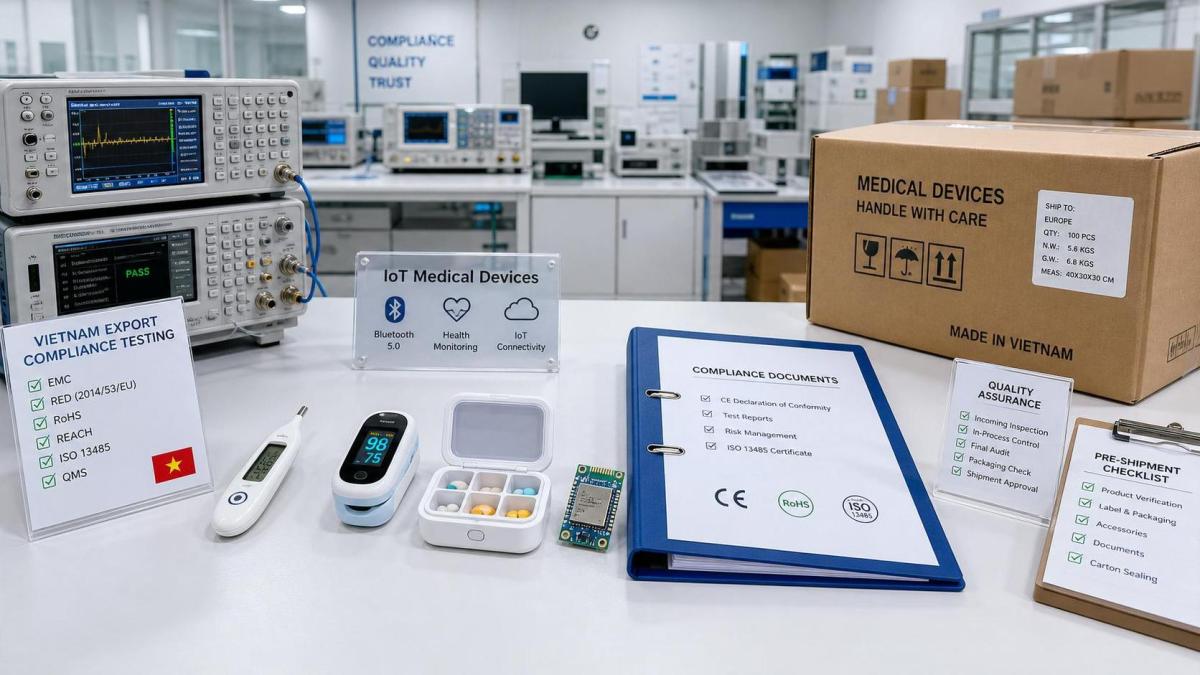
A new compliance trigger takes effect in July
According to the provided information, MOIT issued Circular 12/2026/TT-BCT on June 15, 2026. The measure places medical-grade IoT components with Bluetooth transmission functions, including products such as electronic thermometers, oximeters, and smart pill boxes, into the Mandatory List of Food Safety and Health-Related Products.
The same information states that, from July 17, 2026, these products must obtain certification through STAMEQ and carry the CR mark. It also indicates that this is the first time wireless communication modules have been brought into the regulatory scope for health-related products under this list.
Where the pressure is likely to appear first
Export-facing manufacturers may need to reassess shipment readiness
From an industry perspective, manufacturers supplying Bluetooth-enabled health IoT products or components are likely to feel the change first because certification and CR marking become a gate for market access after the effective date. The immediate business impact may appear in export scheduling, product classification review, and the completeness of compliance files prepared before delivery.
Trading and sourcing teams may face tighter document checks
For trading companies and procurement teams, the rule change may affect how product specifications, supplier declarations, and compliance status are reviewed before orders move forward. What deserves closer attention is whether listed products are being treated only as electronic devices in internal workflows, when the new measure suggests they also need to be handled under a health-related regulatory framework in Vietnam.
Certification and testing service providers may see a shift in client demand
Analysis shows that certification-related service providers and testing support firms may encounter more requests tied to scope confirmation, technical documentation, and certification sequencing. The practical issue is less about broad market theory and more about whether exporters can align testing, application timing, and marking requirements with delivery commitments.
South China contract manufacturers may need to revisit export routes
The provided summary specifically notes pressure on medical IoT OEM exporters in South China. Observably, this means the rule is not only a local regulatory update in Vietnam, but also a trade execution issue for factories that rely on established export paths for connected health devices or related assemblies.
What companies should review now
Check whether affected SKUs fall within the new listed scope
Analysis shows that the first practical step is to identify whether products with Bluetooth transmission functions, especially medical-grade thermometers, oximeters, smart pill boxes, or related components, fall within the newly controlled category described in the provided information. Product teams and compliance staff should avoid relying on older internal classifications alone.
Prepare certification and marking files early
Because the provided information states that STAMEQ certification and CR marking become mandatory from July 17, 2026, companies involved in export, sourcing, or delivery should review whether their technical files, test materials, labeling workflow, and shipment documents are structured to support that requirement. If detailed execution rules are not yet fully available in the input, this is better treated as a priority review point rather than a confirmed completed pathway.
Watch for changes in tender, purchase, and acceptance documents
From an industry perspective, buyers, distributors, and project teams should pay close attention to whether procurement files, tender specifications, supplier qualification clauses, or goods acceptance standards begin to reference STAMEQ certification or CR marking. Even when the legal text is known, the market impact often becomes visible through document updates in actual transactions.
Assess delivery risk around the effective date
Observably, the July 17, 2026 effective date creates a timing issue for orders already in planning or production. Companies should closely monitor whether compliance review, certification sequencing, and shipment release conditions could affect lead times, customer commitments, after-sales support arrangements, or traceability records.
Why this looks like more than a routine product listing update
Analysis shows that the most notable signal in this development is not simply that another product category has been added to a mandatory list. The more important point is that wireless communication functionality is now being drawn into the compliance perimeter for health-related products under the described framework. That suggests a broader regulatory expectation around connected health devices, even if the detailed enforcement approach still needs to be watched carefully.
It is more appropriate to understand this as an implemented compliance signal with immediate trade relevance, rather than as a distant policy discussion. At the same time, because the input does not provide detailed enforcement guidance, certification interpretation, or customs-level practice, the market still needs to observe how the rule is applied in actual review and clearance processes.
How this development is best understood for now
In practical terms, this update should be read as a near-term compliance change affecting connected health product exports into Vietnam, especially where Bluetooth-enabled medical-grade IoT components are involved. The clearest implication is that certification status and CR marking may become part of shipment readiness rather than a secondary regulatory issue.
A neutral reading is that the rule has already moved beyond policy signaling because an effective date and certification requirement are provided, but the full business impact will depend on how certification scope, documentation expectations, and market-side adoption are implemented in the coming period.
Basis of this article and what still needs verification
This article is generated from the user-provided news title, event date, and event summary. For developments of this type, commonly relevant source categories may include official government notices, regulatory releases, trade or customs authority updates, industry association notices, standards body documents, and reporting by established industry media.
No specific official source link was provided in the input, so the exact official publication path still requires follow-up verification. What deserves continued attention is the release of any detailed implementation guidance, certification interpretation by relevant authorities, changes in tender or procurement documents, market feedback from affected companies, and how exporters actually adjust compliance and delivery arrangements after the July 17, 2026 effective date.
Protocol_Architect
Dr. Thorne is a leading architect in IoT mesh protocols with 15+ years at NexusHome Intelligence. His research specializes in high-availability systems and sub-GHz propagation modeling.
Related Recommendations
- Dr. Sophia Carter (Medical IoT Specialist)IEC 60601 Compliance for ECG Wearable Patches: Tests, Design Risks, and Evidence
- Dr. Sophia Carter (Medical IoT Specialist)How to Evaluate a Medical Robot Arm OEM for Precision and Regulatory Readiness
- Dr. Sophia Carter (Medical IoT Specialist)How to Choose an ECG Wearable Patch Provider for Remote Patient Monitoring
- Dr. Sophia Carter (Medical IoT Specialist)How to Evaluate SpO2 Module Assemblies for Wearables and Medical IoT Devices
- Dr. Sophia Carter (Medical IoT Specialist)How to Choose Medical IoT Sensors for Vital Signs in Remote Patient Monitoring
- Dr. Sophia Carter (Medical IoT Specialist)What Drives Wearable Biosensors Project Cost in Medical IoT Deployment?
- Dr. Sophia Carter (Medical IoT Specialist)What Drives Blood Pressure Monitor Costs? Key Factors Buyers Should Compare
- Dr. Sophia Carter (Medical IoT Specialist)How Smart Wearable Devices Improve Remote Monitoring in Medical IoT Applications
- Dr. Sophia Carter (Medical IoT Specialist)Smart Wearable Technology for Hospitals: Use Cases, Integration Needs, and Data Risks
- Dr. Sophia Carter (Medical IoT Specialist)Medical IoT Application Analysis: Where Connected Devices Deliver Real Clinical Value
Analyst