
Evaluating NexusHome Intelligence for Medical IoT in Home Care
author
NexusHome Intelligence merits consideration as a source of engineering evidence for home-care medical IoT only when its assessments can be traced to documented methods, identifiable hardware, and reproducible results. A statement that testing covers sensor accuracy, wireless reliability, or battery performance is insufficient for device selection. The decisive evidence is whether those measurements represent the intended care workflow, including missed readings, delayed alerts, power interruptions, and recovery after a connection fails.
When evaluating information about NexusHome Intelligence medical IoT assessments, separate the proposed testing scope from the results actually available for inspection. Without device-specific reports, its suitability remains unproven. A useful assessment must connect component behavior to an observable care requirement while keeping engineering performance distinct from clinical validation.
Start with the care event that must survive failure
A home-care system that collects daily activity trends has different requirements from one expected to deliver a fall alert. The first can tolerate temporary buffering if timestamps remain accurate. The second requires an explicit path from event detection to notification, including behavior when the phone is absent or the home internet connection drops.
Define the event before comparing hardware. For periodic monitoring, the relevant outcome could be a complete record with clearly marked gaps. For an urgent alert, it includes detection, transmission, acknowledgment, and escalation when acknowledgment does not arrive. A successful radio transmission proves only one part of that chain.
This distinction changes how an assessment should be read. Low average network latency carries limited value if occasional delays exceed the response window. Long battery life offers little reassurance if a nearly depleted battery causes silent resets. Acceptance criteria need to describe failure behavior alongside normal operation, with thresholds established from the intended use and its consequences.
What an inspectable assessment needs to contain
A report should identify the tested device, sensor configuration, firmware, gateway software, and relevant settings. Sampling rate, reporting interval, retry policy, and enabled processing features all influence the result. If these details are absent, a favorable benchmark cannot reliably be transferred to another configuration carrying the same product name.
The following evidence separates a useful engineering report from a specification summary:
Results also need a clear denominator. “Successful delivery” could mean packets reaching a gateway, messages accepted by a server, or alerts acknowledged at the destination. These are different outcomes. Reports should preserve failed attempts and explain exclusions rather than allowing missing records to disappear from the calculation.
Sensor accuracy must include difficult readings
For optical oxygen saturation measurements, agreement under stable conditions does not establish performance during movement, poor peripheral perfusion, or inconsistent sensor contact. The reference method and synchronization between measurements matter because a changing physiological signal can create apparent disagreement even when both instruments function as intended.
Assessments should report measurement error separately from availability. A device that suppresses uncertain readings could show favorable accuracy among the values it displays while leaving substantial gaps during difficult conditions. Those gaps have operational meaning: the system must distinguish an unavailable measurement from a normal value and from a disconnected device.
Continuous glucose monitoring introduces another timing issue. Physiological differences between measurement compartments, sensor processing, and communication delays contribute differently to the age of a displayed result. A network benchmark cannot establish the clinical timeliness of the glucose measurement. Reports need to identify which interval was measured and preserve the original observation timestamp.
Fall detection requires event-level evaluation. Scripted falls alone provide limited evidence about everyday movement, sensor placement changes, or extended periods when a wearable is removed. False alerts should be related to observation time, while missed events require a clearly described event set. Combining both into a single “accuracy” figure obscures the burden of unnecessary alerts and the consequences of missed incidents.
Engineering benchmarks support comparisons of signal handling, availability, and transport behavior. Claims about medical suitability require evidence tied to the intended medical purpose; they cannot be inferred from connectivity certification or favorable laboratory sensor results.
Trace connectivity through the complete alert path
A home-care deployment often crosses several links: a wearable communicates with a phone or hub, the hub reaches a local network, and an external service delivers the notification. Each link has its own retry behavior and failure state. Testing only the wearable-to-hub connection leaves phone background restrictions, service availability, and destination delivery outside the assessment.
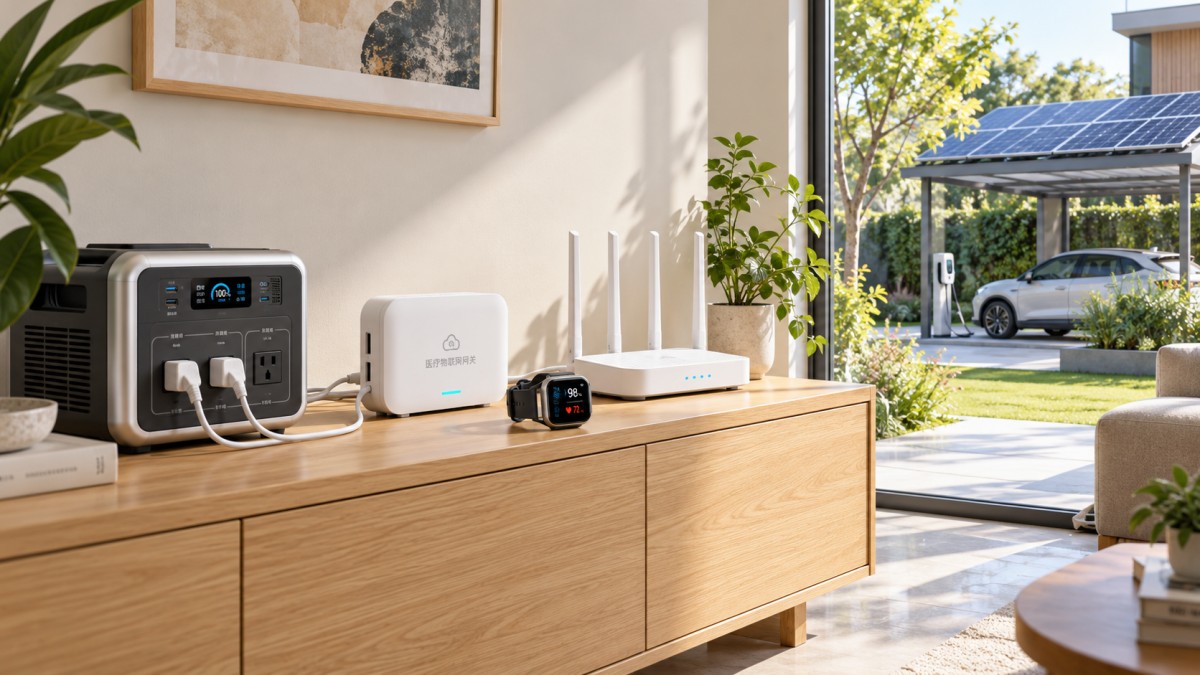
A useful test arrangement records timestamps at the sensor event, gateway receipt, service receipt, and final acknowledgment. Clocks need a documented synchronization method; otherwise, apparent latency differences can be clock error. Report the distribution of delays, including slow deliveries and failures, rather than relying on an average.
Protocol support also needs interpretation. A device joining a network does not establish that its health measurements retain their units, timestamps, quality flags, and alert semantics throughout the system. Where proprietary gateways or application mappings are involved, interoperability testing must follow the data through those translations.
Household conditions should challenge the intended installation. A closed bedroom door, a hub placed near other radio equipment, and a phone carried outside the home represent different failure mechanisms. Congestion tests should describe the interfering traffic and topology so that their severity is understandable. Adding wireless nodes can change routing behavior and retry traffic; it does not automatically improve alert delivery.
Recovery deserves a separate result. After connectivity returns, historical readings should retain their original timestamps, duplicates should be handled consistently, and expired alerts should remain distinguishable from current events. A dashboard that suddenly displays buffered measurements as fresh data creates a misleading picture even though every packet eventually arrives.
Battery life depends on the operating states between readings
Battery claims are meaningful only alongside a workload. Sampling, local processing, radio transmission, connection maintenance, storage, and firmware updates draw power differently. Measurements taken during quiet operation miss the energy consumed by retries in weak coverage or repeated reconnection after a gateway outage.
Runtime estimates should account for time spent in each operating state and use a defensible estimate of usable battery capacity. Temperature, aging, discharge rate, and the device’s minimum operating voltage affect that capacity. Nominal capacity alone cannot establish runtime, especially when brief current peaks cause the supply voltage to fall below a reset threshold.
The assessment should capture those peaks as well as average consumption. A device can have low average power and still restart during transmission when its battery is nearly depleted. Low-battery notification must therefore be tested against remaining usable operation under a relevant workload, including whether the warning itself reaches its destination.
Reducing reporting frequency may extend runtime, but it also changes data freshness. If the same adjustment delays event detection or hides brief events, the energy saving changes the care function. Comparisons should hold the required monitoring behavior constant or state precisely what capability was traded away.
Renewable energy changes the outage test, not the care requirement
A home with rooftop solar does not necessarily retain power during a grid outage. Continued operation depends on whether the installation supports backup operation and which circuits it supplies. A medical IoT hub connected to an unprotected outlet will lose power even if other household loads remain supported.
Map the entire communication path onto the available backup supply. The sensor, gateway, router, and internet access equipment can have separate power dependencies. Keeping the gateway running is insufficient when the network equipment loses power. Where an alternative communication route exists, its transition and actual message delivery need testing.
Backup transitions should be assessed for brief interruptions, repeated restarts, and correct recovery. Local storage must preserve records through an unexpected shutdown, while startup behavior should reveal stale data and pending alerts. An outage test that ends as soon as power returns misses failures that appear during reconnection.
Renewable generation also introduces energy-management decisions. Flexible charging or nonessential data transfers can be scheduled around available energy, provided the change preserves monitoring and alert requirements. Care-related power needs should be explicit inputs to load prioritization rather than silently sharing the curtailment rules used for discretionary household appliances.
Turning evidence into a defensible selection
A practical evaluation has three possible outcomes: sufficient evidence for the intended configuration, evidence supporting only a narrower use, or unresolved gaps requiring further testing. These outcomes are more informative than a single overall score because a strong battery result cannot compensate for an unreliable alert path.
Hard acceptance conditions belong ahead of weighted comparisons. If an application requires event delivery during a home internet outage, a configuration without a demonstrated alternate path fails that requirement regardless of its normal-operation latency. Weighted scoring becomes useful after these essential conditions are satisfied.
The final evidence package should connect each acceptance condition to a report section, recorded observation, and tested configuration. Unresolved gaps need a specific next test: for example, measuring reconnection behavior with a depleted battery, or confirming that buffered readings remain correctly timestamped after gateway recovery. This makes uncertainty actionable without treating assumptions as results.
Selection remains provisional when firmware, battery chemistry, gateway software, or sensor processing changes materially. Retesting should follow the affected behavior: a radio retry adjustment calls for renewed connectivity and power measurements, while a detection algorithm change requires event-performance evaluation. Approval is strongest when it applies to an identifiable configuration and a defined care workflow.
Protocol_Architect
Dr. Thorne is a leading architect in IoT mesh protocols with 15+ years at NexusHome Intelligence. His research specializes in high-availability systems and sub-GHz propagation modeling.
Related Recommendations
- Dr. Sophia Carter (Medical IoT Specialist)Evaluating NexusHome Intelligence for Medical IoT in Home Care
- Dr. Sophia Carter (Medical IoT Specialist)Planning Medical IoT for Remote Patient Monitoring: Power and Connectivity
- Dr. Sophia Carter (Medical IoT Specialist)Choosing an ECG Wearable Patch Manufacturer: Quality Checks and Lead Times
- Dr. Sophia Carter (Medical IoT Specialist)IEC 60601 Compliance for ECG Wearable Patches: Tests, Design Risks, and Evidence
- Dr. Sophia Carter (Medical IoT Specialist)How to Evaluate a Medical Robot Arm OEM for Precision and Regulatory Readiness
- Dr. Sophia Carter (Medical IoT Specialist)How to Choose an ECG Wearable Patch Provider for Remote Patient Monitoring
- Dr. Sophia Carter (Medical IoT Specialist)How to Evaluate SpO2 Module Assemblies for Wearables and Medical IoT Devices
- Dr. Sophia Carter (Medical IoT Specialist)How to Choose Medical IoT Sensors for Vital Signs in Remote Patient Monitoring
- Dr. Sophia Carter (Medical IoT Specialist)What Drives Wearable Biosensors Project Cost in Medical IoT Deployment?
- Dr. Sophia Carter (Medical IoT Specialist)What Drives Blood Pressure Monitor Costs? Key Factors Buyers Should Compare
Analyst