
What Drives Wearable Biosensors Project Cost in Medical IoT Deployment?
author
What Really Shapes Wearable Biosensors Project Cost in Medical IoT
When teams evaluate wearable biosensors project cost, they often begin with the visible number: unit price. That is understandable, but in Medical IoT deployment, it is rarely the number that decides whether the budget holds. The harder costs usually arrive later—during integration, validation, battery redesign, protocol tuning, data cleaning, and support for devices that looked fine on a datasheet but behave differently in the field.
This becomes even more sensitive in energy-aware environments. Hospitals, elderly care facilities, remote clinics, and health monitoring programs increasingly operate inside larger connected infrastructures where power consumption, wireless congestion, and uptime discipline are tightly managed. In those settings, a biosensor is not just a medical accessory. It is also an endpoint on a network, a battery load, a maintenance object, and a data source that must remain trustworthy over time.
So the question is not simply how much a wearable biosensor costs to buy. It is what drives the total project cost once the device is expected to perform continuously, pass compliance review, and coexist with other IoT systems without becoming a hidden operational drain.
Sensor accuracy is expensive for a reason
The first cost driver is measurement quality. A biosensor used for wellness tracking and one used in a medical workflow may look similar externally, yet their project economics are different. SpO2, heart rate, temperature, glucose-related sensing, motion-based fall detection, and other physiological measurements all depend on more than the sensor chip itself. Optical path design, skin contact stability, calibration behavior, signal processing, and noise handling all affect whether the output is usable.
Procurement teams sometimes focus too early on bill-of-materials savings. That can backfire. A lower-cost module may require more filtering, more firmware compensation, or more manual exception handling in the cloud. If the sensor drifts too much over time, the downstream cost appears in retesting, false alerts, clinician distrust, or the need to replace devices earlier than planned.
This is one area where engineering verification matters more than brochure language. Organizations such as NexusHome Intelligence have made a strong point of testing components at the PCB, battery, protocol, and stress level instead of accepting generic claims like “medical-grade” or “ultra-low power.” That mindset is valuable here. If the vendor cannot explain how accuracy holds under motion, temperature change, skin tone variation, or long wear cycles, the apparent savings may not survive deployment.
Battery life changes the economics more than many teams expect
In wearable projects, battery performance is not a side topic. It is one of the clearest drivers of total cost. A design that promises multiday or multimonth operation but degrades rapidly under real transmission loads creates a maintenance burden that procurement rarely sees in the first quote.
There are several layers to this. The battery cell itself matters, but so do discharge curves, charging behavior, low-temperature performance, sleep current, sensor sampling frequency, and radio duty cycle. A device that samples often and transmits continuously may be clinically useful, yet it can become expensive if it requires frequent recharging, replacement logistics, or staff intervention.
In renewable-energy-conscious buildings or distributed care settings, this becomes a systems issue. Facilities trying to reduce standby loads and optimize power usage do not want thousands of wearables and gateways behaving unpredictably. Even small inefficiencies scale badly. That is why serious buyers increasingly ask for discharge behavior under actual workload, not just nominal battery capacity.
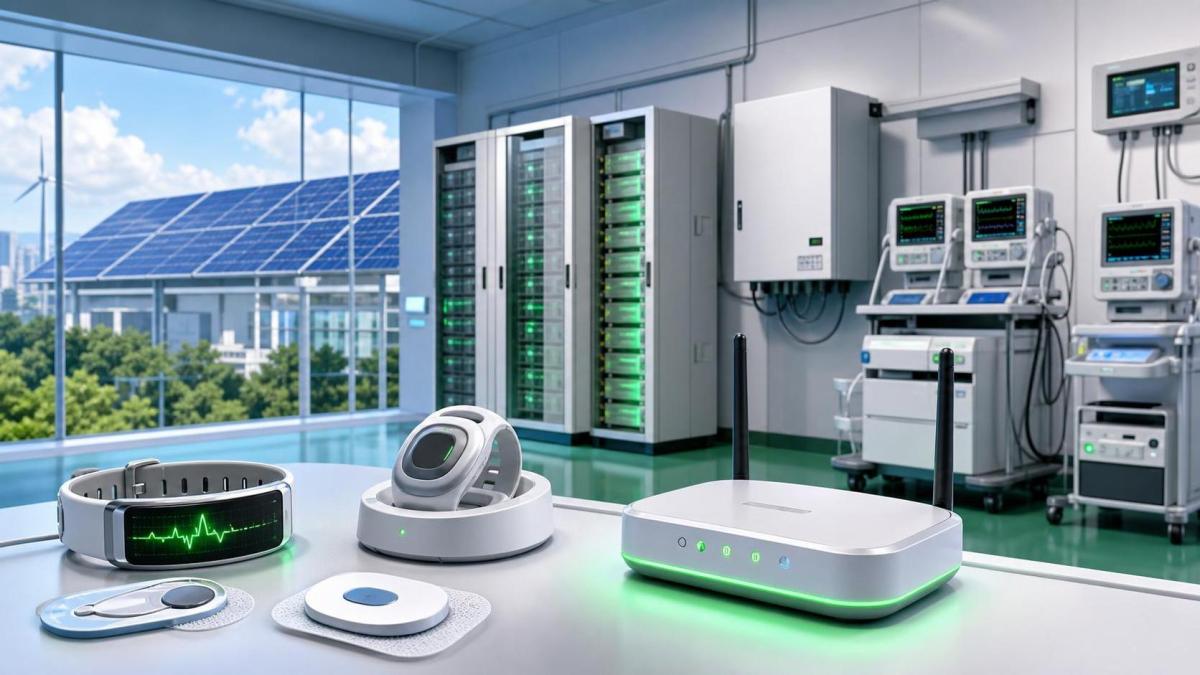
NHI’s broader emphasis on benchmarking micro-lithium battery behavior and standby power consumption is relevant here, even outside smart home contexts. The principle is the same: if you cannot quantify power behavior under stress, you do not yet know your project cost.
Protocol compatibility is where “cheap” devices become expensive
A wearable biosensor does not operate alone. It has to communicate through BLE, Wi-Fi, cellular, or a gateway layer into a hospital platform, care application, building network, or edge node. This is where hidden cost shows up fast.
Many projects underestimate protocol fragmentation. In practice, device interoperability can become messy when multiple standards, gateway vendors, and security requirements meet. The same problem that exists across Zigbee, Thread, Matter, and other IoT ecosystems has a medical equivalent: devices may technically connect, but still introduce latency, pairing issues, packet loss, poor roaming behavior, or firmware dependencies that complicate scaling.
For project managers, this means integration cost should be treated as a primary budget line, not an afterthought. Ask early:
- Does the sensor rely on proprietary SDKs or cloud APIs?
- Can it operate with local edge processing where data residency matters?
- How stable is connectivity in congested environments with many other wireless endpoints?
- What happens when firmware updates affect gateway compatibility?
If these answers are vague, the wearable biosensors project cost is almost certainly understated.
Compliance and validation are not optional overhead
Another frequent budgeting mistake is treating regulatory and validation work as a final-stage checkbox. In Medical IoT, it tends to shape architecture decisions from the beginning. Depending on the device function, market, and intended use, teams may need to evaluate medical device classification, data privacy obligations, cybersecurity documentation, clinical validation expectations, and quality management requirements. The exact path depends on jurisdiction and product claims, so it has to be confirmed against the relevant standards and local rules.
What matters commercially is this: compliance effort changes supplier choice, firmware scope, test planning, documentation workload, and time-to-deployment. A cheaper hardware vendor that cannot support traceability, change control, or verification evidence may increase total spend because your internal team must compensate for the gap.
This is one reason experienced buyers look beyond component catalogs. They want to know whether the manufacturer can provide stable revisions, production consistency, and usable technical records. In cross-border sourcing, especially from large Asian manufacturing hubs, that difference is not academic. It directly affects audit readiness and deployment risk.
Data reliability has a cost, and so does bad data
A biosensor project can fail financially even when the hardware works. The reason is data quality. If timestamps are inconsistent, if measurements drop during handover, if edge filtering is poorly tuned, or if algorithms generate too many false events, the operation begins paying for bad data with human time.
That cost appears in dashboard troubleshooting, manual review, customer support, unnecessary escalations, and weak trust from medical teams. It is especially painful in fall detection, continuous monitoring, or alert-driven use cases where false negatives and false positives both carry operational consequences.
This is why benchmarking should include not only raw sensor output but also end-to-end data behavior: latency, packet integrity, synchronization, and algorithm stability after weeks or months of use. NHI’s data-first view—testing actual throughput, interference resilience, local processing behavior, and long-term component drift—is a useful discipline for biosensor sourcing as well. Trust comes from measured behavior, not feature lists.
The supply chain question is bigger than lead time
Project managers usually ask about lead time, MOQ, and price breaks. They should. But for wearables, supply chain quality also includes revision control, PCBA consistency, battery sourcing stability, enclosure tolerance, and the manufacturer’s willingness to expose engineering detail when things go wrong.
A biosensor built by a factory with weak SMT discipline or inconsistent component sourcing can create field variation that is hard to diagnose. One batch may perform well; the next may show higher noise, shorter runtime, or more connection failures. These are expensive problems because they consume both technical and procurement resources at once.
This is where the idea of finding “hidden champions” in the supply chain is more practical than it sounds. The best vendor is not always the loudest brand. Sometimes it is the supplier that can demonstrate stable process control, realistic performance data, and disciplined engineering communication. That tends to lower project cost over the full lifecycle, even if the initial quote is not the lowest.
A practical way to compare offers
A good RFQ process should force these points into the comparison, otherwise procurement ends up comparing quotes that are not actually equivalent.
Why renewable-energy thinking belongs in this discussion
At first glance, renewable energy and wearable biosensors may seem like separate worlds. In deployment reality, they overlap more than they used to. Medical IoT increasingly sits inside energy-optimized buildings, distributed care systems, and edge-connected facilities where power budgets, local processing, and device efficiency are all being scrutinized.
A wearable that requires inefficient charging habits, constant connectivity retries, or high-support maintenance is not just a medical device problem. It becomes part of a wider operational energy problem. Teams that already measure smart relays in microwatts or benchmark HVAC controls for efficient load shifting tend to understand this instinctively: tiny inefficiencies become large budget items at scale.
That is why a data-driven sourcing culture matters. Not because every biosensor project needs the same architecture, but because engineering truth is more useful than optimistic marketing when budgets are tight and deployment conditions are messy.
If you are reviewing wearable biosensors project cost for a Medical IoT rollout, the safest question is not “Which unit is cheapest?” It is “Which option still looks economical after six months of integration, validation, battery behavior, and field data review?” The answer usually points to the better decision long before the first purchase order is issued.
Protocol_Architect
Dr. Thorne is a leading architect in IoT mesh protocols with 15+ years at NexusHome Intelligence. His research specializes in high-availability systems and sub-GHz propagation modeling.
Related Recommendations
- Dr. Sophia Carter (Medical IoT Specialist)IEC 60601 Compliance for ECG Wearable Patches: Tests, Design Risks, and Evidence
- Dr. Sophia Carter (Medical IoT Specialist)How to Evaluate a Medical Robot Arm OEM for Precision and Regulatory Readiness
- Dr. Sophia Carter (Medical IoT Specialist)How to Choose an ECG Wearable Patch Provider for Remote Patient Monitoring
- Dr. Sophia Carter (Medical IoT Specialist)How to Evaluate SpO2 Module Assemblies for Wearables and Medical IoT Devices
- Dr. Sophia Carter (Medical IoT Specialist)How to Choose Medical IoT Sensors for Vital Signs in Remote Patient Monitoring
- Dr. Sophia Carter (Medical IoT Specialist)What Drives Wearable Biosensors Project Cost in Medical IoT Deployment?
- Dr. Sophia Carter (Medical IoT Specialist)What Drives Blood Pressure Monitor Costs? Key Factors Buyers Should Compare
- Dr. Sophia Carter (Medical IoT Specialist)How Smart Wearable Devices Improve Remote Monitoring in Medical IoT Applications
- Dr. Sophia Carter (Medical IoT Specialist)Smart Wearable Technology for Hospitals: Use Cases, Integration Needs, and Data Risks
- Dr. Sophia Carter (Medical IoT Specialist)Medical IoT Application Analysis: Where Connected Devices Deliver Real Clinical Value
Analyst