
Trampoline Park Design Mistakes That Hurt Guest Flow
author
In complex venue planning, trampoline park design mistakes rarely stay isolated—they disrupt guest flow, strain staffing, increase energy waste, and weaken long-term operational performance.
For technical teams, trampoline park design must balance circulation, safety, visibility, HVAC load, and digital control infrastructure.
That challenge becomes sharper in renewable-energy-aware buildings, where layout decisions directly affect lighting demand, ventilation efficiency, and monitored power use.
This article examines the hidden planning errors that reduce throughput and explains how data-driven design improves both visitor movement and energy performance.
Foundation of Guest Flow in Trampoline Park Design
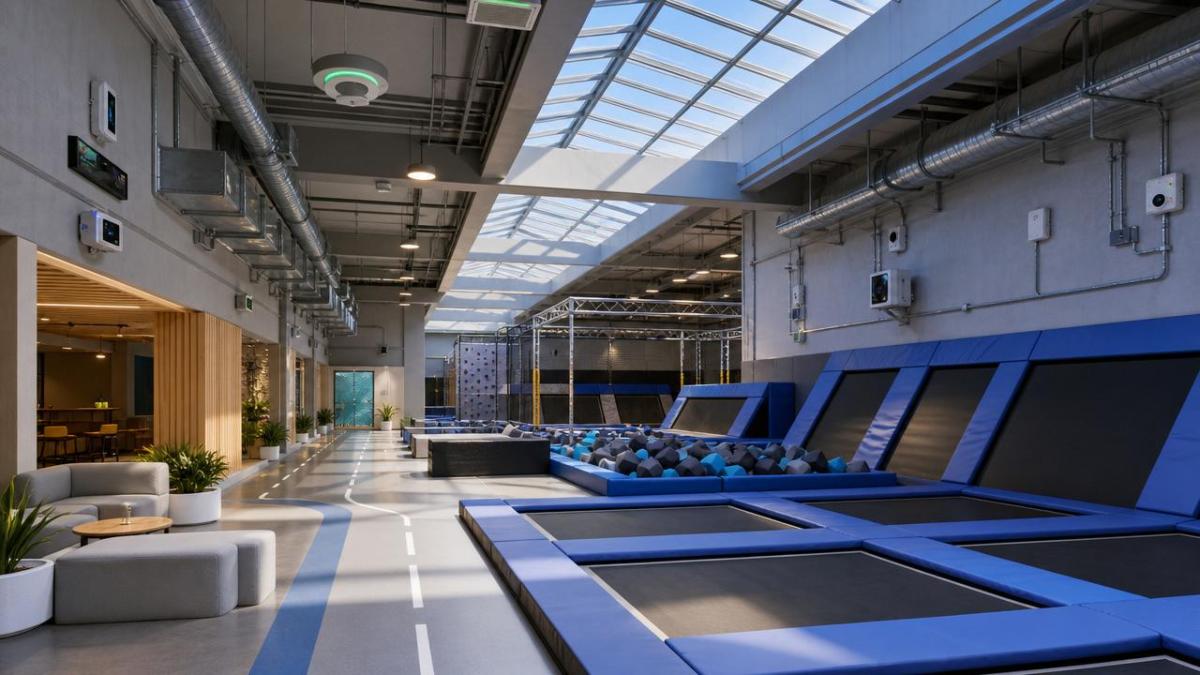
Effective trampoline park design starts with movement logic, not only attraction selection.
Guest flow includes entry, waiver processing, shoe change, briefing, play circulation, rest, food service, and exit.
When these paths intersect poorly, the facility experiences queue spillover, supervision blind spots, and avoidable congestion.
In renewable-energy-conscious facilities, poor flow also increases wasted conditioned air, unnecessary lighting zones, and unstable occupancy-driven control loads.
A modern trampoline park design should therefore connect spatial planning with building energy intelligence.
Core factors that shape movement quality
- Clear zoning between active, waiting, and recovery areas
- Direct sightlines for staff and cameras
- Low-friction transitions between attractions
- Balanced HVAC and lighting distribution by occupancy pattern
- Digital monitoring for peak-load management
Current Industry Pressure Points Affecting Layout Decisions
Today, trampoline park design is influenced by more than entertainment trends.
Facility operators increasingly track energy intensity, air quality, heat recovery, and smart-building interoperability.
This aligns with wider renewable energy goals, where buildings must perform better under variable occupancy.
These forces mean layout mistakes now carry both operational and energy penalties.
Design Mistakes That Hurt Guest Flow and Resource Efficiency
Several recurring errors weaken trampoline park design across customer experience, staffing, and sustainability.
1. Overloading the entrance sequence
Combining check-in, waiver verification, lockers, and retail in one narrow zone creates bottlenecks immediately.
Congestion near doors also increases conditioned air loss and destabilizes indoor temperature.
2. Poor adjacency between high-demand attractions
Placing dodgeball, foam pits, and main courts too close causes crowds to merge unpredictably.
This reduces throughput and forces larger cooling volumes in heavily packed zones.
3. Ignoring recovery and observation space
Guests need pause areas between intense activities.
Without them, circulation paths become informal waiting zones, slowing movement and blocking supervision lines.
4. Creating dead-end circulation
A weak trampoline park design often forces visitors to backtrack through busy areas.
Dead ends increase collision risk and make occupancy-based lighting control less precise.
5. Mismatched HVAC zoning
Active jump zones generate heat differently from cafés, party rooms, or spectator seating.
If the layout ignores this, ventilation systems overwork and renewable electricity savings are diluted.
6. Weak sensor and control placement
Occupancy sensors, CO2 monitors, and smart relays must follow real movement paths.
Bad placement leads to false triggers, delayed response, and wasted power.
Operational Value of Better Trampoline Park Design
Better trampoline park design improves more than comfort.
It strengthens measurable performance across energy, safety, staffing, and digital building control.
- Shorter queues reduce pressure on lobby ventilation and entrance heat loss
- Cleaner zoning supports targeted lighting schedules
- Improved visibility lowers staffing inefficiency
- Balanced occupancy supports peak-load reduction strategies
- Sensor-aligned layouts improve BMS and IoT data accuracy
For organizations focused on decarbonization, these gains matter because entertainment venues often suffer from fluctuating, difficult-to-control demand profiles.
A data-led trampoline park design helps smooth those patterns.
Typical Layout Scenarios and Their Risk Profiles
Not every venue has the same flow risks.
Common formats need different design responses.
Practical Planning Guidance for Smarter Layouts
A stronger trampoline park design process should use flow mapping and energy modeling together.
Recommended actions during planning
- Model visitor paths by time block, not only by floor area.
- Separate high-intensity zones from long-dwell social areas.
- Align HVAC zones with actual metabolic and occupancy loads.
- Position sensors where movement truly changes, not where wiring is easiest.
- Use daylight and localized controls to reduce unnecessary electrical demand.
- Test line-of-sight coverage for staff and machine vision systems.
These steps fit well with the NHI philosophy of engineering truth through measurable performance.
Rather than trusting generic claims, teams should verify how each layout affects latency, sensing reliability, and energy use.
Data-Driven Next Steps for Long-Term Performance
The best trampoline park design is not only attractive on opening day.
It remains adaptable as occupancy patterns, control platforms, and renewable energy strategies evolve.
A practical next step is to audit circulation, supervision coverage, HVAC zoning, and IoT data points before finalizing layout decisions.
Then compare those findings against measurable targets such as queue duration, zone temperature stability, CO2 response time, and power consumption by area.
When trampoline park design is evaluated through both guest flow and resource efficiency, the result is safer movement, cleaner operations, and stronger sustainability outcomes.
That is the path toward venues that perform reliably in a smarter, lower-carbon built environment.
Protocol_Architect
Dr. Thorne is a leading architect in IoT mesh protocols with 15+ years at NexusHome Intelligence. His research specializes in high-availability systems and sub-GHz propagation modeling.
Related Recommendations
- Lina Zhao(Security Analyst)EU Tightens CE-RED for Vision AI Cameras: AI Latency Capped at ≤75ms
- Lina Zhao(Security Analyst)Middle East Vision AI White List Re-Review Launched
- Lina Zhao(Security Analyst)EU CE-RED Update: Vision AI Camera Inference Latency Tightened to ≤75ms
- Lina Zhao(Security Analyst)Middle East 6-Nation AI Security Whitelist Enforces Quarterly Power-Accuracy Reporting
- Lina Zhao(Security Analyst)Trampoline Park Design Mistakes That Hurt Traffic Flow
- Lina Zhao(Security Analyst)EU CE-RED Adds 85ms AI Inference Latency Requirement for Vision Cameras
- Lina Zhao(Security Analyst)Trampoline Park Design Mistakes That Hurt Visitor Flow
- Lina Zhao(Security Analyst)EU CE-RED Adds AI Inference Latency Check for Vision AI Cameras
- Lina Zhao(Security Analyst)GCC Six-Nation Vision AI Security Procurement White List Released
- Lina Zhao(Security Analyst)EU CE-RED Adds AI Latency Check for Vision AI Cameras
Analyst