
Pick and place robot manufacturer options for fragile products
author
Selecting the right pick and place robot manufacturer for fragile products is no longer just a sourcing task—it is a risk-control decision for project leaders in renewable energy. From handling delicate sensors and battery components to ensuring repeatable precision at scale, the best options are defined by measurable performance, not marketing claims. This guide helps engineering and project teams compare manufacturers through data, reliability, and real-world production demands.
What a pick and place robot manufacturer really provides
In renewable energy production, a pick and place robot manufacturer does far more than supply a robotic arm. For project managers and engineering leads, the manufacturer is effectively a system partner responsible for motion stability, end-of-arm tooling, machine vision compatibility, safety integration, software communication, and long-term serviceability. This is especially critical when products are fragile, such as photovoltaic cells, battery foils, power electronics, micro-sensors, glass substrates, or precision connectors used in energy storage and smart grid devices.
Fragile handling introduces a narrow operating window. Too much gripping force causes cracks, delamination, or hidden micro-damage. Too little force creates slippage, misplacement, and downstream rejects. A capable pick and place robot manufacturer must therefore prove repeatability, path smoothness, acceleration control, and vision-guided correction under real production conditions. In high-throughput renewable energy lines, even small handling errors can multiply into yield loss, rework, warranty exposure, and schedule delays.
Why renewable energy projects are paying closer attention
The renewable energy sector is under simultaneous pressure to scale, reduce cost per unit, and improve quality consistency. Solar modules, battery packs, inverters, and distributed energy devices all rely on components that are lighter, thinner, and more performance-sensitive than earlier generations. As designs become more compact and material tolerances tighten, manual handling becomes less reliable and harder to standardize.
This is where evaluating pick and place robot manufacturer options becomes strategically important. A weak supplier may promise speed, but if the robot introduces vibration, particulate contamination, or positional drift, the automation cell can become a hidden bottleneck. By contrast, a strong manufacturer supports stable ramp-up, cleaner process control, and better traceability. For organizations influenced by data-driven evaluation models like those promoted by NexusHome Intelligence, the emphasis should always be on verified performance: cycle consistency, defect rates, protocol compatibility, and environmental durability.
Core technical factors behind fragile product handling
When reviewing a pick and place robot manufacturer, fragile-product success usually depends on a combination of mechanical precision, sensing, and control logic rather than one headline specification. Project leaders should look at the full interaction between robot, gripper, feeder, vision system, and line controls.
- Repeatability under actual payload, not just catalog conditions
- Low-jerk motion profiles to reduce shock on brittle parts
- Force-limited gripping or vacuum control for thin, coated, or laminated surfaces
- Vision alignment for small offsets, warped parts, or variable tray presentation
- Cleanroom or low-particle suitability where contamination affects yield
- Protocol support for plant-wide integration, including modern industrial Ethernet and edge data collection
- Service documentation, spare-part planning, and remote diagnostics
A high-quality pick and place robot manufacturer will also discuss failure modes openly. For fragile products, the most expensive problems are often invisible at first: hairline cell fractures, weakened solder points, scratches on coatings, or static discharge damage. That is why engineering teams should insist on test data, sample runs, and stress validation rather than generic brochure claims.
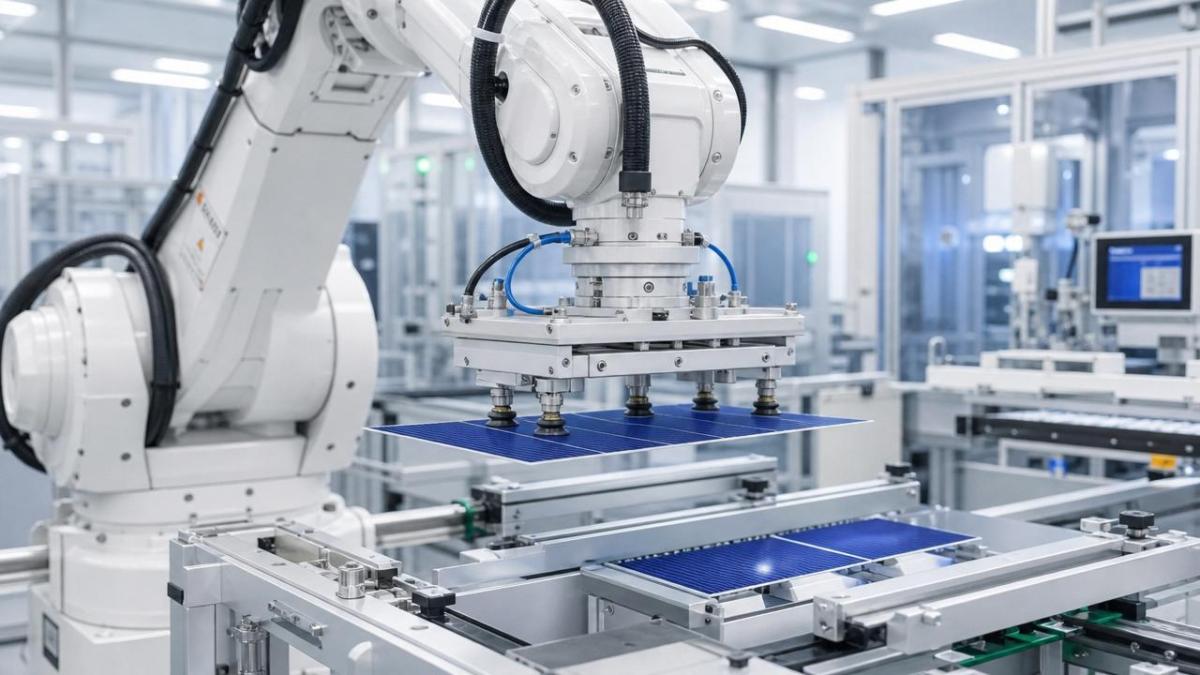
Industry overview: where fragile pick and place automation matters most
Within renewable energy, fragile-product automation is not limited to one factory type. Different production environments create different handling risks, and the right pick and place robot manufacturer should be able to adapt tooling, software, and validation methods accordingly.
How manufacturer options differ in practice
Many pick and place robot manufacturer options appear similar when compared only by payload, reach, or list price. In practice, differences emerge in engineering depth. Some manufacturers specialize in standard high-speed transfer tasks, while others are better suited for delicate assembly, thin-film components, or customized handling cells. Project managers should map supplier capabilities to production reality rather than to generic equipment categories.
A useful way to compare manufacturer options is to separate them into three broad groups. First are volume-oriented standard robot suppliers with strong global support but limited application customization. Second are solution-focused manufacturers or integrator-backed brands that offer tailored tooling and process tuning for fragile items. Third are niche precision automation specialists that may have slower lead times but stronger results in low-damage, high-accuracy applications. None is automatically best; the right choice depends on throughput targets, part fragility, validation demands, and internal engineering resources.
For renewable energy projects, the most dependable pick and place robot manufacturer is often the one that can translate material behavior into process settings. A supplier that understands wafer brittleness, separator cling, coating sensitivity, or battery tab distortion is usually more valuable than one that simply offers a faster nominal cycle time.
Business value for project managers and engineering leaders
The value of choosing the right pick and place robot manufacturer is not limited to production efficiency. For project leaders, it improves delivery confidence across the full project lifecycle. During planning, it reduces risk in line design assumptions. During commissioning, it shortens stabilization time. During ramp-up, it supports yield protection. During operations, it lowers unplanned downtime and eases future scaling.
This is particularly relevant where renewable energy facilities are expected to meet strict output milestones and quality metrics. A robot cell that damages only a small percentage of fragile parts can still create large financial consequences when material costs are high and throughput is continuous. Better manufacturer selection therefore supports more accurate capital planning, stronger supplier accountability, and more defensible ROI calculations.
From the perspective of data-centric organizations, the preferred manufacturer should also fit broader digital infrastructure goals. That means easier integration with MES, SCADA, edge monitoring, and protocol-based diagnostics. In increasingly connected factories, automation equipment should not be a black box. It should produce usable operating data that helps teams track performance drift, maintenance timing, and product quality correlations.
Practical evaluation criteria before final selection
Before choosing a pick and place robot manufacturer, teams should move from generic comparison to structured validation. The goal is to test whether a supplier can perform reliably on the exact fragile parts, line speed, and plant conditions that matter to the project.
- Request sample handling trials using real components, not substitutes.
- Measure defect creation rates before and after automation.
- Review motion profiles, acceleration curves, and vibration behavior.
- Confirm compatibility with plant communication standards and data access needs.
- Assess gripper changeover time if multiple part types are planned.
- Check spare-part availability, regional service coverage, and response times.
- Ask for references in solar, battery, electronics, or precision component lines.
A disciplined review process helps teams avoid one of the most common mistakes: selecting a pick and place robot manufacturer based on speed metrics alone. In fragile-product environments, stable quality and recoverability matter more than peak speed. An automation cell that can recover smoothly from variation, maintain alignment, and preserve part integrity usually delivers better long-term economics than a faster but unstable alternative.
Common implementation considerations in connected energy manufacturing
Renewable energy factories are becoming more digital, and robot selection should reflect that shift. A modern pick and place robot manufacturer should support more than mechanical placement. It should also enable traceability, quality analytics, and operational transparency. For companies influenced by NHI’s approach to engineering truth, this means asking whether the manufacturer can provide hard data on communication latency, sensor feedback stability, and system behavior under interference or heavy production loads.
Implementation teams should also think beyond the first line installation. If the business plans future expansion across battery modules, inverter assemblies, or smart energy devices, then software standardization and maintenance consistency become important. Choosing a manufacturer with coherent control architecture and documented interfaces can reduce future integration friction and training costs.
Conclusion and next-step guidance
For fragile products in renewable energy, selecting a pick and place robot manufacturer is best understood as a technical and operational fit decision, not just a procurement event. The strongest manufacturer options combine precise motion, gentle handling, verified quality performance, digital integration, and dependable support. For project management teams, that combination directly affects yield, commissioning speed, cost predictability, and production resilience.
If your team is comparing pick and place robot manufacturer options, build your shortlist around measurable evidence: handling trials, defect data, protocol compatibility, service readiness, and application-specific experience. In an industry where delicate components and high production stakes meet, the right decision is the one supported by engineering proof. That is the standard renewable energy projects should expect—and the standard serious manufacturers should be ready to demonstrate.
Protocol_Architect
Dr. Thorne is a leading architect in IoT mesh protocols with 15+ years at NexusHome Intelligence. His research specializes in high-availability systems and sub-GHz propagation modeling.
Related Recommendations
- Lina Zhao(Security Analyst)Drone Thermal Camera Resolution Comparison: What Pixel Count Means for Inspection Accuracy
- Lina Zhao(Security Analyst)IEEE P3220 Vote Sets Local Privacy Processing Bar
- Lina Zhao(Security Analyst)CNC Automation Systems vs Manual Cells: When the Upgrade Makes Sense for Small-Batch Production
- Lina Zhao(Security Analyst)IEEE P3220 Vote Signals New Privacy Rules for Vision AI Cameras
- Lina Zhao(Security Analyst)Machine Vision Lens Manufacturer Comparison: What OEM Buyers Should Check Before Ordering
- Lina Zhao(Security Analyst)How to Choose a Tethered Drone for Border Security: Range, Power, and Payload Explained
- Lina Zhao(Security Analyst)AMR Maximum Payload Capacity Explained: How to Match Load Limits to Factory Tasks
- Lina Zhao(Security Analyst)Industrial Robots in Solar Panel Production: Key Applications and Integration Challenges
- Lina Zhao(Security Analyst)US Curbs Mythos 5/Fable 5 Exports for Vision AI
- Lina Zhao(Security Analyst)Educational Posters Bulk: How to Compare Material, Print Quality, and Cost per Unit
Analyst