
3D vision for robotic bin picking when parts keep overlapping
author
When 3D vision for robotic bin picking must perform under constant part overlap, success depends on more than imaging alone. In renewable energy manufacturing, combining sensor fusion lidar and camera, machine vision for defect detection, and edge ai for smart manufacturing helps operators, buyers, and decision-makers reduce picking errors, protect throughput, and build data-driven automation systems that stay reliable in demanding production environments.
Why overlapping parts make robotic bin picking harder in renewable energy production
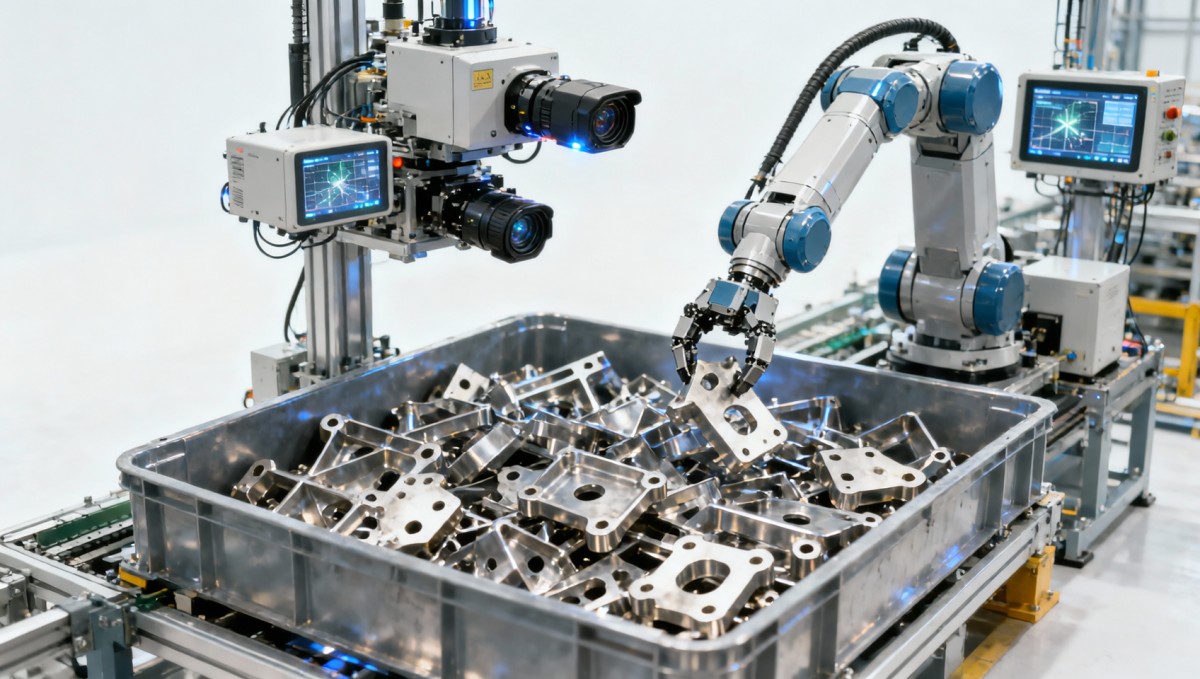
In renewable energy manufacturing, robotic bin picking is rarely a clean laboratory task. Components such as stamped brackets, busbar connectors, fasteners, die-cast housings, cable clips, and small structural parts often arrive in bins with partial occlusion, reflective edges, and irregular stacking. Once overlap becomes continuous rather than occasional, standard 3D vision for robotic bin picking can lose depth confidence, misread grasp points, or fail to separate one part from another within the cycle time window.
This challenge matters because production lines for solar, battery, inverter, and energy storage equipment usually run under strict takt expectations. A missed pick is not just a robot issue. It can trigger feeder starvation, stop an assembly cell, or create downstream inspection congestion. In many factories, a delay of even 2–5 seconds per pick accumulates quickly across 2 or 3 shifts, especially when bins are replenished several times per day.
For information researchers and engineering teams, the key question is not whether a vision system can recognize a part in ideal conditions. The real question is whether it can maintain stable pose estimation when 20%–60% of visible surfaces are blocked by adjacent parts, when ambient light changes across workstations, and when part finishes vary from matte-coated steel to reflective aluminum.
For operators, the pain point is practical. They need fewer manual interventions, faster recovery after a failed pick, and clear alarm logic. For procurement teams, the concern is different: they must compare not just camera resolution, but also sensor fusion lidar and camera architecture, software adaptability, integration effort, and edge computing requirements. For decision-makers, the priority is throughput stability, not brochure claims.
What changes when overlap is persistent instead of occasional
Occasional overlap can often be managed by basic point-cloud filtering and retry logic. Persistent overlap requires a different system design. The vision stack must identify partial geometry, estimate graspable surfaces from incomplete data, and reject picks with a high collision probability. In most industrial settings, this means moving from single-sensor imaging to a fusion strategy that combines depth, reflectance, and contextual scene understanding.
- Depth data must remain usable across mixed surface conditions, including dark polymers, brushed metal, and glossy coatings common in power electronics assemblies.
- The grasp planner must account for neighboring parts within a narrow tolerance band, often in the range of a few millimeters, rather than treating each object as isolated.
- The recovery sequence should support 2–4 fallback actions, such as re-scan, alternate grasp angle, air-blast separation, or skip-and-requeue logic.
This is where a data-driven evaluation approach becomes valuable. NHI focuses on measurable behavior under real interference, protocol variation, and edge processing constraints. That mindset is highly relevant here, because robotic bin picking performance depends on benchmarkable facts: latency, scene reconstruction quality, packet stability between devices, and robustness under stress.
Which vision architecture works better when parts keep overlapping?
There is no single universal vision stack for every renewable energy factory. The right architecture depends on part geometry, surface reflectivity, required cycle time, and the level of bin disorder. Still, some patterns are clear. A monocular camera may support simple guidance, but it usually struggles with dense overlap. Stereo setups improve depth, yet highly reflective or low-texture parts can still cause unstable point clouds. Sensor fusion lidar and camera systems often provide better resilience because they combine complementary signals.
The next layer is software. Machine vision for defect detection is not the same as pick guidance, but in advanced lines the two can support each other. A system that first distinguishes damaged, bent, or contaminated parts can prevent wasted pick attempts. When the robot only targets valid parts, downstream assembly quality improves and operators spend less time removing rejects manually.
Edge AI for smart manufacturing adds another advantage. Instead of sending every image and point cloud to a distant server, the system can process object segmentation, grasp ranking, and anomaly filtering locally. That reduces latency, improves line autonomy during network fluctuation, and aligns with factories that want stronger control over production data. In practical deployments, local inference often matters most when cycle times need to stay within a few seconds.
The table below compares common vision approaches for overlapping-part bin picking in renewable energy production. It is not a ranking. It is a decision aid for matching risk level, part type, and integration complexity.
The comparison shows why price alone is a poor buying filter. A cheaper camera package can become more expensive if it increases manual recovery, scrap handling, and downtime. NHI’s data-first perspective is useful here: the more fragmented the industrial ecosystem becomes, the more procurement should ask for measured latency, interface behavior, retry performance, and real operating limits instead of generic compatibility claims.
Three technical capabilities that matter most
1. Occlusion-tolerant scene reconstruction
The system should estimate usable part geometry even when a large section is hidden. This is especially important for metal hardware used in solar mounting systems, battery pack assembly, and inverter enclosure production, where part edges often interlock visually.
2. Fast local inference
If the cell target is a 3–8 second cycle, sending raw data to remote processing can add unnecessary risk. Edge AI for smart manufacturing keeps segmentation and pick validation close to the robot controller and reduces the chance that network congestion will affect pick timing.
3. Integrated quality filtering
Machine vision for defect detection helps identify burrs, deformation, contamination, or coating damage before a part enters the next station. In renewable energy production, preventing one wrong component from entering battery, inverter, or control assemblies can save much more than the vision inspection cost.
How to evaluate performance, integration, and risk before you buy
Buyers often receive proposals filled with sensor names and AI claims, but too few measurable acceptance criteria. A practical procurement process should define 4 core dimensions from the start: pick success under overlap, cycle time stability, integration with existing control and data systems, and operational maintainability. Without these, even a technically impressive demo may fail in production.
In renewable energy factories, one more factor matters: interoperability. Vision, robot, PLC, MES, edge gateway, and quality systems frequently come from different vendors. NHI’s manifesto emphasizes the risk of protocol silos, and that concern applies directly to automation sourcing. If your 3D vision platform cannot exchange useful diagnostics and timestamped events reliably, operators and engineers lose visibility into why picks fail.
A realistic pilot should run long enough to expose edge cases. For many projects, a 2–4 week validation period is more meaningful than a one-day demo. During that window, teams can test different bin fill levels, surface variations, lighting conditions, and shift changes. This is where weak systems reveal themselves, especially when overlap patterns change after replenishment.
The following table can be used as a procurement checklist for 3D vision for robotic bin picking in overlap-heavy applications.
A good selection process should also include operator input. Many failures are not algorithmic alone. They come from dirty optics, poor bin placement, inconsistent replenishment, or unclear HMI alarms. If the frontline team cannot interpret the system state within a few seconds, uptime suffers even when the vision engine is strong.
A practical 5-point buying checklist
- Define 3 bin conditions for testing: fresh fill, mid-run overlap, and low-level residual picking.
- Request measured scan-to-decision timing, not only average cycle claims from ideal scenes.
- Confirm whether machine vision for defect detection can be combined with picking logic or must be deployed separately.
- Verify local processing options if edge AI for smart manufacturing is required for latency or data governance reasons.
- Ask for a support plan covering recipe changes, spare parts, and remote diagnostics over the first 6–12 months.
These checks reduce the risk of buying a system that demos well but struggles after installation. They also create better alignment between procurement, engineering, and operations, which is often the difference between a usable automation cell and an expensive troubleshooting project.
Implementation, compliance, and common mistakes teams should not ignore
Implementation success depends on more than the sensor head. In renewable energy facilities, robotic bin picking often sits inside a wider digital environment that includes traceability, quality records, energy monitoring, and secure industrial communications. That means integrators should review not only mechanical reach and lighting, but also data flow, cybersecurity responsibilities, and maintainable software updates.
A staged rollout usually works best. Many factories follow a 3-stage path: offline sample validation, controlled pilot at one station, then scaled deployment to similar cells. This staged model helps teams compare part families, tune grasp libraries, and establish acceptance criteria before wider investment. It also gives operators time to build trust in the system rather than treating it as a black box.
Compliance should be addressed early. Depending on the plant and region, teams may need to consider machine safety integration, electrical conformity, industrial network security policies, and local data handling rules. If image streams or production data are retained, internal governance can become just as important as technical capability. NHI’s emphasis on measurable security and edge computing discipline is relevant because local processing and clear audit trails reduce avoidable compliance friction.
The most common mistake is assuming that better imaging alone solves overlap. In reality, stable performance usually comes from a combined package: suitable end-effector design, consistent bin presentation, robust sensor fusion lidar and camera setup, reliable edge inference, and realistic operator procedures. If one of these is weak, the entire cell becomes inconsistent.
Frequent misconceptions in overlap-heavy bin picking
“Higher resolution always means better picking”
Resolution helps, but only when lighting, compute capacity, and algorithm design support it. Otherwise, larger image loads can increase processing time without improving grasp certainty.
“One successful demo proves production readiness”
A short demo rarely exposes replenishment variation, dirt buildup, mixed lots, or network traffic changes. Production readiness requires repeated testing over multiple runs and operating conditions.
“AI will compensate for poor mechanical design”
AI can improve segmentation and grasp ranking, but it cannot fully overcome unsuitable grippers, unstable fixturing, or badly positioned bins. Mechanical and digital layers must be designed together.
FAQ for researchers, buyers, and plant teams
How do I know if sensor fusion lidar and camera is worth the extra cost?
It is usually worth deeper evaluation when parts are reflective, overlap is frequent, lighting is variable, or the line cannot tolerate frequent manual recovery. If your current system fails mainly at the end of the bin or under mixed material conditions, fusion-based sensing often deserves priority review.
Can machine vision for defect detection and bin picking run in the same cell?
Yes, in many cases they can be coordinated, but the architecture should be planned carefully. The pick task needs fast scene interpretation, while defect checks may require different viewing angles or lighting. The benefit is that unsuitable parts can be screened before they enter assembly.
What deployment timeline is realistic?
For a single defined part family, teams often plan several phases: sample review, pilot integration, and line validation. Actual timing varies by tooling, software training, and interface work, but buyers should request a clear breakdown rather than one total number.
Why is edge AI for smart manufacturing becoming more important?
Because factories want faster decisions, stronger resilience during network instability, and tighter control over industrial data. Local processing also helps when multiple vision nodes operate across the same plant and bandwidth needs to be managed carefully.
Why choose a data-driven partner for evaluation and next-step planning
When overlapping parts keep disrupting robotic bin picking, the safest path is not more marketing language. It is better measurement, clearer comparison, and a stronger engineering filter. That is where NHI’s position matters. Our approach is built around transparent benchmarking, protocol awareness, edge performance scrutiny, and practical verification across connected hardware environments. In factories facing fragmented ecosystems, those disciplines help separate usable solutions from attractive claims.
For renewable energy manufacturers, this means support that aligns with real production priorities: stable picking under overlap, meaningful interoperability, realistic deployment planning, and visibility into technical trade-offs. Whether you are comparing 3D vision for robotic bin picking platforms, reviewing sensor fusion lidar and camera options, or assessing how machine vision for defect detection and edge AI for smart manufacturing should work together, the right next step is a structured technical discussion.
You can contact us to discuss parameter confirmation, part characteristics, overlap severity, integration architecture, expected cycle time, edge deployment needs, defect inspection scope, sample evaluation planning, and supplier comparison criteria. We can also help frame questions around delivery stages, customization boundaries, data handling expectations, and the practical checkpoints that procurement and engineering teams should align on before launch.
If your team is preparing a pilot or reviewing vendors now, share the part type, bin state, target throughput, and system interfaces under consideration. A focused review at that stage can reduce rework later and help you move from uncertain automation claims to evidence-based decisions.
Protocol_Architect
Dr. Thorne is a leading architect in IoT mesh protocols with 15+ years at NexusHome Intelligence. His research specializes in high-availability systems and sub-GHz propagation modeling.
Related Recommendations
- Lina Zhao(Security Analyst)ToF Camera Depth Accuracy in Millimeters: What Affects Precision in Real Applications?
- Lina Zhao(Security Analyst)Mapping Drone for Mining Industry: Key Sensors, Flight Time, and Accuracy Factors
- Lina Zhao(Security Analyst)How to Choose Rotating Jewelry Displays for Retail Counters and Trade Show Booths
- Lina Zhao(Security Analyst)Robotic Arm Vibration Analysis: How to Diagnose Resonance, Wear, and Positioning Drift
- Lina Zhao(Security Analyst)Solid-State LiDAR Point Cloud Density Explained: What Affects Accuracy in Outdoor Mapping?
- Lina Zhao(Security Analyst)How to Evaluate TOF Camera Depth Accuracy at the Millimeter Level
- Lina Zhao(Security Analyst)What Is a Good starlight night vision lux rating?
- Lina Zhao(Security Analyst)What sets a safe lidar payload weight limit today?
- Lina Zhao(Security Analyst)DeepSeek-V4-Pro API Price Cut to 25% of Original
- Lina Zhao(Security Analyst)EN 303 646-2:2026 Enforced: Edge Inference Latency Testing for Vision AI Devices
Analyst