
What Is a Good starlight night vision lux rating?
author
For renewable energy sites, a good starlight night vision lux rating is not a decorative specification.
It is a field reliability metric for cameras protecting solar farms, wind parks, battery yards, and remote substations.
Low-light cameras must identify activity under moonlight, cloud cover, and near-dark conditions without excessive power draw.
This article explains how to interpret lux numbers, compare sensors, and select practical low-light capability for energy infrastructure.
Starlight Lux Rating Fundamentals for Energy Sites
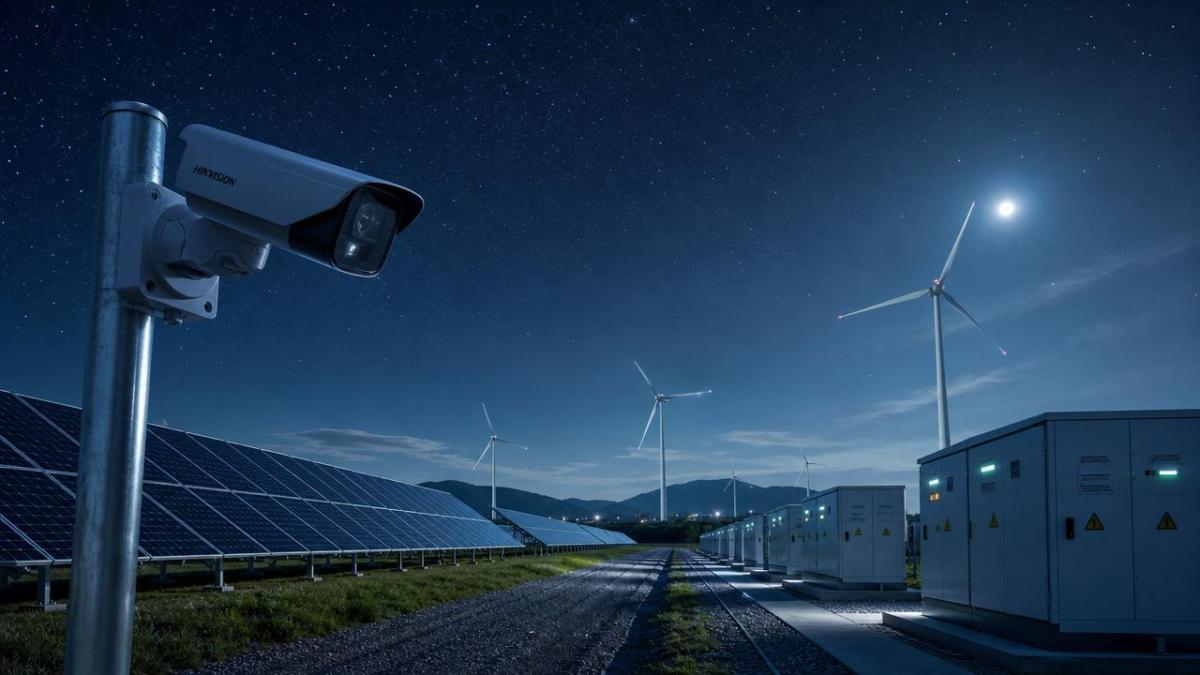
Lux measures illuminance, or how much visible light reaches a surface.
A starlight night vision lux rating indicates the minimum light level at which a camera can produce usable imagery.
In practice, “usable” must be defined carefully.
A brochure image may look bright, yet fail to identify faces, tools, vehicles, or cable theft activity.
A good starlight night vision lux rating usually falls between 0.005 lux and 0.001 lux for demanding outdoor surveillance.
For many renewable energy perimeters, 0.01 lux is acceptable only when supplemental lighting or infrared support exists.
At 0.001 lux, high-quality sensors can capture meaningful color detail under clear starlight or weak ambient sky glow.
However, the starlight night vision lux rating alone never proves total performance.
Lens aperture, sensor size, exposure time, image processing, compression, and noise reduction all influence the final result.
Common Lux Reference Points
Why Renewable Energy Infrastructure Raises the Standard
Renewable energy assets are often distributed across large, low-traffic, poorly lit terrain.
They may sit far from city lighting, network backhaul, maintenance teams, and fast response resources.
This makes the starlight night vision lux rating especially important for early detection and evidence quality.
Solar farms face copper theft, inverter tampering, wildlife intrusion, and panel vandalism during low-light hours.
Wind parks require tower base monitoring, access road visibility, substation surveillance, and weather-resistant analytics.
Battery energy storage systems need precise visual verification around containers, fire suppression zones, and restricted access points.
A weak starlight night vision lux rating increases missed events, false alarms, and dependence on bright lighting.
Bright lighting can disturb wildlife, consume power, create glare, and reduce community acceptance near rural projects.
Current Technical Signals to Watch
- Larger CMOS sensors improve photon capture and reduce heavy digital amplification.
- F1.0 to F1.4 lenses improve low-light input but may affect depth of field.
- Wide dynamic range remains critical near reflective panels and service vehicle headlights.
- Edge AI requires enough detail for classification, not only a bright video frame.
- Low bitrate compression can destroy low-light texture after the sensor performs well.
Defining a Good Starlight Night Vision Lux Rating
A good starlight night vision lux rating depends on identification distance, risk level, site lighting, and required evidence quality.
For perimeter detection only, 0.01 lux may be workable with analytics tuned for movement and object shape.
For color recognition and object identification, 0.005 lux or lower is a stronger baseline.
For remote high-value assets, the preferred starlight night vision lux rating is often 0.001 lux with verified testing.
The best specification includes illumination, shutter speed, lens aperture, gain limit, resolution, and color mode status.
A rating of 0.0005 lux can be impressive, but it may rely on long exposure or excessive noise reduction.
Long exposure improves brightness but can blur moving people, vehicles, animals, and swinging service gates.
Therefore, a good starlight night vision lux rating must be evaluated with motion, not still scenes.
Practical Rating Bands
Performance Factors Beyond the Published Number
The starlight night vision lux rating should never be separated from the optical and electronic system behind it.
A larger sensor captures more light per frame, improving signal quality before software enhancement begins.
A wider aperture increases light intake, but optical sharpness must remain acceptable across the full scene.
High gain can brighten video, yet it also amplifies noise and may weaken AI event confidence.
Noise reduction can smooth the picture, but too much processing erases small tools, cables, and facial features.
Compression settings also matter for renewable energy networks using LTE, microwave, or satellite backhaul.
If bitrate is too low, a good starlight night vision lux rating may be wasted after encoding.
Minimum Data to Request
- Lux value with color or black-and-white mode clearly stated.
- Lens aperture, focal length, and sensor size.
- Shutter speed used during the low-light test.
- Gain level, noise reduction mode, and frame rate.
- Recorded video sample under controlled 0.001 lux and 0.005 lux conditions.
Application Value Across Renewable Energy Assets
A reliable starlight night vision lux rating reduces the need for constant floodlighting across large clean energy sites.
Lower lighting demand supports auxiliary power savings and reduces stress on off-grid surveillance nodes.
Better low-light imaging also improves incident timelines, maintenance verification, and insurance documentation.
For solar farms, cameras must read movement between panel rows and detect work near combiner boxes.
For wind assets, cameras must handle darkness, fog, rain, tower shadows, and moving vegetation.
For storage yards, the starlight night vision lux rating supports early visibility around containers and access control areas.
The business value is not only security.
It includes reduced truck rolls, better remote operations, faster fault confirmation, and improved compliance records.
Typical Deployment Mapping
Testing Methodology for Trustworthy Comparison
The strongest way to verify a starlight night vision lux rating is controlled field testing under repeatable conditions.
Tests should include static objects, moving people, license plates, reflective surfaces, and distant fence lines.
Use calibrated lux meters at the target plane, not only near the camera body.
Record raw clips and compressed streams, because the monitored output is usually the compressed version.
Compare cameras using identical mounting height, field of view, bitrate, frame rate, and scene distance.
A starlight night vision lux rating should be rejected if it depends on unusable shutter speeds.
For security applications, 1/25 or 1/30 second is often more realistic than multi-second exposure.
Where analytics are used, evaluate detection confidence and false alarms, not only visual brightness.
Recommended Test Checklist
- Measure scene lux at 0.01, 0.005, and 0.001 lux.
- Test walking speed, vehicle movement, and stationary object recognition.
- Document settings for shutter, gain, WDR, and noise reduction.
- Review clips on the same monitoring platform used in operation.
- Repeat testing during fog, rain, dust, or high humidity when possible.
Practical Selection Guidance and Trade-Offs
Selecting the lowest advertised starlight night vision lux rating is not always the best engineering decision.
Ultra-sensitive modes may require lower frame rates, higher bandwidth, or aggressive processing that weakens forensic detail.
In many renewable energy sites, the best design combines starlight cameras, selective IR, and low-glare adaptive lighting.
This hybrid approach balances image quality, energy consumption, wildlife impact, and maintenance cost.
Where color evidence is required, choose cameras that maintain color at the target starlight night vision lux rating.
Where long-range detection is more important, thermal imaging may complement visible-light starlight cameras.
Network power budgets should also be considered for remote poles using solar panels and battery backup.
A brighter camera that doubles bandwidth or power draw may not suit autonomous monitoring stations.
Decision Rules for Specification
- Use 0.001 lux for critical gates, substations, and battery storage compounds.
- Use 0.005 lux for broad perimeter zones with moderate incident risk.
- Avoid relying on 0.01 lux where color identification is mandatory.
- Pair starlight cameras with IR where cloud cover is frequent.
- Validate AI analytics at the same lux level used in specification documents.
Data-Driven Evaluation for Connected Energy Systems
Modern renewable energy security is part of a larger IoT and operational data ecosystem.
Camera performance affects alarms, bandwidth planning, edge computing, storage retention, and maintenance dispatch decisions.
The starlight night vision lux rating should therefore be benchmarked like any other measurable technical parameter.
NexusHome Intelligence focuses on this type of verification across connected hardware, sensors, protocols, and edge systems.
For energy and climate infrastructure, measurable truth matters more than vague promises of seamless visibility.
A transparent test report should expose the exact conditions behind every starlight night vision lux rating claim.
That includes lighting, motion, compression, environmental stress, and the operational task being evaluated.
Actionable Next Steps for Specification Work
Begin by mapping each camera location to a visual task, risk level, and available ambient light range.
Then define the minimum acceptable starlight night vision lux rating for detection, recognition, or identification.
Request evidence at 0.005 lux and 0.001 lux, using realistic shutter speeds and operational compression settings.
Shortlist cameras only after reviewing moving-scene video, not just still promotional images.
For critical renewable energy assets, treat 0.001 lux as the preferred benchmark when color detail is valuable.
For lower-risk areas, 0.005 lux can provide a strong balance of performance, cost, and power efficiency.
The right starlight night vision lux rating is ultimately the one proven under site-like conditions.
Use measured data, repeatable tests, and scene-specific acceptance criteria before approving any low-light surveillance design.
Protocol_Architect
Dr. Thorne is a leading architect in IoT mesh protocols with 15+ years at NexusHome Intelligence. His research specializes in high-availability systems and sub-GHz propagation modeling.
Related Recommendations
- Lina Zhao(Security Analyst)How to Design a Smart Building Security Ecosystem That Integrates Access, Video, and Energy Data
- Lina Zhao(Security Analyst)How Lidar-Camera Fusion Improves Autonomous Inspection Robots for Solar Farms
- Lina Zhao(Security Analyst)How to Choose AI Security Cameras for Apartments Without Compromising Privacy
- Lina Zhao(Security Analyst)How to Evaluate a Commercial AI Camera Supplier for Long-Term Project Reliability
- Lina Zhao(Security Analyst)How to Plan Smart Security for Warehouses: Access Control, AI Monitoring, and ROI
- Lina Zhao(Security Analyst)How to Choose a Smart Traffic Sensor for Intersections: Key Specs and Deployment Factors
- Lina Zhao(Security Analyst)How to Evaluate Custom AMR AGV Navigation for Complex Warehouse Routes
- Lina Zhao(Security Analyst)METI Tightens Audit Rules for Vision AI Security Devices
- Lina Zhao(Security Analyst)Smart Camera Infrared Range Explained: What Affects Night Detection Distance?
- Lina Zhao(Security Analyst)Vision AI for Renewable Energy: 7 Inspection Tasks It Can Automate
Analyst