
When custom robotic end effectors solve tooling bottlenecks
author
In renewable energy manufacturing, throughput losses often start where standard tooling stops. Custom robotic end effectors help operators handle fragile cells, irregular components, and high-mix production with greater precision, consistency, and safety. For production environments under pressure to cut downtime and improve yield, the real value lies not in automation alone, but in data-driven tooling engineered to remove bottlenecks at the source. As solar modules, battery systems, power electronics, and smart energy devices become more complex, custom robotic end effectors are increasingly shaping the next efficiency curve across the sector.
Tooling bottlenecks are becoming a bigger constraint in renewable energy production
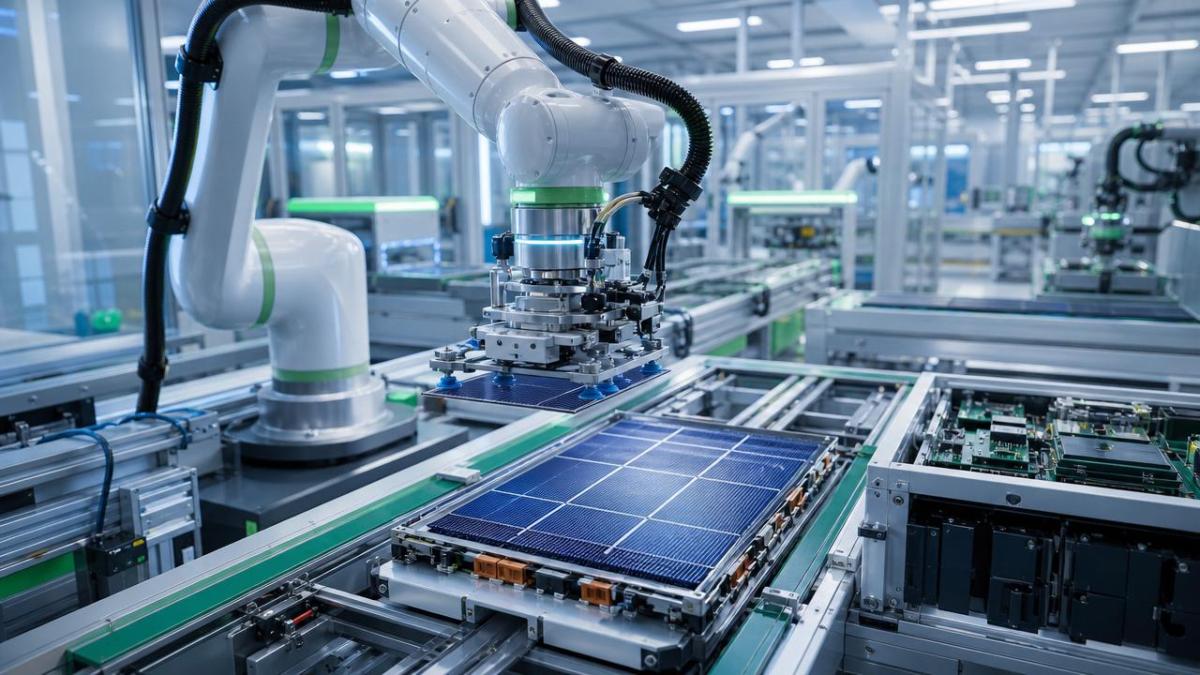
Renewable energy manufacturing has entered a new phase. Scale still matters, but line flexibility, process stability, and measurable quality control now matter just as much. In solar panel assembly, battery pack production, inverter manufacturing, and smart energy control hardware, standard grippers often struggle with thin wafers, reflective surfaces, coated components, thermal sensitivity, and frequent SKU changes. This is where custom robotic end effectors move from optional upgrade to strategic requirement.
The shift is especially visible in operations that combine automation with demanding handling tasks. A conventional end-of-arm tool may work well in a stable, repetitive environment, but renewable energy lines increasingly require mixed-material handling, tighter tolerances, and lower defect rates. When a standard tool causes microcracks in photovoltaic cells, drops pouch cells during transfer, or slows changeovers between product variants, the bottleneck is no longer the robot. It is the tooling interface.
This is also consistent with the broader industrial direction highlighted by data-driven technology organizations such as NexusHome Intelligence, where engineering truth is measured through real performance rather than marketing claims. In connected energy hardware, success depends on tested reliability, process transparency, and component behavior under stress. The same logic applies to custom robotic end effectors: performance must be validated by cycle time, defect reduction, grasp repeatability, and long-term maintainability, not by brochure language.
Several signals show why custom robotic end effectors are gaining momentum now
The rise of custom robotic end effectors in renewable energy is not a temporary response to labor pressure. It is being driven by structural changes in products, materials, and production economics. The table below summarizes the strongest trend signals shaping this shift.
These signals point to a larger conclusion: the most effective automation investments are becoming more application-specific. Instead of forcing fragile renewable energy products to fit generic tooling, leading lines are redesigning the last point of contact between robot and component. That redesign is exactly where custom robotic end effectors create outsized returns.
The strongest drivers come from material complexity, quality pressure, and digital verification
Three forces are accelerating adoption faster than many expected.
- Material sensitivity is increasing. Renewable energy products often involve brittle glass, laminated layers, conductive films, heat-sensitive adhesives, and precision-aligned parts. Custom robotic end effectors can distribute force more evenly, reduce vibration, and match contact surfaces to actual part geometry.
- Yield loss is more expensive than before. When cells, packs, or control modules carry higher value and stricter performance requirements, minor handling errors can trigger disproportionate scrap costs. A well-designed custom robotic end effector directly addresses this hidden cost center.
- Verification standards are rising. Industrial users increasingly want evidence: cycle stability, pressure consistency, leak monitoring, pick success rates, and maintenance intervals. This aligns with the NHI philosophy of benchmarking technology through measurable engineering performance. Custom robotic end effectors fit this direction because they can be tested and optimized around actual process data.
As a result, custom robotic end effectors are no longer defined only by shape or gripping method. They are increasingly integrated systems that combine mechanics, sensing, pneumatics, compliance control, and line data. In renewable energy manufacturing, that integration helps transform tooling from a passive accessory into an active source of process intelligence.
The impact extends across solar, battery, and smart energy hardware lines
The effect of custom robotic end effectors varies by process, but the common outcome is improved control at critical handling points. In solar manufacturing, this may mean safer transfer of wafers and cells, reduced chipping, and more stable placement before stringing or lamination. In battery production, it can mean better handling of pouch cells, cylindrical cell grouping, busbar positioning, and module assembly where dimensional variation must be managed without slowing the line.
In smart energy hardware such as inverters, controllers, metering devices, and connected HVAC or grid-edge components, custom robotic end effectors support the broader shift toward precise, traceable assembly. This is particularly relevant when handling PCBA, housings, connectors, thermal pads, or sensor-rich modules that require both repeatability and ESD-aware contact strategies. Because renewable energy systems increasingly intersect with IoT infrastructure, reliable assembly of electronic subsystems becomes part of the energy performance story itself.
Where bottleneck relief is most visible
- Pick-and-place steps involving fragile or slippery surfaces
- Stations with high reject rates caused by inconsistent gripping force
- Changeover-heavy lines producing multiple product variants
- Processes where contact marks, contamination, or static discharge affect quality
- Cells where downtime often traces back to tool wear, misalignment, or vacuum instability
The most important question is not whether to customize, but what to measure
Not every application needs a fully bespoke solution, but every serious evaluation should begin with measurable constraints. Too many automation projects still focus on robot selection before documenting the actual failure modes at the end effector level. In renewable energy environments, that sequence often leads to underperforming tooling and disappointing ROI.
The better approach is to define the handling problem through data first. Key evaluation points include:
- Part variability: size range, surface condition, flatness, weight tolerance, and thermal behavior
- Failure history: cracks, drops, scratches, mispicks, vacuum loss, and jam frequency
- Cycle expectations: takt time, acceleration profile, orientation needs, and placement accuracy
- Environment factors: dust, temperature, humidity, static control, and clean-contact requirements
- Serviceability: seal replacement time, wear part access, sensor diagnostics, and cleaning routines
When these inputs are clear, custom robotic end effectors can be designed around actual production physics instead of assumptions. This is where data-driven organizations and engineering-led operations have a clear advantage: they can connect tooling decisions to real throughput, defect, and maintenance outcomes.
Practical priorities now point toward smarter, testable custom robotic end effectors
The near-term direction is not just more customization, but smarter customization. In renewable energy production, the strongest solutions increasingly combine mechanical adaptation with embedded feedback. A custom robotic end effector that can detect vacuum decay, confirm part presence, compensate for tolerance drift, or log grip anomalies creates value beyond handling alone.
This is also where the renewable energy sector can borrow from the benchmarking mindset seen in advanced IoT and connected hardware evaluation. The more complex the product ecosystem becomes, the less useful generic claims become. Whether assessing a communication module or custom robotic end effectors, trust comes from stress-tested evidence.
The next step is to map bottlenecks before redesigning the full line
A practical starting point is to identify the top one or two handling steps that create the most hidden cost. This may be a station with recurring microdamage, frequent regrips, excessive changeover time, or unexplained stoppages linked to tooling wear. Once that point is isolated, custom robotic end effectors can be evaluated against a narrow set of process metrics instead of being treated as a broad automation upgrade.
For renewable energy operations seeking durable efficiency gains, the opportunity is clear. Custom robotic end effectors solve tooling bottlenecks by aligning robot capability with product reality. When designed around measured constraints, validated under real conditions, and tracked with performance data, they help increase yield, stabilize throughput, and support the precision standards that modern energy hardware now demands.
If the goal is to improve output quality without adding unnecessary complexity, start with the point of contact. In many lines, that is exactly where the next performance breakthrough begins.
Protocol_Architect
Dr. Thorne is a leading architect in IoT mesh protocols with 15+ years at NexusHome Intelligence. His research specializes in high-availability systems and sub-GHz propagation modeling.
Related Recommendations
- NHI Data Lab (Official Account)How Customizable IoT Components Enable Scalable Solar and Energy Monitoring Systems
- NHI Data Lab (Official Account)Hardware Benchmarking for Vibration Testing: Metrics for Comparing Test Systems
- NHI Data Lab (Official Account)IoT Sourcing Guide for Distributors: Vet Suppliers, Certifications, and Supply Risk
- NHI Data Lab (Official Account)How to Evaluate a CNC Automation Manufacturer for Custom Production Lines
- NHI Data Lab (Official Account)Interactive Brokers Adds Bucharest Exchange Trading Access
- NHI Data Lab (Official Account)How to Plan RoHS Compliance for Commercial IoT Devices Before Mass Production
- NHI Data Lab (Official Account)How to Assess Supplier Capability in Southeast Asia for Renewable Energy Projects
- NHI Data Lab (Official Account)How Surface Mount PCB Assembly Improves Reliability in Renewable Energy Devices
- NHI Data Lab (Official Account)Sensor Surge Extends South China PCBA Lead Times
- NHI Data Lab (Official Account)SLA 3D Printing China: How to Evaluate Quality, Lead Time, and Export Support
Analyst