
Fibocom Ships Matter-over-Thread PCBA for OEMs
author
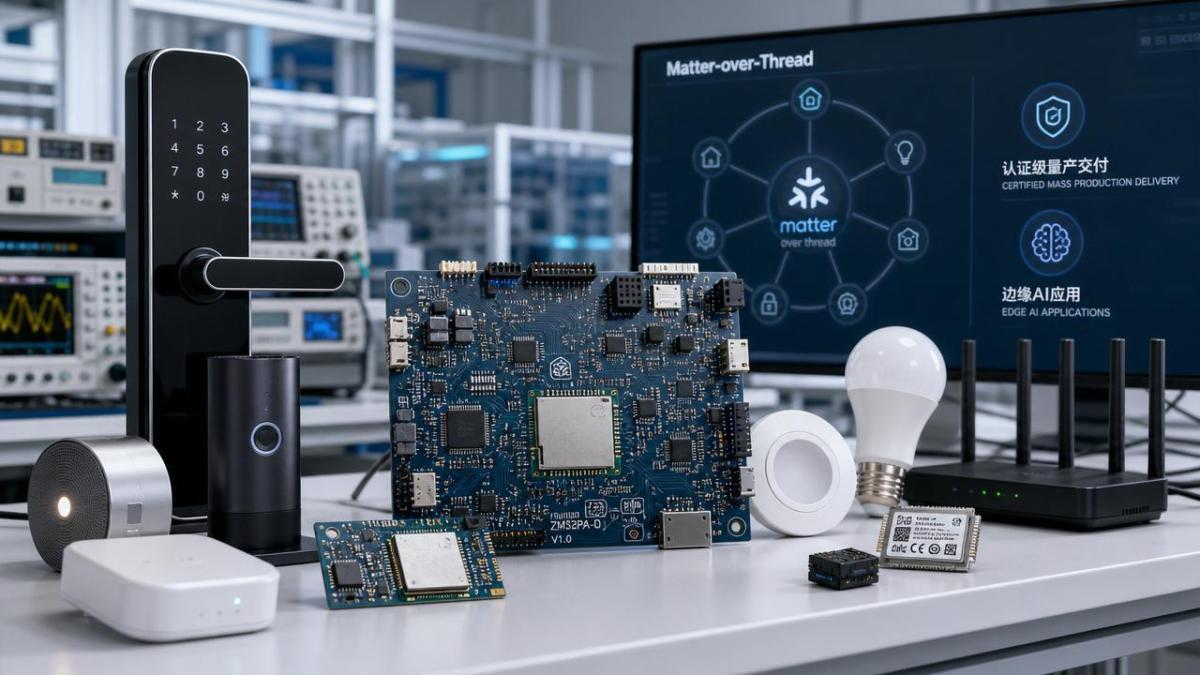
On June 14, 2026, Fibocom announced mass production and delivery of its FG180 series, described as its first dual-mode Matter-over-Thread PCBA solution to pass CSA Matter 1.5 certification. The update is worth watching for overseas smart security and lighting OEMs, as well as product, sourcing, and delivery teams, because it combines protocol compatibility with on-device AI inference and is positioned to reduce time to market for export-oriented products.
What has been confirmed in this release
According to the information provided, the FG180 series is a Matter-over-Thread dual-mode PCBA solution that has entered mass production and delivery. It has passed CSA Matter 1.5 certification and supports the full Thread 1.3.1 and Matter 1.5 stack. The solution also integrates an NPU for edge-side visual AI inference, including functions such as human-form recognition and preliminary screening of abnormal behavior. Fibocom has also stated that the product has already received orders from leading North American smart lighting and smart lock OEM customers.
Where the impact may show up first
Export-focused device makers may reassess product planning
From an industry perspective, overseas OEMs in smart lighting, smart locks, and adjacent smart security categories may be affected first because certification status, protocol stack support, and module readiness directly influence launch schedules. The main impact is likely to appear in product definition, platform selection, and overseas model planning, especially where buyers want to shorten the path from development to sellable devices.
Sourcing and supply teams may pay closer attention to component-level readiness
Analysis shows that procurement and supply chain teams may focus less on a single feature claim and more on whether a PCBA solution can simplify certification alignment, software integration, and delivery coordination. What deserves closer attention is whether customers begin asking suppliers for clearer documentation around Matter 1.5 and Thread 1.3.1 compatibility, AI function boundaries, and production delivery timing.
Service and integration partners may face new implementation questions
For design service providers, firmware integration teams, and project delivery partners, the effect may center on implementation work rather than headline specifications. Observably, a solution that combines connectivity and local visual inference can shift project discussions toward edge processing scope, interoperability testing, and how quickly overseas OEM programs can move from evaluation into commercial rollout.
What companies should monitor next
How certification language is used in customer communication
Companies involved in export projects should closely track how certified status is described in proposals, technical documents, and customer-facing materials. In practice, the key issue is not only that a solution passed CSA Matter 1.5 certification, but also how that status maps to the specific end product, integration path, and delivery commitment in each OEM program.
Which categories move fastest in actual orders
Based on the confirmed information, smart lighting and smart lock OEMs in North America are the first visible demand signals. What deserves closer attention is whether similar interest appears in other smart security categories, or whether adoption remains concentrated in products where interoperability and deployment speed matter most.
The difference between AI capability and deployable use cases
Analysis shows that the inclusion of an NPU and support for local visual AI inference will draw attention, but buyers and suppliers still need to clarify the practical boundary between feature availability and deployable application. Functions such as human-form recognition and preliminary abnormal-behavior screening may influence evaluation priorities, yet actual deployment will depend on each customer's product scope and integration requirements.
Delivery preparation and supplier documentation
For purchasing and project management teams, a practical focus is whether suppliers can provide complete technical materials, stack compatibility details, and delivery coordination support early in the project cycle. Where overseas OEM timelines are tight, document completeness and communication clarity can matter as much as the hardware feature set itself.
Why this looks more like a market signal than a final outcome
Observably, this release says more than a single product shipment, but it should not yet be treated as a settled market conclusion. The confirmed facts point to two signals: first, OEM demand in overseas smart lighting and lock segments is placing value on ready-to-integrate Matter-over-Thread hardware; second, local AI inference is becoming part of the module-level conversation rather than being left entirely to higher-level system design. Even so, the current information is still best read as an early commercial and technical signal, not proof of broad adoption across all smart home categories.
How this news is best understood now
At this stage, it is more appropriate to understand the update as a near-term commercialization signal with longer-term implications for smart home device architecture. The immediate significance lies in certification-backed readiness, protocol support, and the potential to shorten overseas launch cycles. The broader implication is that connectivity standards and edge AI functions are beginning to be presented together at the PCBA level, which may reshape how some OEM projects are evaluated. That said, wider market impact still requires continued observation.
Basis of this article and what still needs verification
This article is generated from the user-provided news title, event date, and event summary. For this type of development, commonly relevant source categories may include company announcements, official statements, industry association updates, authoritative media coverage, and standard-organization materials. A specific official source link was not provided in the input, so further verification remains necessary. Follow-up attention should focus on subsequent official disclosures, customer rollout progress, and any additional information that clarifies deployment scope in overseas security and lighting programs.
Protocol_Architect
Dr. Thorne is a leading architect in IoT mesh protocols with 15+ years at NexusHome Intelligence. His research specializes in high-availability systems and sub-GHz propagation modeling.
Related Recommendations
- NHI Data Lab (Official Account)How Customizable IoT Components Enable Scalable Solar and Energy Monitoring Systems
- NHI Data Lab (Official Account)Hardware Benchmarking for Vibration Testing: Metrics for Comparing Test Systems
- NHI Data Lab (Official Account)IoT Sourcing Guide for Distributors: Vet Suppliers, Certifications, and Supply Risk
- NHI Data Lab (Official Account)How to Evaluate a CNC Automation Manufacturer for Custom Production Lines
- NHI Data Lab (Official Account)Interactive Brokers Adds Bucharest Exchange Trading Access
- NHI Data Lab (Official Account)How to Plan RoHS Compliance for Commercial IoT Devices Before Mass Production
- NHI Data Lab (Official Account)How to Assess Supplier Capability in Southeast Asia for Renewable Energy Projects
- NHI Data Lab (Official Account)How Surface Mount PCB Assembly Improves Reliability in Renewable Energy Devices
- NHI Data Lab (Official Account)Sensor Surge Extends South China PCBA Lead Times
- NHI Data Lab (Official Account)SLA 3D Printing China: How to Evaluate Quality, Lead Time, and Export Support
Analyst