
Using a Chinese industrial cobot to automate battery module assembly
author
A Chinese industrial cobot can be a practical choice for battery module assembly when the work involves manageable loads, repeatable presentation of parts, and processes that benefit from controlled handling or fastening. The strongest starting point is a defined station: placing cells into a fixture, installing insulation, applying thermal interface material, or tightening module hardware. Automating an entire module build requires a broader assessment of material flow, process equipment, inspection, and fault recovery.
For an engineering project leader, the decision rests on whether the complete station can meet production and quality requirements at an acceptable installed cost. The robot’s purchase price and advertised repeatability provide only part of that answer. A credible proposal must connect the selected arm, tooling, fixtures, controls, and safety measures to a specific battery design and a measurable acceptance test.
Choose the assembly operation before choosing the robot
Battery modules for renewable energy storage differ in cell format, mechanical construction, electrical connections, and thermal management. Those differences determine which operations suit a cobot. A station designed around rigid prismatic cells will have different gripping and positioning demands from one assembling cylindrical cells or handling flexible pouch cells.
Begin with a process map that identifies how each component arrives, what the robot must do to it, and what evidence proves successful completion. Include manual interventions and rejected parts. If an operator must repeatedly correct cell orientation or reposition an unstable tray, the proposed automation boundary needs further work.
Some operations justify dedicated equipment even when a cobot handles adjacent tasks. Cell compression may require a controlled press and a purpose-built fixture. Electrical joining needs its own validated process and inspection strategy. A cobot can position a joining tool, but arm motion alone does not establish weld quality or make the process safe.
Finished-module handling deserves separate consideration. A module may exceed the arm’s usable payload once the gripper, adapters, cables, and load position are included. Using the same cobot for individual cells and completed modules can force compromises in reach, speed, or tooling. Splitting those duties may produce a simpler station.
Translate robot specifications into battery process requirements
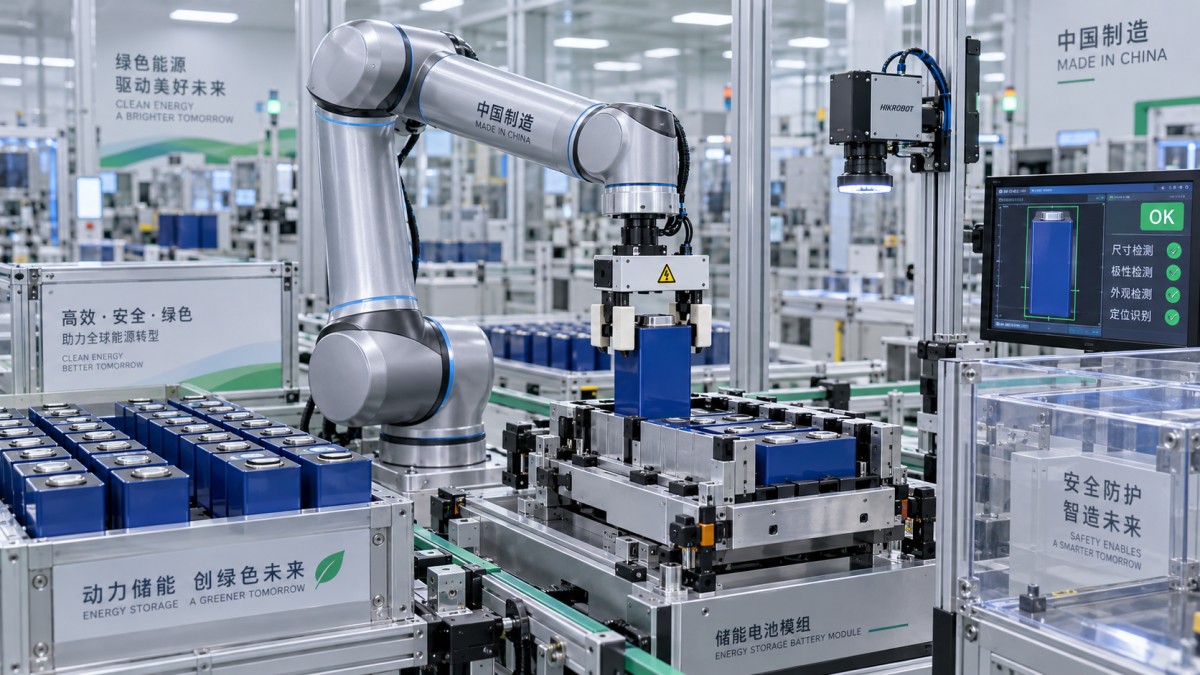
Payload selection must include everything carried at the wrist. Ask the supplier to evaluate the intended tool and workpiece together, including their center of gravity and inertia. A long screwdriver or an offset gripper can impose demanding loads even when its mass appears comfortably below the nominal payload rating. Confirm performance at the poses used in the proposed layout.
Reach requires the same treatment. A robot may reach the farthest fixture position yet approach it with poor clearance or an unsuitable wrist orientation. The layout review should include trays, clamps, tool changes, inspection equipment, cable routing, and maintenance access. Leave enough space to recover a dropped part or replace a worn tool without dismantling the station.
Repeatability describes how consistently the robot returns to a position under specified conditions. It does not establish the accuracy of the complete assembly. Cell dimensions, tray tolerances, fixture location, tool deflection, camera calibration, and thermal movement all affect the final result. Mechanical locating features can remove some variation; vision or force sensing may address others. Each addition also introduces calibration and maintenance work.
For cell handling, define permissible contact locations and gripping forces with the cell supplier’s requirements in mind. The tool should avoid loading sensitive surfaces or creating a path between exposed terminals. Vacuum gripping needs assessment against surface condition, leakage, and loss of suction. Mechanical gripping needs assessment against deformation and local pressure. Include detection of a missing, misoriented, or incompletely gripped cell.
Fastening needs a process specification beyond the instruction to “tighten the screw.” Establish the tightening sequence, tool alignment, joint requirements, and acceptance criteria. A controlled screwdriver can record torque and angle, but an acceptable reading does not by itself prove correct joint assembly. Missing washers, incorrect screws, cross-threading, and poor seating need suitable prevention or detection.
Where thermal interface material is applied, robot path repeatability is only one variable. Dispense volume, material condition, nozzle behavior, substrate position, and the chosen inspection method determine whether the application meets its specification. Assign responsibility for the complete dispensing process so that failures do not become disputes between the robot supplier and material-equipment supplier.
Cycle time should cover the entire station sequence: part detection, gripping, movement, settling, processing, inspection, data transfer, and release. For a fastening station, screw feeding and tightening may dominate the cycle. For cell loading, tray presentation and orientation checks may matter more than travel speed. Compare sustained output with the required takt time, including replenishment, rejected parts, and routine stoppages.
A collaborative operating mode can constrain motion enough to affect throughput. A guarded arrangement may permit a different motion strategy, subject to the station’s risk assessment. Decide how people will interact with the equipment before accepting a cycle-time promise; otherwise, the promised output may depend on operating conditions the installation cannot support.
Make safety and traceability part of the station design
A cobot designation does not make a battery assembly station safe for unrestricted human access. Grippers, screwdrivers, sharp components, trapping points, and fixtures create hazards beyond contact with the arm. Battery cells also introduce electrical and thermal hazards that robot collision detection cannot control.
The risk assessment must cover the complete application, including loading, maintenance, fault recovery, and foreseeable misuse. Collaborative operation requires validation of the relevant protective measures for the actual tool, workpiece, motion, and contact conditions. Depending on the task, guarding, interlocked access, protective sensing, or separation of manual and automatic work may be necessary.
Battery-specific controls should address terminal protection, conductive debris, damaged cells, dropped parts, and unintended contact between energized surfaces. Insulating features and protected handling paths can reduce exposure, but their suitability depends on the module design and electrical state. Establish a response for abnormal cell condition and identify who controls isolation and escalation. Restarting the robot should never substitute for investigating a potentially damaged cell.
Traceability begins before final inspection. The station should associate the module identifier with the relevant incoming components and process results. Depending on the product’s quality plan, records may include cell identities, assembly recipe, fastening results, inspection outcomes, rework history, and disposition.
Define this association before programming the line interface. A scanner, camera, screwdriver, and robot controller can each produce valid data while the station still assigns a result to the wrong module. The controls must prevent production from advancing when identity or required results are missing. They must also preserve the relationship between the physical assembly and its record after a stoppage.
Recovery logic deserves explicit acceptance criteria. If a screw has already been tightened when power is interrupted, the restart sequence must account for that completed operation. If a cell is in the gripper, the controller needs a safe way to establish its state. If inspection fails, the module needs controlled handling and a recorded disposition. These decisions directly affect downtime, scrap, and operator workload.
Validate the Chinese supplier’s complete delivery scope
Sourcing from China can give a project access to different robot platforms and integration options. Country of origin does not establish application performance. Evaluate the proposed model, the integration team, and the support arrangements against the same battery-specific requirements used for any other supplier.
First establish what is being purchased. An arm supplier may provide the robot and controller while leaving tooling, fixtures, safety engineering, and line integration to others. A station builder may take responsibility for the assembled system but still depend on separate process-equipment vendors. The contract should identify one party responsible for demonstrating the agreed station performance and define the interfaces that remain with the buyer.
Ask for a demonstration using representative parts and the intended tooling. A video showing an empty gripper moving between points provides little evidence about cell handling, fastening, inspection, or data retention. If production components cannot be supplied initially, document which risks the substitute parts leave unresolved and address those risks before acceptance.
The acceptance plan should concentrate on outcomes that determine whether the station can enter production:
- Output: sustained cycle performance with the intended safety configuration, replenishment method, and product mix.
- Quality: conformity to handling, placement, fastening, and inspection requirements, with controlled rejection of defective assemblies.
- Recovery: demonstrated behavior after interrupted cycles, missed picks, failed inspections, and communication faults.
- Integration: correct exchange of identities, recipes, results, and status with the line controller or manufacturing system.
- Handover: usable documentation, backups, training, maintenance instructions, and access needed to support the installation.
Factory acceptance should exercise the complete sequence before shipment. Site acceptance must address installation-dependent conditions such as utilities, upstream part presentation, network behavior, and downstream release. Set the test duration and acceptance thresholds around the project’s production requirements rather than accepting a short demonstration as proof of sustained capability.
For overseas deployment, examine support in practical terms: who diagnoses faults, which spare parts are available, how replacements arrive, and who can modify the program. Confirm ownership and access rights for robot code, recipes, vision settings, and controller backups. Remote support also needs an agreed access method, permissions, and a way to operate when that connection is unavailable.
Applicable machinery, electrical, and workplace requirements depend on the installation location and application. Documentation for the robot arm does not establish conformity of the completed station. Assign responsibility for the system-level assessment, technical documentation, and required validation early enough to influence the design.
The investment case should use installed cost: robot, tooling, fixtures, process equipment, safeguarding, integration, freight, commissioning, training, spares, and production ramp-up. Evaluate benefits through achievable output, labor allocation, quality losses, and changeover effort. Include the technicians and maintenance time the automated station will require.
A focused pilot is a useful next commitment when it resolves a material uncertainty, such as safe cell gripping or reliable fastening-result tracking. Choose a station with clear acceptance criteria and enough production relevance to expose its constraints. Expansion becomes easier to justify once the pilot demonstrates repeatable assembly quality, recoverable faults, and maintainable operation with the battery design the line will actually build.
Protocol_Architect
Dr. Thorne is a leading architect in IoT mesh protocols with 15+ years at NexusHome Intelligence. His research specializes in high-availability systems and sub-GHz propagation modeling.
Related Recommendations
- NHI Data Lab (Official Account)Crop Spraying Drone Batteries: Choosing Capacity and Charging Speed
- NHI Data Lab (Official Account)Choosing a Smart Wearable Factory: Solar Charging and Battery Test Criteria
- NHI Data Lab (Official Account)Using a Chinese industrial cobot to automate battery module assembly
- NHI Data Lab (Official Account)When is a Chinese industrial cobot suitable for battery tab welding?
- NHI Data Lab (Official Account)Can a Chinese industrial cobot keep up with battery pack packaging?
- NHI Data Lab (Official Account)How gripper weight affects Chinese cobot payload for battery packs
- NHI Data Lab (Official Account)How much reach does a Chinese cobot need for battery palletizing?
- NHI Data Lab (Official Account)Does CE marking on a Chinese cobot cover a battery assembly cell?
- NHI Data Lab (Official Account)What does a Chinese industrial cobot cost for battery production?
- NHI Data Lab (Official Account)When do wholesale cobot orders from China cut battery plant costs?
Analyst