
A crop spraying drone battery should be judged by usable energy under load, rather than capacity claims or headline charging times alone.
For technical evaluators, the best choice balances payload, flight duration, turnaround time, and battery degradation while meeting aircraft compatibility requirements and maintaining operational safety.
Start with the aircraft manufacturer’s approved battery system, then verify whether its usable energy and charging workflow can sustain your intended spraying schedule.
This guide applies NexusHome Intelligence’s emphasis on verifiable data to battery evaluation, including discharge performance, thermal management, charging infrastructure, and renewable energy integration.
How Much Battery Capacity Can Your Drone Actually Use?
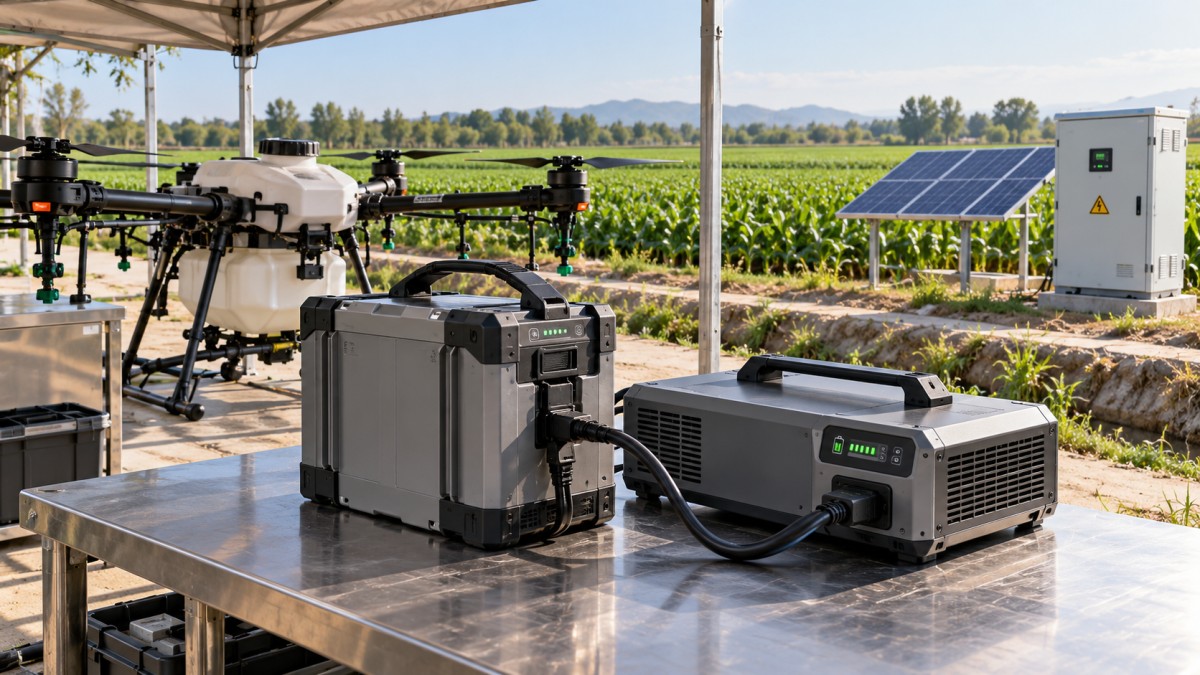
Compare batteries in watt-hours before comparing amp-hours. Amp-hour capacity alone cannot establish stored energy because batteries with different nominal voltages contain different amounts of energy.
Calculate nominal energy by multiplying nominal voltage by amp-hour capacity. An illustrative 51.8-volt, 30-amp-hour battery therefore stores approximately 1,554 watt-hours, or 1.55 kilowatt-hours.
This calculation describes rated energy, not the energy available for spraying. Landing reserves, temperature, discharge current, aging, and protection thresholds all reduce the usable amount.
Ask suppliers for measured discharge energy under a representative flight load, with starting temperature, cutoff conditions, battery age, and test equipment clearly documented.
Check whether reported energy covers discharge to a laboratory cutoff or discharge to the aircraft’s required landing reserve. Those measurements answer different operational questions.
A useful preliminary estimate divides usable watt-hours by average electrical demand, then multiplies by 60 to express the resulting flight duration in minutes.
For example, 1,100 usable watt-hours at an assumed average demand of 6,000 watts suggests approximately 11 minutes of operation under those specific conditions.
This example is illustrative, not an aircraft specification. Actual demand changes with tank weight, wind, altitude, maneuvering, pump operation, and the evolving payload during spraying.
Will a Larger Battery Increase Productive Spraying Time?
A larger battery carries additional energy, but also increases aircraft mass. That extra mass raises propulsion demand and may reduce the permitted liquid payload.
Evaluate each approved configuration using productive hectares per hour at a defined application rate. Flight duration alone can reward configurations that deliver less useful work.
Record application volume, swath width, working speed, refill time, transit distance, and landing reserve. Keep these conditions consistent when comparing batteries or aircraft configurations.
If the spray tank empties before the battery reaches its reserve, additional capacity may offer limited benefit unless it supports another useful operating segment.
If the aircraft repeatedly lands with significant liquid remaining, greater usable energy may reduce interruptions, provided the aircraft supports that battery and operating weight.
Use maximum takeoff mass and the manufacturer’s payload limits as hard boundaries. Mechanical fit alone does not establish electrical, thermal, firmware, or flight-control compatibility.
For procurement, request results for at least two realistic operating conditions: typical spraying work and the most demanding approved mission your team expects to perform.
Which Discharge Specifications Predict Reliable Flight?
High-current performance matters because a battery can retain substantial stored energy while failing to maintain sufficient voltage during a demanding climb or loaded maneuver.
Internal resistance produces voltage sag and heat under load. Cold temperatures and aging can worsen these effects, causing earlier warnings or reduced available power.
Do not accept a discharge C-rating without its test conditions. Ask for allowable continuous current, peak duration, temperature limits, and the corresponding voltage behavior.
For perspective, a 30-amp-hour battery labeled 10C implies 300 amperes under the supplier’s stated conditions. It does not independently prove safe aircraft compatibility.
Inspect cell-group voltage differences near the end of representative flights. A weak group may reach its lower limit before the pack average appears concerning.
Request synchronized logs of pack voltage, current, cell-group voltages, temperature, and state of charge. These measurements help distinguish insufficient capacity from power-delivery limitations.
Also verify state-of-charge accuracy during dynamic loads. An optimistic percentage display can undermine mission planning even when the battery’s measured capacity remains acceptable.
How Fast Can the Battery Return to Service?
Headline charging time is meaningful only when its starting charge, ending charge, battery temperature, input power, and charging mode match your intended field workflow.
A quoted 30%–90% charging time cannot be compared directly with a 10%–100% result. Charging also generally slows near the upper voltage limit.
Measure turnaround from landing until the battery is ready for another approved flight. Include cooling, inspection, charging, balancing, handling, and any required post-charge waiting.
A battery that charges quickly after laboratory temperature conditioning may take considerably longer after a hot, high-load flight in direct sunlight during field operations.
Charging performance therefore depends on thermal management as much as charger rating. Check permitted charging temperatures and whether cooling equipment is required or integrated.
Use only manufacturer-approved charging arrangements. Compatible connectors do not establish correct charge voltage, communication behavior, current limits, firmware support, or battery protection coordination.
How Many Batteries and Chargers Will Sustain Operations?
Battery inventory should follow the complete operating cycle. A fast charger cannot compensate for insufficient cooling capacity, limited electrical supply, or slow handling procedures.
As an initial estimate, divide off-aircraft recovery time by the interval between battery changes, round upward, and add the battery currently powering the aircraft.
If recovery takes 24 minutes and changes occur every 12 minutes, three batteries provide a theoretical rotation with no allowance for disruption or delays.
Add practical margin for temperature variation, charging queues, inspection failures, and aging. Validate the rotation over consecutive missions rather than one successful battery swap.
This estimate assumes adequate charging capacity whenever each battery needs it. Shared chargers, sequential charging ports, or constrained power can create additional queues between flights.
Check whether multi-port chargers divide their rated output across connected batteries. Two available connectors do not necessarily mean two batteries charge simultaneously at full power.
Model refill and charging operations together. When liquid replenishment already determines the turnaround interval, further charging-speed investment may deliver little additional daily spraying capacity.
Can Your Field Power Supply Support Fast Charging?
Estimate the power requirement from energy replenishment and available time. Then account for charger losses, cooling equipment, simultaneous loads, and any input-power limitations.
Replacing 1.0 kilowatt-hour in 15 minutes requires an average battery-side charging power of 4 kilowatts. The required electrical input will be higher because of losses.
At an illustrative 90% charger efficiency, that energy transfer requires about 4.44 kilowatts of average input power, before adding external cooling or other equipment.
Actual charging power varies throughout the session. Check the charger’s maximum input requirements separately when sizing cables, distribution equipment, generators, and protective devices for operation.
For generator use, verify continuous output, supply quality, ambient-temperature derating, and compatibility with the charger. Peak generator ratings alone are insufficient for sustained charging.
Solar generation can contribute energy, but direct solar output varies with weather and time. Reliable high-power charging often requires appropriately sized stationary storage or backup.
Size the renewable system for both daily energy and instantaneous demand. A system can generate enough daily kilowatt-hours yet lack sufficient power for simultaneous chargers.
Include inverter losses, storage losses, battery limits, and cloudy-day requirements. Compare actual fuel displacement or grid consumption before making renewable energy or emissions claims.
What Determines Battery Life and Cost per Hectare?
Cycle-life claims need a defined endpoint, such as remaining capacity, and a disclosed test protocol. Without these details, supplier cycle counts are difficult to compare.
Depth of discharge, temperature, charging rate, storage conditions, and calendar age all influence degradation. Their relative effects depend on cell chemistry and pack design.
A battery may become unsuitable for spraying because voltage sag or heating becomes excessive before its remaining capacity reaches the supplier’s stated replacement threshold.
Assess retirement criteria against the aircraft manufacturer’s instructions, including physical condition, fault history, cell imbalance, power delivery, and any specified service-life or inspection limits.
Calculate battery cost per productive hectare by dividing purchase and attributable replacement costs by the hectares treated over the battery’s actual useful service life.
For fleet comparisons, add electricity or fuel, charging infrastructure, cooling, labor, and downtime. Avoid counting longer flights as savings unless they improve completed work.
Faster charging can justify higher expenditure when it removes a measured operational bottleneck. Evaluate its effect on battery life using evidence from the intended charging profile.
What Should a Battery Acceptance Test Include?
Begin with documented compatibility across the aircraft, battery, charger, cooling equipment, and firmware. Confirm that the proposed combination is approved for the intended operating conditions.
Next, define a repeatable mission with representative payload, application settings, landing reserve, and environmental conditions. Record deviations so comparisons remain interpretable across test days.
Measure delivered energy, productive area, voltage sag, temperatures, turnaround time, and charging input energy. Repeat enough consecutive missions to reveal heat accumulation and charging queues.
Assess safety provisions through documentation and qualified review. Confirm fault reporting, temperature protection, inspection procedures, emergency guidance, and transport documentation appropriate to the applicable jurisdiction.
Request a UN 38.3 test summary where applicable to transport requirements. It does not independently establish spraying performance, charging suitability, or compatibility with an aircraft.
Agree on acceptance thresholds before purchasing: required productivity, allowable temperatures, minimum reserve, maximum turnaround, and acceptable degradation under a clearly specified operating and maintenance schedule.
Choose the approved battery system that repeatedly meets those thresholds at the lowest defensible operating cost. Capacity and charging speed matter through the productivity they enable.