
IoT Gateway Sourcing Problems Start With Protocol Fit
author
IoT gateway sourcing often fails long before price or lead time matters—it fails at protocol fit. In renewable energy deployments, weak Matter standard compatibility, poor Zigbee mesh capacity, and unclear protocol latency benchmark data can undermine performance, uptime, and ROI. This article shows why buyers need IoT hardware benchmarking and IoT engineering truth to evaluate gateways with confidence.
For solar farms, battery energy storage systems, microgrids, EV charging clusters, and smart commercial buildings, an IoT gateway is not just a connector. It is the control bridge between field devices, edge intelligence, cloud dashboards, and energy optimization logic. When protocol support is vague or overstated, operators face packet loss, delayed alarms, unstable remote control, and expensive site visits that could have been prevented during sourcing.
That is why protocol fit must be treated as an engineering decision, not a catalog checkbox. Buyers need measurable proof: latency by protocol, mesh node behavior under interference, gateway CPU loading under mixed traffic, and real compatibility with renewable energy assets that run 24/7. This is where a data-driven approach, aligned with the NexusHome Intelligence view of engineering truth, helps procurement teams reduce risk before deployment begins.
Why Protocol Fit Comes First in Renewable Energy IoT Gateway Sourcing
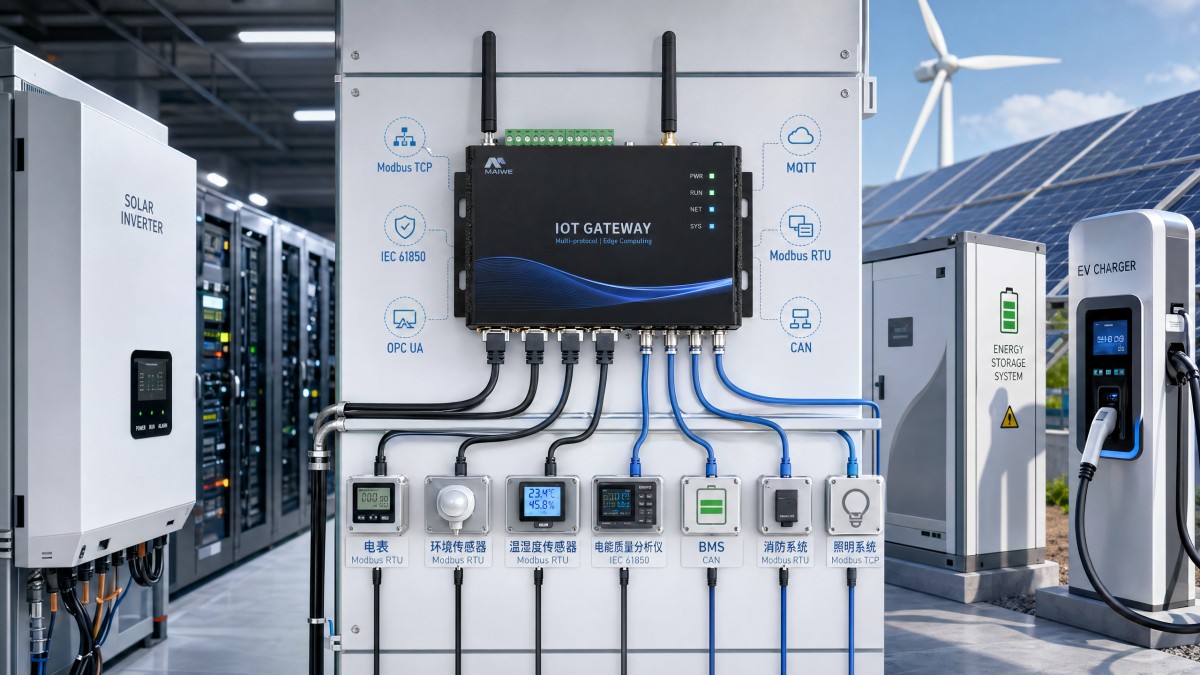
In renewable energy environments, protocol decisions affect system stability at every layer. A gateway may need to collect inverter data every 1-5 seconds, relay battery management events with sub-second urgency, and coordinate HVAC, lighting, or load-shedding commands across a facility. If the gateway is strong on Wi-Fi but weak on Zigbee routing, or if its Matter support is partial rather than production-ready, the entire control stack becomes fragile.
Protocol fragmentation is especially visible in mixed estates. A single commercial energy project may include Modbus devices, Zigbee sensors, BLE maintenance tools, Thread-based environmental nodes, and cloud APIs that expect normalized data. In these deployments, “supports multiple protocols” is not enough. Buyers should ask how many concurrent device sessions the gateway can sustain, what its average local forwarding latency is under 70%-80% traffic load, and how it behaves when 30, 60, or 100 nodes are active at once.
This matters because renewable energy assets are operational infrastructure, not consumer gadgets. A 300 ms delay may be tolerable for a home dashboard update, but it can be unacceptable for fault propagation alerts, peak-load response, or coordinated switching across distributed energy resources. Even a 1%-3% telemetry dropout rate can distort analytics, hide battery anomalies, and weaken predictive maintenance models.
NHI’s view is straightforward: the gateway must be sourced based on measurable protocol behavior in real operating conditions. That means evaluating not only whether a standard is listed on the datasheet, but whether it remains stable in electrically noisy cabinets, metal-heavy plant rooms, and solar-plus-storage sites where interference, temperature swings, and uptime requirements are all higher than in ordinary smart home use cases.
Where protocol mismatch usually appears first
- Telemetry collection frequency is inconsistent, such as 10-second updates stretching to 30-60 seconds during peak traffic.
- Mesh devices fall offline when node density rises, especially beyond 40-50 Zigbee endpoints in utility rooms or distributed floors.
- Command acknowledgment becomes unreliable during simultaneous uplink and downlink traffic.
- Battery-powered field sensors drain faster because routing or polling behavior is poorly optimized.
The Hidden Cost of Weak Matter, Zigbee, and Multi-Protocol Performance
Many sourcing failures occur because teams compare gateways by unit price rather than lifecycle behavior. In renewable energy projects, the lower-cost unit can become the higher-cost decision within 6-12 months if it generates repeated truck rolls, unstable data ingestion, or platform integration rework. The financial impact is rarely limited to hardware replacement. It often includes commissioning delays, engineering hours, retraining, and lost visibility into asset performance.
Matter standard compatibility is a good example. Some buyers assume Matter automatically guarantees interoperability, but real deployment quality depends on version support, transport behavior, multi-node stability, and firmware maturity. In an energy-aware building, a gateway may need to bridge occupancy sensing, thermostatic control, smart relays, and sub-metering workflows. If Matter-over-Thread support is unstable under multi-hop conditions, automation timing may drift and energy-saving routines may stop delivering expected reductions.
Zigbee mesh capacity is another common blind spot. A gateway may perform well in a 10-node demo and fail in a 75-node equipment zone with RF congestion. Renewable energy environments often include metal enclosures, power electronics, switchgear, and cable density that degrade radio conditions. Under these conditions, buyers should not accept generic claims like “strong mesh.” They need benchmarks for node count, rejoin time, packet delivery ratio, and latency under interference.
The table below outlines how protocol weakness translates into operational cost in typical renewable energy applications.
The key takeaway is simple: protocol weakness creates compounding cost. What looks like a small RF or compatibility issue at procurement stage can later affect energy reporting quality, response time during demand peaks, and service overhead across hundreds or thousands of field assets.
Four sourcing mistakes that inflate risk
- Approving a gateway without protocol-specific test data.
- Assuming lab performance equals cabinet or plant-room performance.
- Ignoring concurrent traffic behavior across Wi-Fi, Zigbee, BLE, and Thread.
- Evaluating hardware without mapping it to 3-5 year maintenance cost.
What to Benchmark Before You Approve an IoT Gateway
A more reliable sourcing process starts with a benchmark checklist tied to the renewable energy use case. For a solar-plus-storage site, you may prioritize event delivery and uptime. For a smart commercial building pursuing carbon reduction, you may care more about dense sensor handling and stable control loops. The same gateway should not be accepted for both without validating its operating envelope.
At a minimum, buyers should request latency data, throughput ranges, supported node counts, firmware update policy, and edge processing behavior. Useful benchmarks are not abstract. They should describe conditions such as 25, 50, and 100 active nodes; single-hop versus multi-hop routing; signal interference scenarios; and packet success rates over 24-hour or 72-hour stress windows. This is the difference between brochure sourcing and engineering sourcing.
For renewable energy projects, power resilience is also essential. A gateway should recover predictably after outages, preserve local queues when backhaul is unstable, and restore sessions without excessive manual intervention. Recovery time of 30-120 seconds may be acceptable in some monitoring-only cases, but critical control environments often require a much tighter recovery and data integrity strategy.
The following table provides a practical benchmark framework that procurement, operations, and technical teams can use together during evaluation.
This kind of benchmark matrix helps teams compare gateways on operational fit instead of marketing language. It also gives enterprise buyers a more defensible basis for vendor shortlisting, pilot approval, and long-term rollout planning.
Recommended validation steps before purchase order
- Run a pilot with the actual mix of energy meters, relays, environmental sensors, and controller endpoints.
- Test at least 2 traffic modes: normal polling and burst-event conditions.
- Check device behavior after power cycling, weak backhaul, and firmware rollback.
- Require logs or benchmark reports, not just verbal assurances from sales teams.
A note on edge intelligence
Gateways used in renewable energy increasingly process data locally before forwarding it upstream. That can reduce cloud dependency, lower bandwidth costs, and speed up local control. But edge features add processor load. If a gateway is running local rules, buffering telemetry, and translating 3 or 4 protocols at once, benchmark data should show CPU and memory stability during peak demand rather than idle conditions alone.
How Procurement and Operations Teams Should Evaluate Gateway Suppliers
Sourcing success depends on cross-functional evaluation. Procurement may lead the commercial process, but gateway selection should also involve operations, controls engineering, and whoever owns energy performance reporting. A low-cost gateway that cannot maintain stable communication with distributed battery racks or rooftop sensor clusters can create years of operational drag. Decisions should therefore combine commercial terms with technical verification.
One useful approach is to score suppliers across 5 dimensions: protocol depth, benchmark transparency, firmware support, deployment resilience, and documentation quality. For example, a supplier that claims Zigbee 3.0 support but cannot provide interference test data should score lower than one offering clear node-density limits and recovery logs. The same applies to Matter readiness, OTA update governance, and support for secure remote troubleshooting.
NHI’s broader supply chain perspective is highly relevant here. The renewable energy sector increasingly depends on manufacturers that may not have the loudest branding but do have stronger technical integrity. Hidden champions often outperform larger competitors when evaluated by PCB quality, protocol discipline, and stability under stress. For buyers, this means supplier evaluation should go deeper than catalog polish or exhibition claims.
The table below can help procurement teams structure supplier comparison in a way that aligns with field performance and lifecycle value.
A structured scorecard makes internal approval easier, especially when enterprise decision-makers need to justify total cost of ownership rather than initial unit price alone. It also gives operators a stronger voice in the sourcing process, which is critical because they live with the consequences of protocol mismatch long after procurement closes the deal.
What enterprise buyers should require in writing
- Documented protocol versions and scope of support, including known limitations.
- Expected device capacity by topology, not only theoretical maximums.
- Typical lead times for engineering samples, pilot units, and production batches, such as 2-6 weeks depending on customization.
- Support terms for firmware maintenance and issue resolution during the first 12 months.
Practical Deployment Guidance and FAQ for Renewable Energy Buyers
Once a gateway is shortlisted, the deployment plan should be treated as part of sourcing, not an afterthought. Many failures blamed on field conditions were actually predictable during pre-deployment validation. A good rollout sequence usually includes lab simulation, limited pilot, controlled production release, and post-install performance review. In energy projects, this staged process can reduce rework and improve site acceptance speed.
For most medium-scale deployments, a 4-step model works well: validate protocol fit in the lab, test 1-3 pilot sites, monitor 30-day stability, then expand in batches. This helps identify whether latency, packet success, and device rejoin behavior remain stable when the environment becomes more complex. It also gives operators time to refine alert thresholds and data normalization rules before full-scale rollout.
Below are common buyer questions that frequently appear in renewable energy gateway projects and deserve clear, data-oriented answers.
How do I know if a gateway is suitable for a solar-plus-storage site?
Start by mapping the actual device mix and polling frequency. If you need frequent inverter telemetry, battery status events, and local environmental sensing, ask for benchmark data under concurrent traffic. A gateway that performs well with 15 devices may not remain stable with 60 devices and mixed protocol translation. Recovery behavior after short power interruptions is also critical because energy sites cannot depend on manual resets.
What protocol metrics matter most during procurement?
Prioritize 4 metrics: latency, packet reliability, stable node count, and outage recovery. For many renewable energy use cases, packet success above 99%, clear multi-hop latency data, and proven stress performance over 24-72 hours are more useful than theoretical throughput claims. If a supplier cannot provide these, risk remains high regardless of price.
Are gateways with Matter support automatically future-proof?
No. Matter can improve interoperability, but future readiness depends on implementation quality, firmware maintenance, and coexistence with other protocols already present in your energy environment. Buyers should verify version alignment, Thread behavior, and whether Matter functionality remains stable under the real node count and automation load expected on site.
How long should a serious evaluation take?
For enterprise renewable energy deployments, a realistic path is often 2-3 weeks for lab verification, 2-4 weeks for pilot observation, and another 1-2 weeks for final scoring and procurement alignment. Rushing this process may save time upfront but often causes longer delays later through commissioning fixes and unstable performance.
Final decision checklist
- Confirm protocol fit against actual field devices, not generic compatibility claims.
- Review measurable benchmarks for Matter, Zigbee, Thread, BLE, or other required stacks.
- Validate resilience under interference, outage recovery, and edge processing load.
- Select suppliers that can translate technical capability into documented, verifiable evidence.
In renewable energy, the best IoT gateway is not the one with the longest feature list. It is the one that can prove stable protocol behavior in the environments where uptime, data quality, and energy performance actually matter. NHI’s data-first philosophy is built around that reality: trust comes from benchmarks, not buzzwords. If you are evaluating IoT gateways for solar, storage, smart buildings, or broader decarbonization infrastructure, now is the right time to compare suppliers through protocol evidence, field-fit benchmarks, and lifecycle support readiness. Contact us to discuss your gateway shortlist, request a tailored evaluation framework, or explore more data-driven sourcing solutions.
Protocol_Architect
Dr. Thorne is a leading architect in IoT mesh protocols with 15+ years at NexusHome Intelligence. His research specializes in high-availability systems and sub-GHz propagation modeling.
Related Recommendations
- Dr. Aris ThorneWi-Fi 7 IoT Procurement Checklist for Secure Renewable Energy Site Networks
- Dr. Aris ThorneWhat to Evaluate in a Wi-Fi 7 Smart Home Router for Dense IoT Networks
- Dr. Aris ThorneWi-Fi 6E vs Wi-Fi 7: Which Delivers Lower Latency for Industrial IoT?
- Dr. Aris ThorneFCC Tightens Wi-Fi 7 IoT Approval Rules
- Dr. Aris ThorneFCC Tightens Wi-Fi 7 IoT Filing Rules from Oct. 2026
- Dr. Aris ThorneFCC Tightens Wi-Fi 7 IoT Rules From Oct. 2026
- Dr. Aris ThorneFCC Tightens Wi-Fi 7 IoT Certification for 2026
- Dr. Aris ThorneFCC Tightens Wi-Fi 7 IoT Rules From Sept. 1, 2026
- Dr. Aris ThorneFCC Tightens Wi-Fi 7 IoT Certification for US Market
- Dr. Aris ThorneFCC Tightens Wi-Fi 7 IoT RF Rules From August 2026
Analyst