
FCC Tightens Wi-Fi 7 IoT Approval Rules
author
On August 10, 2026, the U.S. Federal Communications Commission (FCC) put new requirements into force for Wi-Fi 7 (IEEE 802.11be) IoT devices, raising the bar for radio-frequency exposure assessment and dynamic power control verification. The change matters most to companies shipping smart lighting products, HVAC controllers, and PCBA-integrated modules to the U.S. market, because it directly affects certification timing, testing scope, and compliance cost rather than product labeling alone.
What the FCC Rule Now Requires
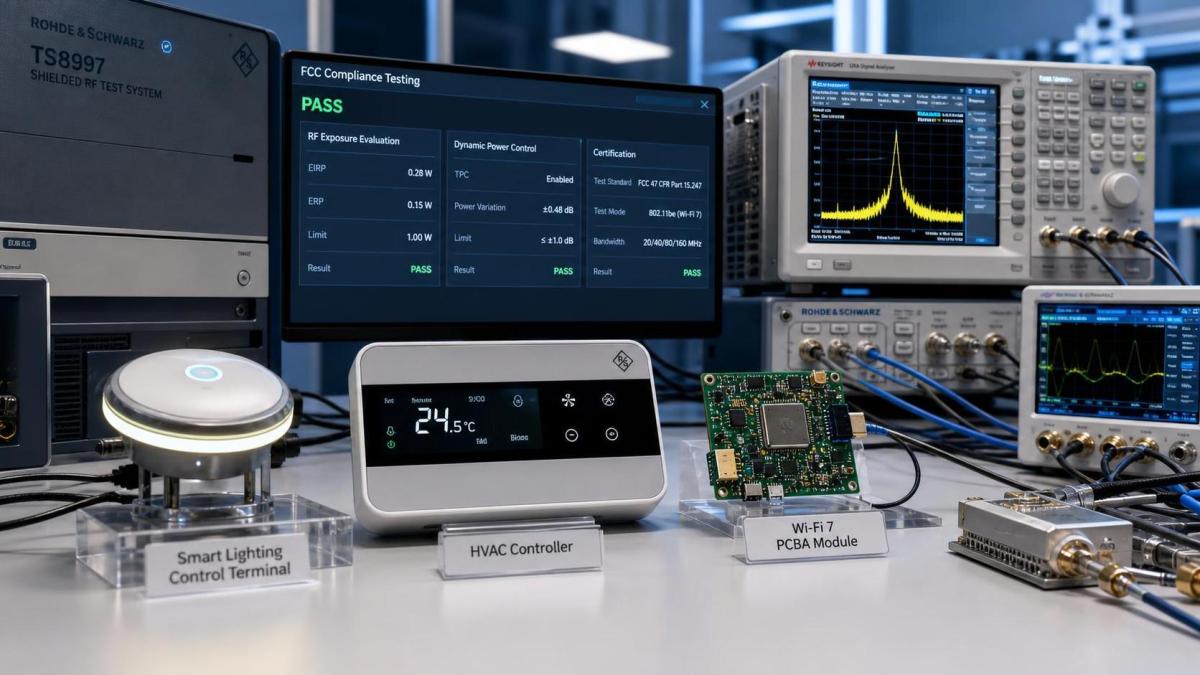
According to the provided information, the FCC rule became effective on August 10, 2026 and applies to IoT terminal devices using Wi-Fi 7 technology. The updated requirement introduces stricter radio-frequency exposure evaluation and tighter verification of dynamic power control. It covers export categories including smart lighting, HVAC controllers, and PCBA integrated modules.
The same information also states that manufacturers exporting Wi-Fi 7 IoT products from China to the United States will face direct effects on certification lead times and testing costs. In addition, applicants are required to provide an EMC consistency report for coordinated multi-channel transmission under OTA scenarios.
Where the Pressure Will Be Felt First
Export-facing device makers will see compliance move earlier in the project cycle
From an industry perspective, manufacturers selling finished Wi-Fi 7 IoT products into the U.S. are likely to feel the impact first because certification is part of market access. The immediate pressure point is not only final testing, but also how early product teams prepare for RF exposure assessment, dynamic power control verification, and the added OTA-related EMC documentation.
Module and PCBA suppliers may face higher documentation demands
For suppliers of PCBA integrated modules, the rule matters because compliance evidence may increasingly become part of customer qualification and export documentation. Analysis shows that even when a supplier is not the final brand owner, its test records, technical files, and coordination with downstream customers can become more important once certification requirements become more detailed.
Certification and testing service providers may need to manage longer workflows
Service providers involved in testing and certification are also within the impact range. Observably, the added need for EMC consistency reporting in OTA multi-channel transmission scenarios can translate into more coordination across test planning, sample readiness, and report delivery. The business effect is less about headline policy change and more about workflow complexity.
Buyers and channel-side partners may need to recheck delivery assumptions
For overseas buyers, importers, or channel partners sourcing Wi-Fi 7 IoT products, the practical issue is whether product launch or replenishment schedules were built around earlier certification assumptions. What deserves closer attention is that a rule change affecting approval pace can also affect shipment planning, model introduction timing, and supplier communication.
What Companies Should Watch Closely Now
Whether product scope has been mapped correctly
Companies should first verify which exported products fall within the affected range, especially where Wi-Fi 7 capability is embedded in smart lighting devices, HVAC controllers, or PCBA-based designs. The core issue is to avoid treating the rule as relevant only to finished branded devices when integrated hardware may also trigger compliance work.
Whether test preparation still matches the old certification path
Analysis shows that businesses should review whether their current certification planning still reflects older assumptions on RF exposure and power-control verification. If internal schedules, customer commitments, or supplier handoffs were based on narrower test expectations, those plans may need adjustment before they create delivery friction.
Whether OTA multi-channel EMC evidence is ready in time
The added requirement for an EMC consistency report under OTA multi-channel coordinated transmission scenarios is a practical checkpoint. Companies should pay attention to sample readiness, supporting records, and the sequence in which evidence is assembled, because delays here can affect the broader approval timetable.
Whether customer communication and lead-time commitments need updating
For export teams and account managers, the distinction between a rule taking effect and a shipment remaining on schedule is important. What deserves closer attention is how certification cycle changes are explained to customers, especially where contracts, forecast windows, or launch dates depend on approval milestones.
Why This Looks Like More Than a Routine Filing Change
Analysis shows that this update should be read as a compliance-tightening signal around Wi-Fi 7 IoT market access in the United States, rather than as a minor documentation revision. The confirmed facts point to stricter technical verification and additional reporting expectations, which means the operational effect is likely to show up in testing depth, approval sequencing, and cross-party coordination.
At the same time, it is more appropriate to understand this as a concrete near-term compliance change with longer-term implications still worth watching. The rule is already in force, so the immediate issue is execution. Broader conclusions about how far the effect will extend across product categories, cost structures, or sourcing decisions still require continued observation.
How the Industry Is Best Reading This Signal
The practical significance of this development is clear: for Wi-Fi 7 IoT products entering the U.S. market, compliance requirements are becoming more exacting in ways that can affect approval time and testing burden. A neutral reading is that this is neither a temporary headline nor a basis for sweeping market conclusions. It is more appropriate to understand it as an active regulatory requirement with direct operational consequences for exporters, module suppliers, and compliance-related service providers.
Basis of This Article and What Still Needs Verification
This article is based on the user-provided news title, event date, and event summary. For developments of this kind, relevant source categories typically include official regulatory notices, company compliance disclosures, industry association updates, authoritative media reporting, and standards-related documentation. No specific official source link was provided in the input, so the exact text and subsequent interpretive updates should continue to be verified. Areas that still warrant follow-up include any later FCC clarifications, implementation wording, and any further detail affecting certification practice for Wi-Fi 7 IoT export products.
Protocol_Architect
Dr. Thorne is a leading architect in IoT mesh protocols with 15+ years at NexusHome Intelligence. His research specializes in high-availability systems and sub-GHz propagation modeling.
Related Recommendations
- Dr. Aris ThorneWi-Fi 7 IoT Procurement Checklist for Secure Renewable Energy Site Networks
- Dr. Aris ThorneWhat to Evaluate in a Wi-Fi 7 Smart Home Router for Dense IoT Networks
- Dr. Aris ThorneWi-Fi 6E vs Wi-Fi 7: Which Delivers Lower Latency for Industrial IoT?
- Dr. Aris ThorneFCC Tightens Wi-Fi 7 IoT Approval Rules
- Dr. Aris ThorneFCC Tightens Wi-Fi 7 IoT Filing Rules from Oct. 2026
- Dr. Aris ThorneFCC Tightens Wi-Fi 7 IoT Rules From Oct. 2026
- Dr. Aris ThorneFCC Tightens Wi-Fi 7 IoT Certification for 2026
- Dr. Aris ThorneFCC Tightens Wi-Fi 7 IoT Rules From Sept. 1, 2026
- Dr. Aris ThorneFCC Tightens Wi-Fi 7 IoT Certification for US Market
- Dr. Aris ThorneFCC Tightens Wi-Fi 7 IoT RF Rules From August 2026
Analyst