
How to compare palletizing robot suppliers beyond unit price
author
When evaluating palletizing robot suppliers, unit price is only the starting point. For procurement teams in renewable energy, long-term value depends on uptime, integration capability, safety compliance, energy efficiency, and after-sales support. This guide shows how to compare suppliers with a data-driven lens, helping you reduce operational risk and choose a partner that delivers measurable performance beyond the initial quote.
Why procurement teams should use a checklist, not just a quote comparison
In renewable energy operations, palletizing systems often support high-volume movement of cartons, battery modules, inverter packaging, cable accessories, and spare parts. A low quoted price may look attractive, but the real cost of working with palletizing robot suppliers is shaped by line stoppages, integration delays, inconsistent cycle time, software limitations, maintenance burden, and weak technical support. That is why procurement teams should evaluate suppliers through a structured checklist instead of a simple side-by-side price sheet.
This matters even more when facilities are expected to run lean, meet sustainability goals, and integrate with broader digital infrastructure. At NexusHome Intelligence, the core principle is that trust should come from verifiable data rather than marketing language. That same mindset applies here: claims such as “high speed,” “easy integration,” or “energy saving” should be translated into measurable criteria, test conditions, and proof from installed projects.
The first-pass checklist for comparing palletizing robot suppliers
Before you request a final commercial proposal, use the following screening checklist. It helps procurement teams eliminate weak options early and focus on palletizing robot suppliers that can support long-term operational performance.
- Confirm payload, reach, stacking pattern flexibility, and maximum throughput under your real product dimensions.
- Check whether the supplier has experience in renewable energy manufacturing, warehousing, or distribution environments.
- Verify integration capability with conveyors, vision systems, barcode readers, WMS, MES, and safety systems.
- Request documented uptime targets, mean time between failures, and maintenance interval recommendations.
- Assess energy consumption per cycle or per pallet, not just motor power rating.
- Review compliance with local and export-market safety standards.
- Evaluate spare parts availability, response time, remote diagnostics, and training support.
- Ask for total cost of ownership over three to five years, including software, tooling, commissioning, and service.
If a supplier cannot answer these points clearly, the low unit price is likely masking future cost and risk.
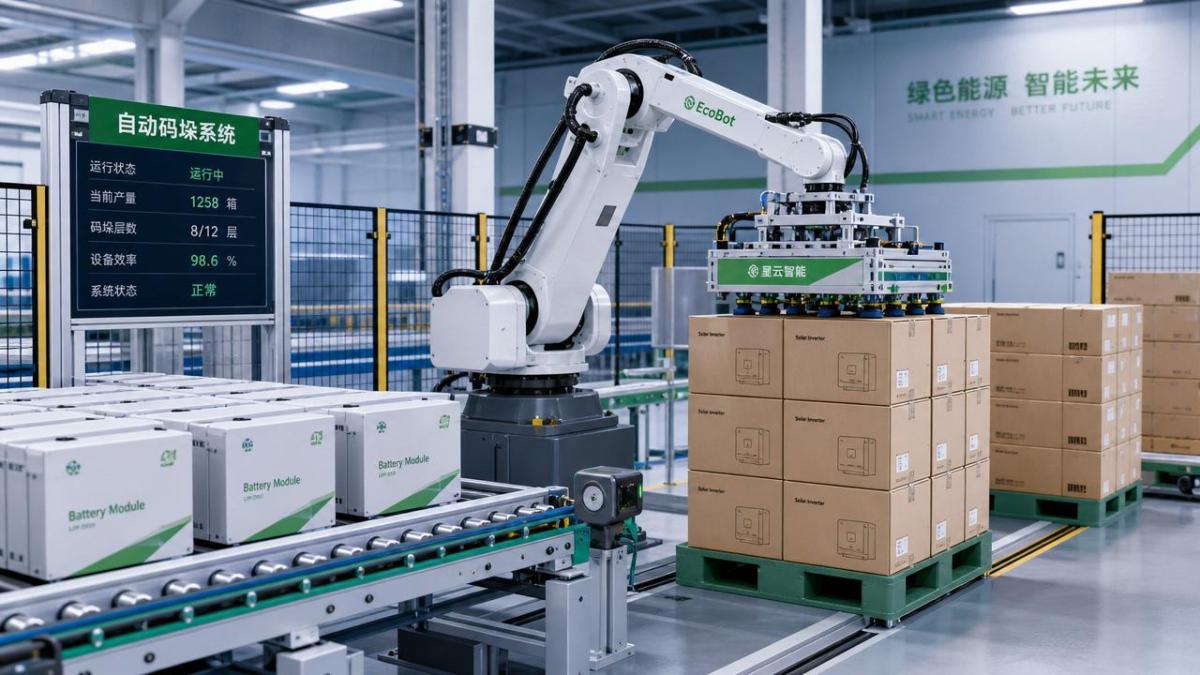
Core evaluation criteria procurement should score before selecting palletizing robot suppliers
1. Technical fit to your SKU mix and packaging variability
Many palletizing robot suppliers perform well in controlled demos but struggle when carton sizes vary, loads shift, or packaging quality is inconsistent. Procurement should ask for a technical fit analysis based on actual product data: carton dimensions, product weight ranges, pallet types, target stack heights, shift pattern, and expected future SKU expansion. For renewable energy businesses, this is important because packaging can vary significantly between solar components, storage accessories, monitoring hardware, and aftermarket kits.
A strong supplier should explain end-of-arm tooling options, gripper tolerance, layer-forming logic, and changeover time. The best comparison is not “Which robot is cheapest?” but “Which supplier can keep stable performance across our full operating window?”
2. Integration depth and data visibility
For modern facilities, palletizing is no longer an isolated machine purchase. It is part of a connected material flow system. Procurement teams should compare palletizing robot suppliers on PLC compatibility, communication protocols, software openness, recipe management, and availability of production data. If your site is pursuing digital traceability or energy reporting, the robot cell should support event logs, alarm history, remote monitoring, and clean data exchange with plant systems.
This is where a data-driven procurement approach becomes practical. Ask suppliers what performance variables can be exported, how downtime is categorized, and whether remote diagnostics are included or licensed separately. Better data visibility improves not only maintenance but also continuous improvement and ESG reporting.
3. Proven reliability under industrial operating conditions
Reliability should be measured with evidence, not broad claims. Ask palletizing robot suppliers for case studies showing runtime, failure modes, and installed base in demanding production settings. Useful questions include: What is the average uptime achieved after stabilization? Which components fail most often? How quickly can a failed gripper, sensor, or drive be replaced? What preventive maintenance tasks are required weekly, monthly, and annually?
In renewable energy supply chains, shipment schedules can be tight and seasonal. One unstable palletizing cell can slow outbound logistics and damage on-time delivery performance. Procurement should therefore score suppliers based on maintainability as well as speed.
4. Safety compliance and real-world operability
Price-led selection often underestimates safety-related cost. Compare palletizing robot suppliers on guarding design, emergency stop logic, safe access zones, light curtains, interlocks, and operator recovery procedures. A safer system is not only about certification; it is also about how quickly operators can clear minor faults without exposing themselves to risk or waiting excessively for engineering intervention.
For multinational procurement, check whether the supplier understands the destination country’s safety expectations and documentation needs. Missing compliance details can delay commissioning and create hidden rework cost long after purchase order approval.
5. Energy efficiency and sustainability performance
Because the industry focus is renewable energy, energy efficiency should be a formal sourcing criterion. Procurement teams should ask palletizing robot suppliers for measured power consumption during idle, normal operation, peak load, and restart conditions. The most useful metric is not simply installed power, but actual energy used per pallet or per thousand units handled.
Also check compressed air use, regenerative drive options, standby modes, and software settings that reduce unnecessary motion. Over several years, lower operating energy and less wear can outweigh modest differences in initial price. This aligns with the broader NHI view that engineering truth is found in measured performance, not brochure adjectives.
A practical scorecard to compare palletizing robot suppliers
A weighted scorecard helps procurement teams avoid overvaluing the purchase price. The example below can be adapted to your plant priorities.
This kind of scorecard creates a common language between procurement, engineering, EHS, and operations. It also makes supplier selection more defendable internally.
Scenario-based checks for renewable energy applications
Not all palletizing robot suppliers are equally strong across all use cases. Procurement should adjust the checklist based on the operating scenario.
Battery and energy storage packaging
Focus on load stability, product protection, traceability integration, and safe handling of heavier or higher-value packaged units. Ask how the supplier manages mispicks, damaged cartons, and pallet pattern consistency for transport-sensitive products.
Solar component logistics
Here, throughput and packaging variation may matter more. Compare palletizing robot suppliers on changeover speed, pattern library flexibility, and conveyor synchronization. Seasonal demand spikes also make service responsiveness especially important.
Spare parts and mixed-SKU distribution
For distribution environments with varied cartons, software intelligence and recipe management become major differentiators. Procurement should check whether the supplier can support future expansion toward semi-automated or fully connected warehouse workflows.
Common blind spots when reviewing palletizing robot suppliers
- Comparing quoted speed without asking how cycle time changes with different box sizes or pallet heights.
- Ignoring software licensing, recipe upgrades, and remote support fees until late-stage negotiation.
- Assuming local service exists when support is actually remote or subcontracted.
- Overlooking spare parts lead time for imported components.
- Failing to define factory acceptance test and site acceptance test criteria in the contract.
- Treating energy use as secondary, even when sustainability reporting is a business priority.
These blind spots can turn an apparently competitive deal into a costly operational problem. Strong procurement practice means identifying them before supplier selection, not after installation.
Execution advice: what to ask suppliers before final negotiation
To move from shortlist to decision, ask each supplier the same structured questions. This improves fairness and makes comparison easier.
- Provide a reference layout and cycle time model based on our actual SKU and pallet data.
- List all included and excluded items in the quote, including tooling, safety, software, and commissioning.
- State expected energy use and maintenance cost with assumptions.
- Define response time for faults, spare parts commitment, and escalation path.
- Share acceptance test criteria and ramp-up support plan.
- Explain how future line modifications or additional SKU recipes will be handled.
FAQ for procurement teams comparing palletizing robot suppliers
Is the lowest quote ever the best choice?
Only if the supplier can prove equivalent reliability, integration, compliance, and support. In most cases, the lowest upfront quote does not represent the lowest lifecycle cost.
What metric should matter most after price?
For most renewable energy operations, uptime under real operating conditions is the most important metric, followed closely by integration capability and service responsiveness.
How can procurement validate supplier claims quickly?
Request measured data, reference sites, acceptance criteria, and scenario-based performance assumptions. A trustworthy supplier should be able to document, not just describe, expected results.
Final action checklist
When comparing palletizing robot suppliers, procurement should avoid treating the robot as a standalone capital item. The better approach is to compare full operational value: technical fit, uptime, integration depth, safety readiness, energy performance, and service quality. If you need to move the project forward, prepare these inputs first: SKU data, pallet specifications, target throughput, plant interface requirements, safety expectations, service location, expansion plans, and budget range. Then ask each supplier to respond against the same checklist and scorecard.
That process will help you identify palletizing robot suppliers that can support resilient, efficient, and scalable operations for the renewable energy sector. And if you need deeper confirmation of parameters, solution fit, delivery timeline, lifecycle cost, or cooperation model, the next conversation should focus on measurable performance evidence rather than marketing promises.
Protocol_Architect
Dr. Thorne is a leading architect in IoT mesh protocols with 15+ years at NexusHome Intelligence. His research specializes in high-availability systems and sub-GHz propagation modeling.
Related Recommendations
- Lina Zhao(Security Analyst)6 axis robot arm wholesale quality issues that show up late
- Lina Zhao(Security Analyst)Custom AMR AGV supplier or standard platform: which ages better
- Lina Zhao(Security Analyst)How to shortlist a heavy duty AGV manufacturer for harsh sites
- Lina Zhao(Security Analyst)The hidden limits of a collaborative robot payload 10kg rating
- Lina Zhao(Security Analyst)Factory AGV navigation systems: lidar, QR, or SLAM?
- Lina Zhao(Security Analyst)Custom robotic end effectors that cut downtime, not just cycle time
- Lina Zhao(Security Analyst)Pick and place robot manufacturer red flags before sample testing
- Lina Zhao(Security Analyst)Why welding robot arm price varies so much between quotes
- Lina Zhao(Security Analyst)Palletizing robot suppliers with short lead times are not always safer
- Lina Zhao(Security Analyst)Autonomous mobile robot China options are widening fast
Analyst