
India BIS Smart Lock新规5月4日启动预审:全温区生物识别成硬门槛
author
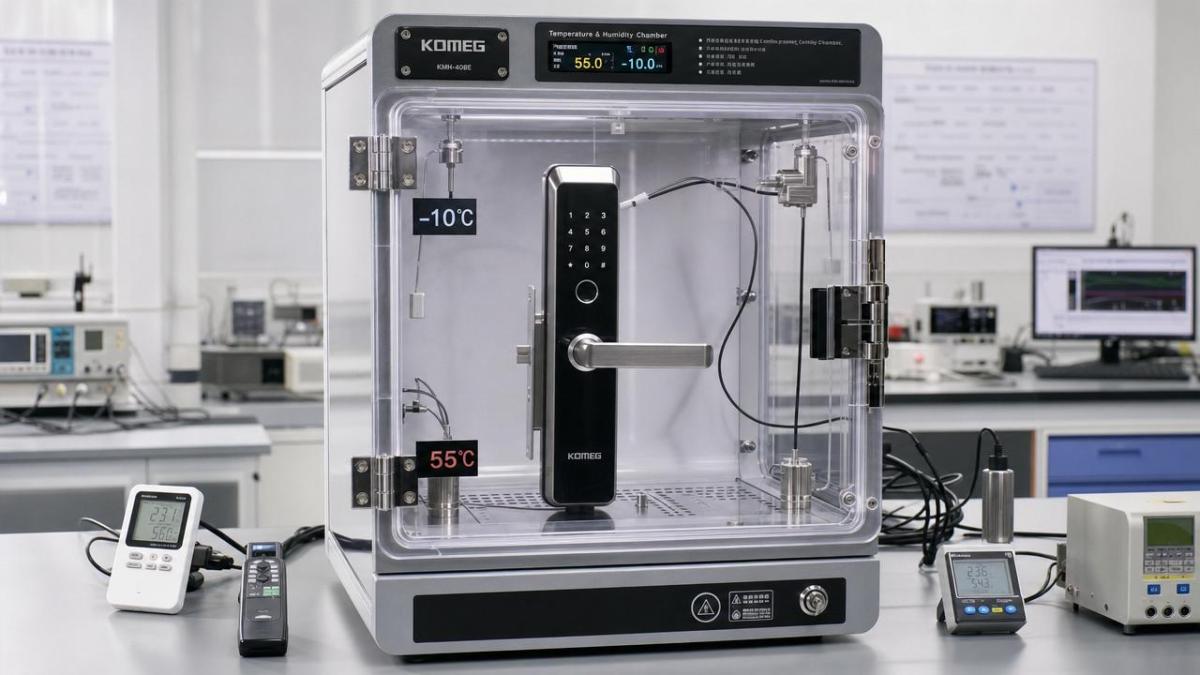
India’s Bureau of Indian Standards (BIS) opened pre-assessment applications for the new IS 17899:2026 standard for smart locks on May 4, 2026 — a regulatory shift with direct implications for smart lock exporters, ODM manufacturers, and importers serving the Indian market. The requirement for biometric stability across -10°C to 55°C — with ≤0.8% FRR and ≤0.3% FAR — introduces a measurable technical threshold not present in the superseded IS 16013. This update warrants attention from hardware OEMs, testing service providers, and cross-border supply chain stakeholders.
Event Overview
The Bureau of Indian Standards (BIS) commenced pre-assessment submissions for IS 17899:2026 — the new mandatory standard for smart locks — effective 00:00 IST on May 4, 2026. The standard mandates that all certified smart lock models demonstrate biometric recognition performance of ≤0.8% False Rejection Rate (FRR) and ≤0.3% False Acceptance Rate (FAR) across the full operating temperature range of -10°C to 55°C. IS 17899:2026 will replace the current IS 16013 standard and is scheduled for full enforcement in Q3 2026.
Industries Affected by Segment
Smart Lock ODM/OEM Manufacturers (China-based)
Chinese smart lock ODM suppliers face immediate pressure to validate product performance under extended thermal conditions. Unlike prior certification requirements, IS 17899:2026 explicitly ties compliance to environmental robustness — meaning existing lab capabilities calibrated only for room-temperature biometric testing are insufficient. Impact manifests in delayed time-to-market, added validation costs, and potential rework of fingerprint or facial recognition modules.
International Importers & Brand Owners (India-focused)
Importers distributing smart locks in India must now vet supplier readiness beyond documentation — specifically confirming whether the supplier has initiated BIS pre-assessment under IS 17899:2026. Failure to do so risks inventory non-compliance post-Q3 2026 enforcement, leading to customs rejection or market withdrawal. Selection criteria for new suppliers should now include verified environmental test capacity and active pre-assessment status.
Third-Party Testing & Certification Service Providers
Laboratories accredited for BIS certification need to confirm capability for low- and high-temperature biometric validation per IS 17899:2026 Annexes. Demand for climate-controlled biometric test chambers (with traceable calibration across -10°C–55°C) is expected to rise among clients preparing submissions. Labs without such infrastructure may see reduced engagement from manufacturers seeking end-to-end support.
What Relevant Enterprises Should Monitor and Act On
Track official BIS updates on pre-assessment timelines and document requirements
While pre-assessment opened May 4, 2026, BIS has not yet published detailed checklists for environmental test reports, sample submission protocols, or acceptable test methodologies for FRR/FAR under thermal stress. Stakeholders should monitor the BIS website and official notifications for clarifications — especially regarding whether third-party lab reports must be issued by BIS-empanelled labs only.
Prioritize temperature-stress validation for high-volume SKUs
Manufacturers should identify top-selling models destined for India and allocate resources for full-temperature-range biometric testing before Q3 2026. Given finite chamber availability and longer test cycles at extremes, early scheduling avoids bottlenecks. Models with plastic housings or unsealed sensors may require design review first.
Distinguish between pre-assessment eligibility and final certification readiness
Pre-assessment does not guarantee certification. It is an administrative step confirming application completeness. Final approval requires successful test results, factory audit, and surveillance plan acceptance. Companies should avoid interpreting pre-assessment initiation as de facto compliance — especially given the stringent FRR/FAR thresholds across the full thermal envelope.
Align procurement and logistics planning with anticipated lead-time extensions
Environmental validation adds 2–4 weeks to typical certification timelines. Importers should revise order forecasts and safety stock levels for Indian-bound shipments, particularly for models lacking prior thermal data. Coordination with ODMs on revised documentation handover dates is recommended to prevent shipment delays at port clearance.
Editorial Perspective / Industry Observation
Observably, IS 17899:2026 signals a structural tightening of India’s smart lock regulatory framework — shifting emphasis from basic functionality and electrical safety to real-world operational resilience. Analysis shows this is less a one-off revision and more an indicator of BIS’s broader intent to align with international expectations on biometric reliability in diverse climatic conditions. From an industry perspective, the -10°C to 55°C mandate reflects India’s geographic thermal variability — not merely a technical formality. Current enforcement timing (pre-assessment now, full mandate in Q3) suggests BIS intends to allow a six-month runway for capability ramp-up — but also implies limited tolerance for appeals or grace periods post-deadline. Continued observation is warranted on whether BIS publishes interpretive guidance on edge-case scenarios (e.g., condensation-related sensor failure, battery voltage drift under thermal stress).
In summary, IS 17899:2026 represents a calibrated escalation in technical accountability for smart lock market access in India — not a sudden disruption, but a defined inflection point requiring targeted operational adjustments. It is best understood not as a barrier, but as a specification-driven threshold: one that rewards preparedness in environmental testing and supply chain coordination, rather than penalizing late-stage adaptation.
Source: Official announcement from Bureau of Indian Standards (BIS), IS 17899:2026 standard document (publicly released version), and BIS portal notice dated May 4, 2026. Note: Details on test methodology acceptance, lab accreditation scope expansion, and post-pre-assessment audit scheduling remain under observation and subject to official clarification.
Protocol_Architect
Dr. Thorne is a leading architect in IoT mesh protocols with 15+ years at NexusHome Intelligence. His research specializes in high-availability systems and sub-GHz propagation modeling.
Related Recommendations
- Lina Zhao (Security Analyst)India BIS Smart Lock新规5月4日启动预审:全温区生物识别成硬门槛
- Lina Zhao (Security Analyst)India BIS Proposes New Smart Lock Rules: Wide-Temp Biometric Stability Mandatory
- Lina Zhao (Security Analyst)India BIS Proposes New Smart Lock Standard: -10°C to 55°C Biometric Stability Mandatory
- Lina Zhao (Security Analyst)India BIS Drafts New Smart Lock Standard: -10°C to 55°C Biometric Stability Mandatory
- Lina Zhao (Security Analyst)India BIS Drafts New Smart Lock Standard: Full-Temperature Biometric Stability Mandatory
- Lina Zhao (Security Analyst)Hardware Root of Trust Is Not a Box to Tick
- Lina Zhao (Security Analyst)Smart lock OEM China options differ most in security validation
- Lina Zhao (Security Analyst)Where smart security access control systems usually fail first
- Lina Zhao (Security Analyst)Hardware root of trust choices that affect long-term device risk
- Lina Zhao (Security Analyst)Smart Lock OEM China: How to Avoid Bad Fits
Analyst