
Biometric False Rejection Rate FRR Explained Simply
author
Biometric False Rejection Rate (FRR) sounds technical, but its impact is simple: when valid users are denied access, security, usability, and operational efficiency all suffer. For teams evaluating smart security access control in renewable energy facilities and connected buildings, understanding biometric false rejection rate FRR is essential. Backed by IoT hardware benchmarking and smart home hardware testing, NHI explains what FRR means, why it matters, and how data-driven verification supports smarter sourcing decisions across the IoT supply chain.
In renewable energy operations, access control is not a side issue. Solar farms, wind turbine substations, battery energy storage systems, and distributed energy sites often rely on restricted zones, unmanned infrastructure, and multi-shift technician access. When a biometric smart lock rejects an authorized engineer at 2:00 a.m. during a weather event or grid fault, the cost is measured in more than inconvenience. Delayed intervention can affect uptime, safety response, and maintenance scheduling.
For researchers, operators, procurement teams, and business evaluators, FRR is one of the most useful indicators for separating marketing claims from real-world performance. A low advertised error rate means little unless the device has been tested across temperature swings, wet fingers, dust exposure, power fluctuations, and protocol interference. That is why NHI approaches smart security access as a measurable engineering discipline rather than a brochure feature.
What Biometric False Rejection Rate Means in Renewable Energy Access Control
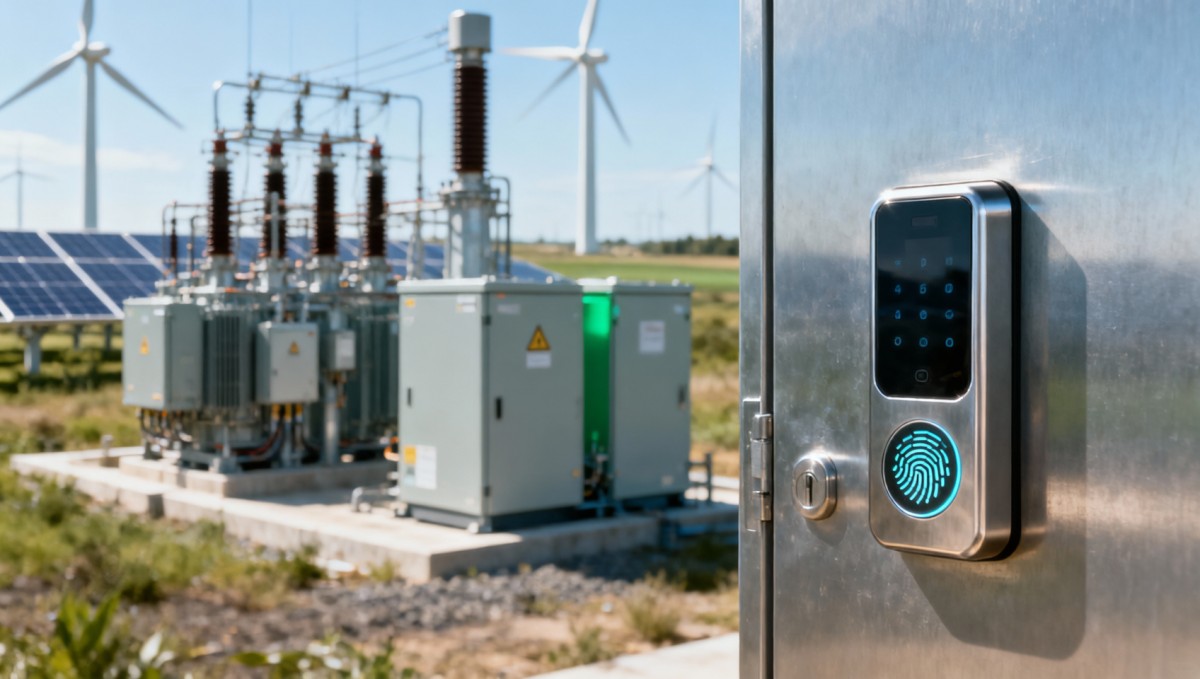
Biometric False Rejection Rate, usually shortened to FRR, refers to the percentage of valid users who are incorrectly denied access by a biometric system. In simple terms, if 100 authorized access attempts are made and 3 are rejected, the FRR is 3%. The user is legitimate, but the system fails to recognize them under actual operating conditions.
This matters especially in renewable energy environments because these sites are rarely climate-controlled office spaces. A technician opening an enclosure at a photovoltaic plant may have dusty hands, gloves removed in cold weather, and only a 30-second service window before moving to the next string inverter. A biometric system with a laboratory FRR below 1% may perform very differently in field conditions of -10°C to 45°C, high humidity, or direct sun exposure.
FRR is often discussed alongside FAR, or False Acceptance Rate. FAR measures how often an unauthorized user is incorrectly accepted, while FRR measures how often an authorized user is incorrectly rejected. Procurement teams should never review one metric in isolation. A vendor may tune a system to reduce FAR, but that can unintentionally raise FRR to a level that frustrates field staff and slows emergency access.
In renewable energy facilities, common biometric methods include fingerprint, facial recognition, palm vein, and sometimes mobile-based biometric authentication tied to edge gateways. Fingerprint systems remain common due to cost and compact size, but they are also more sensitive to skin dryness, contamination, and placement quality. For sites with frequent outdoor access, the practical FRR can vary significantly between morning dew, midday heat, and winter maintenance cycles.
Why FRR Is Not Just a Security Metric
An elevated false rejection rate creates a chain reaction. Operators lose time, supervisors handle more override requests, and site managers may respond by weakening policy, such as keeping cabinets unlocked during maintenance windows. In other words, a poor biometric experience can reduce both security and compliance.
For distributed energy portfolios with 20, 50, or 200 remote access points, even a 2% to 5% FRR can become operationally visible. A system that rejects one out of every 40 or 50 valid attempts may still appear acceptable on paper, yet become expensive when multiplied across daily inspections, contractor visits, and after-hours service calls.
Typical FRR Interpretation in Field Use
The table below shows how many procurement and technical teams interpret FRR ranges in practical renewable energy deployments. These are evaluation ranges, not universal pass-fail standards, because actual suitability depends on site criticality, fallback method, and testing conditions.
The key takeaway is that acceptable FRR depends on the consequences of delay. A battery storage site with thermal safety protocols may need tighter usability thresholds than a low-risk indoor meter room. The correct question is not “Is the FRR low?” but “Is the FRR low enough under our actual environmental and operational conditions?”
Why FRR Matters for Solar, Wind, Storage, and Smart Building Energy Systems
Renewable energy infrastructure is becoming more distributed, more automated, and more dependent on connected hardware. That means access control devices increasingly sit at the boundary between cybersecurity, physical safety, and asset uptime. A biometric lock with weak field performance can interrupt technician workflows, increase truck roll time, and create audit gaps when emergency overrides are used too often.
At a utility-scale solar site, one maintenance team may move through 10 to 30 access points in a day, including inverter stations, combiner boxes, control rooms, and perimeter gates. If each location has even a short 20- to 40-second delay from repeated biometric attempts, time loss accumulates quickly. Over a month, that inefficiency can affect service windows, contractor productivity, and preventative maintenance completion rates.
In wind energy, FRR becomes more sensitive because technicians may work under gloves-off conditions, high vibration, salt fog in coastal regions, or limited connectivity for cloud authentication. In battery energy storage systems, denied access during an alarm event is a risk factor, not just a user annoyance. In smart commercial buildings with solar-plus-storage, access delays can also disrupt HVAC controls, microgrid switching, or energy management inspections.
For procurement and business assessment teams, FRR should be linked directly to site criticality and response time. A site with a required intervention window of 5 minutes demands a different access-control profile than a site where entry can be delayed by 15 minutes without operational impact. The more time-sensitive the environment, the more valuable verified FRR data becomes.
Operational Risks Caused by High FRR
- Delayed corrective maintenance during inverter, transformer, or BESS alarm events.
- Increased use of backup PINs, physical keys, or manual overrides that weaken auditability.
- Higher training burden when operators must learn workaround procedures for failed authentication.
- Lower confidence in smart lock deployments across remote renewable assets.
- Potential safety exposure when restricted areas cannot be accessed on the first attempt.
These risks explain why NHI emphasizes benchmark testing over generic claims. A lock that performs well in a showroom may fail in a dusty containerized energy storage system, especially after repeated use, battery drain, or radio interference from nearby wireless devices. Reliable procurement requires data that reflects the edge conditions of real infrastructure.
Scenario-Based Impact by Facility Type
The next table maps common renewable energy scenarios to the practical importance of FRR. This helps non-engineering stakeholders understand where usability and access speed become procurement priorities rather than optional performance details.
Across all four scenarios, the same lesson applies: if access technology creates friction, teams eventually bypass it. That is why the renewable energy sector should treat FRR as an operational KPI tied to uptime, labor efficiency, and risk control.
How NHI Benchmarks FRR Beyond Vendor Claims
NHI was built around a simple principle: trust should come from verifiable data, not polished language. In smart security and access, that means testing biometric devices under the same pressures they will face in connected buildings, distributed energy sites, and mixed-protocol IoT environments. FRR is never reviewed as a single headline number without context.
A robust FRR benchmark starts with enrollment quality. If user enrollment is inconsistent, the error rate becomes meaningless. NHI therefore examines at least three layers: initial capture quality, repeated-use consistency, and environmental tolerance. For example, a device may be tested across dry, damp, and contaminated finger conditions, or facial systems may be checked under backlight, low-light, and helmet-adjacent usage patterns.
Environmental stress is especially relevant for renewable energy. Outdoor edge hardware may face 24-hour temperature shifts of 15°C to 25°C, dust ingress, and intermittent power or network quality. NHI’s broader benchmarking philosophy also matters here because authentication speed and protocol stability affect perceived FRR. If a lock times out because of unstable Thread, BLE, or gateway communication, the user still experiences a failed entry event, even if the biometric engine itself is accurate.
That is why access control should be evaluated as part of the full IoT chain: sensor quality, processing latency, edge computing behavior, battery performance, and protocol resilience. A renewable energy operator does not buy an isolated fingerprint module. They buy a field system that must work under electrical, environmental, and human variability.
A Practical FRR Verification Workflow
- Define the site type: solar, wind, storage, or energy-smart building.
- Set environmental profiles such as heat, moisture, dust, and low-light operation.
- Enroll multiple authorized users with varied usage habits and hand conditions.
- Run repeated access attempts over a realistic cycle, such as 200 to 500 events.
- Record rejection events, retry counts, unlock time, and fallback credential usage.
- Review whether failures come from biometrics, battery sag, connectivity, or software logic.
This method gives procurement teams a more useful answer than a single brochure number. It reveals whether a device remains dependable after repeated cycles, whether battery performance drops in cold weather, and whether system latency makes operators perceive the product as unreliable.
What Should Be Documented During Testing
The table below summarizes the data points that matter most when evaluating biometric false rejection rate FRR in renewable energy access control projects.
When these records are available, teams can compare suppliers on engineering evidence rather than broad claims such as “industrial grade” or “works with smart energy systems.” That approach aligns with NHI’s role as an engineering filter in a fragmented global IoT supply chain.
How Buyers and Operators Should Evaluate FRR Before Procurement
For B2B buyers, the most common mistake is choosing biometric access hardware based on feature lists instead of deployment fit. A smart lock may support Matter, BLE, or cloud dashboards, but that does not guarantee stable recognition in a renewable energy field environment. FRR should be reviewed together with battery life, enclosure protection, offline authentication capability, and integration with site operations.
The first procurement question should be environmental alignment. If the device will be installed on outdoor cabinets or energy storage containers, ask how FRR changes across heat, cold, condensation, and contaminated surfaces. A second question is workload alignment: how many entries per day, per week, and per maintenance cycle does the device need to support? For some sites, 10 daily events are normal; for others, 100 or more access attempts may occur during outage response or commissioning.
The third question is fallback design. No buyer should assume zero rejection events. Instead, evaluate whether the fallback path is secure, fast, and auditable. Good options may include encrypted mobile credentials, role-based temporary access, or supervised PIN fallback. Poor options include shared codes written on-site or physical keys with weak tracking.
Business evaluators should also connect FRR to total cost of ownership. A cheaper device with frequent access failures may create hidden costs in support calls, technician downtime, retraining, site exceptions, and premature replacement. In remote energy infrastructure, even one unnecessary visit can outweigh a small unit-price saving.
Procurement Checklist for Renewable Energy Teams
- Request tested FRR data across at least 2 to 3 environmental conditions relevant to your site.
- Verify whether authentication can run locally if cloud or backhaul connectivity fails.
- Check average unlock time, not just acceptance accuracy; 1 to 2 seconds is very different from 6 to 8 seconds during urgent access.
- Confirm the number of supported users, audit log retention, and temporary credential controls.
- Review battery or power architecture for seasonal performance, especially below 0°C or above 40°C.
- Ask whether the vendor can separate biometric rejection from communication timeout in system logs.
These questions improve sourcing discipline and reduce the chance of installing access hardware that looks advanced but performs poorly under renewable energy operating realities. They also help align procurement with engineering, safety, and facilities management teams instead of letting each function evaluate hardware through a different lens.
Common Buying Mistakes
Several recurring mistakes appear in smart security sourcing for energy sites. Teams often assume a low FAR automatically means high quality, ignore enrollment training, underestimate battery behavior in cold weather, or fail to test with actual users such as field technicians and contractors. Each of these errors can make a nominally good product perform badly in practice.
A disciplined buying process should therefore include a pilot period of 2 to 4 weeks, a realistic user group, and clear pass criteria such as acceptable FRR, retry rate, and entry speed. That turns procurement from feature comparison into evidence-based validation.
FAQ and Final Guidance for Smarter Access Control Decisions
Many stakeholders encounter FRR for the first time during product evaluation. The questions below reflect common search intent from technical researchers, operators, procurement teams, and commercial decision-makers in renewable energy and connected building projects.
How low should FRR be for renewable energy sites?
There is no single universal threshold, but many teams look for field-verified performance below 1% for higher-criticality access points and within 1% to 3% for less time-sensitive areas, provided secure fallback options exist. The right target depends on the cost of delay, the number of daily access attempts, and environmental stress.
Can a good enrollment process reduce false rejection rate?
Yes. Enrollment quality has a direct effect on biometric performance. Capturing multiple finger positions or face angles, training users on placement, and re-enrolling after failed pilots can reduce operational FRR noticeably. In many deployments, poor enrollment practices create more trouble than the core sensor itself.
Should remote sites avoid biometric access altogether?
Not necessarily. Remote sites can benefit strongly from biometrics when the hardware supports local processing, durable power management, and secure fallback methods. The decision should depend on benchmarked performance, not on a blanket assumption that remote environments are unsuitable.
What other metrics should be reviewed with FRR?
At minimum, review FAR, average unlock time, retry count, offline mode behavior, battery profile, communication stability, and audit log quality. In renewable energy settings, it is also wise to examine environmental tolerance such as dust, moisture, and temperature variation over a full maintenance cycle.
Biometric false rejection rate FRR is easy to define but costly to ignore. In renewable energy facilities, every failed entry can affect maintenance speed, safety workflow, and confidence in smart security infrastructure. The best decisions come from benchmarking that reflects actual field conditions, not generic marketing language.
NexusHome Intelligence helps buyers and technical teams evaluate smart access devices through data, protocol verification, and real-world hardware testing. If you are comparing biometric locks, edge access systems, or connected security hardware for solar, wind, storage, or energy-smart buildings, contact NHI to discuss benchmarking criteria, sourcing priorities, and a more reliable path to deployment.
Protocol_Architect
Dr. Thorne is a leading architect in IoT mesh protocols with 15+ years at NexusHome Intelligence. His research specializes in high-availability systems and sub-GHz propagation modeling.
Related Recommendations
- Lina Zhao (Security Analyst)Biometric False Rejection Rate FRR Explained Simply
- Lina Zhao (Security Analyst)How to Compare Biometric Sensor Metrics Fairly
- Lina Zhao (Security Analyst)Which Biometric Sensors Work Best in Daily Use
- Lina Zhao (Security Analyst)Japan METI Expands PSE Certification to Biometric Smart Locks from Apr 2026
- Lina Zhao (Security Analyst)Vietnam Proposes New Rule: Chinese-Origin Tech White Paper Required for Smart Sensor Imports
- Lina Zhao (Security Analyst)What Biometric Sensor Metrics Actually Predict Performance
- Lina Zhao (Security Analyst)Why Biometric Sensors Pass Lab Tests but Fail in Use
- Lina Zhao (Security Analyst)How to Compare Biometric Sensor Metrics Across Vendors
- Lina Zhao (Security Analyst)Biometric False Rejection Rate FRR: What Is Acceptable
- Lina Zhao (Security Analyst)Japan METI Expands PSE Certification to Biometric Smart Locks from Apr 2026
Analyst