
When Custom End Effectors Solve Problems Standard Grippers Cannot
author
In renewable energy automation, standard grippers often fail when components vary in shape, fragility, surface finish, or positioning tolerance. For technical evaluators comparing performance, reliability, and integration risk, custom robotic end effectors provide a data-driven path to higher precision, lower damage rates, and more stable throughput. Understanding where tailored tooling outperforms off-the-shelf gripping is essential to building resilient, scalable smart manufacturing systems.
Why do standard grippers break down in renewable energy production?
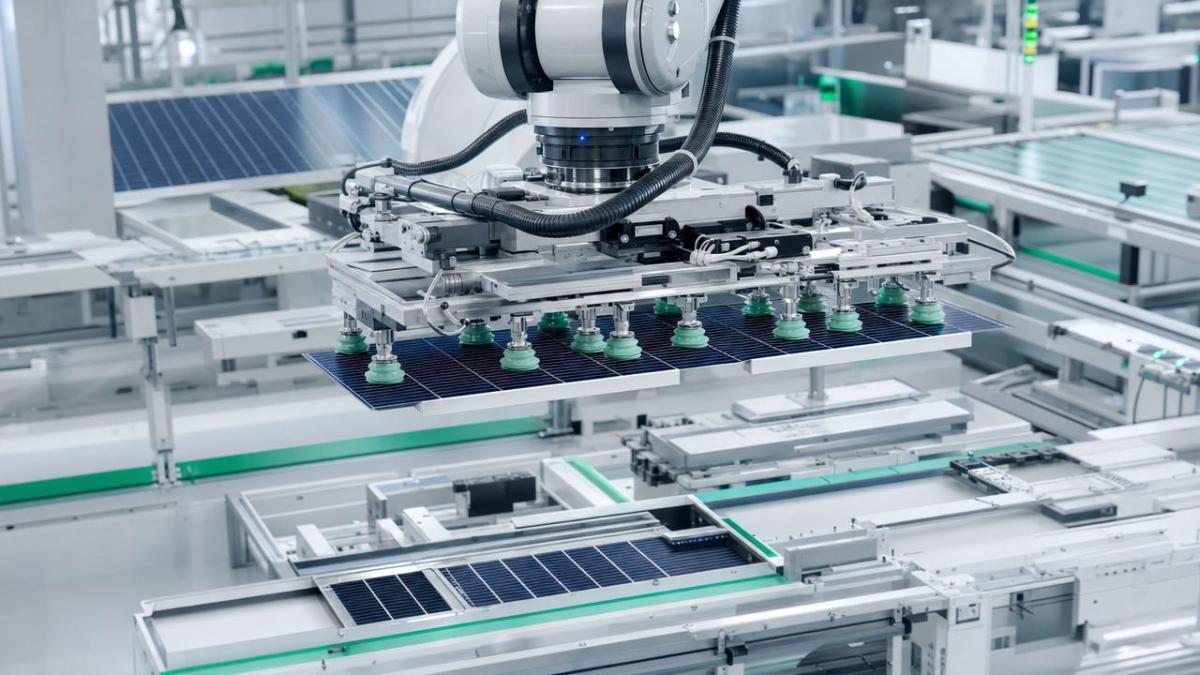
Technical evaluation teams in renewable energy rarely struggle with simple pick-and-place. The real problem appears when automation must handle solar wafers, battery cells, composite housings, cable assemblies, inverters, heat sinks, or sensor modules across changing product variants. Standard grippers are built for repeatability under narrow assumptions. Renewable energy manufacturing is not narrow. It is variable, high-mix, and increasingly connected to quality tracking, energy monitoring, and predictive maintenance systems.
This is where custom robotic end effectors become more than mechanical accessories. They are risk-control tools. A poorly matched gripper can cause micro-cracks in photovoltaic cells, deformation in pouch cells, inconsistent torque transfer during assembly, or contamination on coated surfaces. Each failure mode increases scrap, rework, downtime, and data noise in the production system.
At NHI, the focus is not on marketing claims such as “high precision” or “smart compatibility.” The useful question is measurable: under actual line conditions, does the end effector maintain force consistency, positioning accuracy, cycle stability, communication reliability, and component safety? In fragmented automation environments where sensors, edge devices, and controllers may span multiple protocols, the answer must come from testable engineering data.
- Surface variability: reflective, coated, dusty, textured, or anti-static materials reduce the reliability of standard vacuum or friction gripping.
- Geometry changes: different module sizes, busbar layouts, frame profiles, and enclosure dimensions require adaptable contact points.
- Tight damage thresholds: many renewable energy components tolerate only low contact pressure, limited torsion, and minimal vibration.
- Traceability demands: smart lines increasingly require end-of-arm tooling to integrate sensors for force, vacuum, presence detection, and cycle verification.
Where do custom robotic end effectors create measurable value?
For technical evaluators, the strongest argument for custom robotic end effectors is not novelty. It is measurable process improvement. In renewable energy factories, value is created when tailored tooling reduces hidden failure costs that standard grippers cannot control. These costs often sit outside the purchase price and show up later as yield loss, intermittent line stops, maintenance calls, or difficult root-cause analysis.
The table below compares recurring production conditions in renewable energy applications and explains why custom end-of-arm tooling often outperforms general-purpose gripping systems.
The key takeaway is simple: custom robotic end effectors improve line economics when they are designed around actual failure modes. If the component is delicate, unstable, reflective, abrasive, or dimensionally inconsistent, off-the-shelf gripping usually transfers risk back to the integrator and the production team.
Typical performance gains technical evaluators look for
A custom design is usually justified when it strengthens one or more of the following measurable outcomes:
- Lower component damage rates, especially for brittle, coated, or high-value parts.
- More stable cycle time under mixed batches rather than best-case trials only.
- Reduced need for frequent manual adjustment when upstream tolerances drift.
- Cleaner process data from integrated sensing, making root-cause analysis easier.
- Better interoperability with edge monitoring, PLC logic, and plant-level energy optimization systems.
What should technical evaluators compare before approving a design?
The most common procurement mistake is comparing a standard gripper and a custom end effector only by unit price. In renewable energy automation, evaluation must include process reliability, communication fit, maintenance burden, and upgrade flexibility. NHI’s data-first approach is especially useful here because mechanical tooling no longer sits in isolation. It increasingly interacts with sensors, local controllers, machine vision, and energy-management logic.
The following selection framework helps technical evaluators move from brochure language to engineering judgment.
A useful comparison method is to score each dimension against actual line risk, not generic capability. A low-cost gripper that requires frequent recalibration or causes occasional product damage may become the most expensive option over the first year of operation.
Questions that reveal hidden integration risk
- Does the custom robotic end effector include sensor outputs that can be mapped cleanly into existing control architecture?
- Has the supplier documented performance under vibration, dust, heat, or electrostatic conditions common in renewable energy facilities?
- Can the design support future product variants without replacing the entire assembly?
- Are wear components standardized enough to avoid spare-part delays?
How do custom robotic end effectors fit into data-driven smart manufacturing?
Renewable energy plants are becoming more connected. Handling tools are expected not only to grip parts but also to report process state. This aligns directly with NHI’s principle of bridging ecosystems through data. In fragmented industrial environments, the problem is not simply whether a tool works on day one. The problem is whether its data can be trusted across the lifecycle of the line.
A custom end effector can act as an edge data node when designed correctly. Vacuum pressure trends can reveal seal degradation. Force signatures can detect warped modules or misaligned battery trays. Presence sensors can validate pick success before movement begins. When this information is integrated with local edge computing, technical evaluators gain far better visibility into real causes of yield loss and line instability.
Data points worth capturing from end-of-arm tooling
- Grip confirmation timing to identify inconsistent part presentation.
- Vacuum or pressure decay to predict leaks before a missed pick occurs.
- Force and displacement data during insertion or seating operations.
- Cycle-to-cycle variance correlated with shift, material lot, or upstream equipment.
This is also where protocol discipline matters. If the line includes industrial Ethernet, local gateways, or plant-level monitoring layers, communication behavior must be checked as carefully as mechanical design. NHI’s broader benchmarking philosophy applies here: claims of compatibility are not enough unless latency, stability, and error behavior are understood under load.
What about cost, lead time, and alternatives?
Custom robotic end effectors do introduce engineering cost and sometimes longer initial lead times. For budget-sensitive projects, this creates understandable hesitation. However, evaluators should separate initial cost from total operational cost. In renewable energy manufacturing, a single recurring defect mode can quickly outweigh the savings from a standard gripper.
The comparison below is useful when reviewing capital requests or supplier proposals.
In practice, the best alternative is often a modular custom design. It combines dedicated contact surfaces and sensing with replaceable fingers, pads, or nests. That approach lowers future changeover cost while preserving the benefits of custom robotic end effectors.
When a custom solution is usually justified
- The handled part has a high scrap value or is difficult to inspect for latent damage.
- Product variants change more than once per year or differ significantly by size and surface condition.
- The line depends on digital traceability and process verification rather than operator observation.
- Downtime penalties are severe due to utility-scale project delivery schedules or battery demand peaks.
Which standards and compliance checks should not be ignored?
Compliance requirements vary by equipment type and region, but technical evaluators should review more than pure mechanical fit. Renewable energy automation often intersects with machinery safety, EMC behavior, electrostatic sensitivity, and environmental durability. If the end effector includes sensors, valves, controllers, or edge electronics, the assessment becomes broader.
Practical compliance checklist
- Confirm machine safety alignment with applicable risk assessment practices and guarding logic.
- Review ESD protection if handling battery cells, PCBA, sensors, or communication modules.
- Check material compatibility where contact surfaces touch coated solar elements, adhesives, or sealants.
- Assess ingress and durability needs if the line environment includes dust, thermal cycling, or chemical cleaning exposure.
- For smart tooling, verify signal integrity, edge-device interoperability, and cybersecurity responsibilities at the interface level.
The last point is increasingly important. As plants collect more operational data, even peripheral tooling must be evaluated as part of a broader connected system. NHI’s cross-domain perspective is valuable because connectivity, energy control, and hardware integrity are no longer separate procurement conversations.
FAQ for technical evaluators reviewing custom robotic end effectors
How do I know whether a standard gripper is truly insufficient?
Look for repeated symptoms rather than isolated failures: inconsistent pick success, unexplained micro-damage, frequent re-teaching, unstable cycle times, or sensitivity to minor part variation. If these issues remain after fixture tuning and robot path optimization, the bottleneck is often at the end effector level.
Are custom robotic end effectors only worth it for very high-volume lines?
No. They can also be justified in medium-volume environments when part value is high, damage is expensive, or line flexibility matters. In renewable energy equipment production, moderate volume does not mean low risk. Battery, solar, and power electronics components can carry high quality and warranty consequences even at smaller batch sizes.
What should be requested from suppliers during evaluation?
Request part interaction assumptions, force strategy, sensor architecture, maintenance plan, spare-part concept, and communication details. Ask how the design behaves under variation, not just nominal conditions. If electronics are included, clarify interface behavior, alarm handling, and data availability for plant monitoring systems.
How long is the validation cycle usually?
That depends on design complexity, part risk, and integration depth. A simple semi-custom adapter may move quickly, while a fully instrumented solution for fragile renewable energy components requires more testing. The important point is to validate against realistic tolerances, environmental conditions, and communication loads rather than short demo runs.
Why choose us for evaluation support and sourcing decisions?
NHI approaches custom robotic end effectors the same way we approach connected hardware across the IoT and smart industrial ecosystem: with engineering scrutiny, not brochure language. For technical evaluators in renewable energy, that means clearer visibility into mechanical fit, sensing strategy, integration risk, and long-term operational value.
Our strength is not generic product promotion. It is structured technical filtering. We help procurement and engineering teams compare solutions based on measurable criteria, identify hidden supply-chain weaknesses, and align automation tooling with broader digital manufacturing goals.
You can contact us to discuss:
- Parameter confirmation for fragile, coated, flexible, or tolerance-sensitive renewable energy components.
- Product selection between standard tooling, semi-custom designs, and fully custom robotic end effectors.
- Integration review covering sensors, PLC interfaces, edge data capture, and protocol compatibility.
- Delivery cycle planning, spare-part strategy, and sample validation priorities.
- Certification and compliance considerations for smart, connected, or electronically assisted end-of-arm tooling.
- Quotation alignment based on total cost of ownership rather than purchase price alone.
If your team is comparing handling solutions for solar, battery, inverter, or smart energy assembly lines, a data-based review can shorten decision cycles and reduce downstream surprises. Share your part conditions, target throughput, communication environment, and reliability concerns, and we can help map the right evaluation path.
Protocol_Architect
Dr. Thorne is a leading architect in IoT mesh protocols with 15+ years at NexusHome Intelligence. His research specializes in high-availability systems and sub-GHz propagation modeling.
Related Recommendations
- NHI Data Lab (Official Account)Why Some Wholesale 6 Axis Robot Arms Cost More to Maintain
- NHI Data Lab (Official Account)6 Axis Robot Arm Wholesale: Which Specs Matter First?
- NHI Data Lab (Official Account)Why Custom AMR AGV Projects Often Run Over Budget
- NHI Data Lab (Official Account)Custom AMR AGV Supplier Options for Narrow Aisle Warehouses
- NHI Data Lab (Official Account)What Delays Heavy Duty AGV Deployment More Than Most Expect
- NHI Data Lab (Official Account)Heavy Duty AGV Manufacturer Claims vs Real Load Performance
- NHI Data Lab (Official Account)Where 10kg Payload Cobots Lose Efficiency in Real Tasks
- NHI Data Lab (Official Account)A 10kg Collaborative Robot Payload Sounds Enough, but Is It?
- NHI Data Lab (Official Account)What Separates a Reliable AGV Navigation Systems Factory
- NHI Data Lab (Official Account)AGV Navigation Systems Factory Checklist Before a Site Visit
Analyst