
How to Compare Welding Robot Arm Price Beyond Unit Cost
author
When evaluating welding robot arm price for renewable energy projects, procurement teams need to look far beyond the unit quote. Payload stability, duty cycle, integration with smart production lines, maintenance data, and long-term energy efficiency all shape the true investment value. This guide helps buyers compare costs with the engineering clarity needed for reliable, scalable sourcing decisions.
Why renewable energy buyers must compare by scenario, not by list price
In renewable energy manufacturing, the same welding robot arm price can represent very different business value. A robot used for solar mounting structures faces different weld paths, takt times, and material profiles than one used in battery rack fabrication, wind tower subassembly, or energy storage container production. For procurement teams, this means unit cost alone is a weak buying signal. A lower quote may hide slower throughput, weaker arc stability, poor software compatibility, or higher downtime risk.
This matters even more in factories moving toward data-driven production. Companies influenced by smart manufacturing principles, such as those championed by NexusHome Intelligence’s engineering-first philosophy, increasingly need verifiable performance data instead of brochure claims. In practice, the true comparison of welding robot arm price should connect capex with output consistency, integration effort, operator burden, and lifetime service economics.
For procurement personnel, the right question is not “Which robot arm is cheapest?” but “Which robot arm fits our production scenario with the lowest total risk and best long-term return?”
Common renewable energy production scenarios where welding robot arm price is evaluated differently
The most effective way to compare welding robot arm price is to map the buying decision to a real production scenario. Below are typical applications where selection criteria shift significantly.
Solar mounting and support structure fabrication
This scenario often involves repetitive welding on galvanized steel components, brackets, and support frames. Buyers usually prioritize cycle speed, repeatability, and easy fixture integration. Here, a competitive welding robot arm price is valuable only if the arm can sustain high-volume throughput with low rework rates. Compact footprint and simple programming can be more important than extreme payload.
Battery rack and energy storage cabinet manufacturing
Battery energy storage systems require precision because weld quality affects structural stability, thermal management layout, and downstream assembly accuracy. In this scenario, buyers should compare welding robot arm price against motion precision, path consistency, and compatibility with traceability systems. A slightly higher equipment cost may reduce hidden losses from dimensional drift, scrap, and quality disputes.
Wind energy component subassembly
Wind-related fabrication may involve larger parts, awkward geometries, and heavier tooling demands. Here, welding robot arm price must be judged alongside reach, payload, torch orientation flexibility, and durability in demanding production environments. If the arm cannot handle large work envelopes efficiently, the low initial quote quickly loses value through manual intervention and slower line balance.
Hydrogen, inverter, and containerized power unit enclosures
Enclosure welding often combines medium batch sizes with frequent model changes. In these situations, a favorable welding robot arm price should include ease of reprogramming, offline simulation support, and compatibility with vision or sensing upgrades. Flexibility matters because product revisions are common in fast-evolving renewable energy markets.
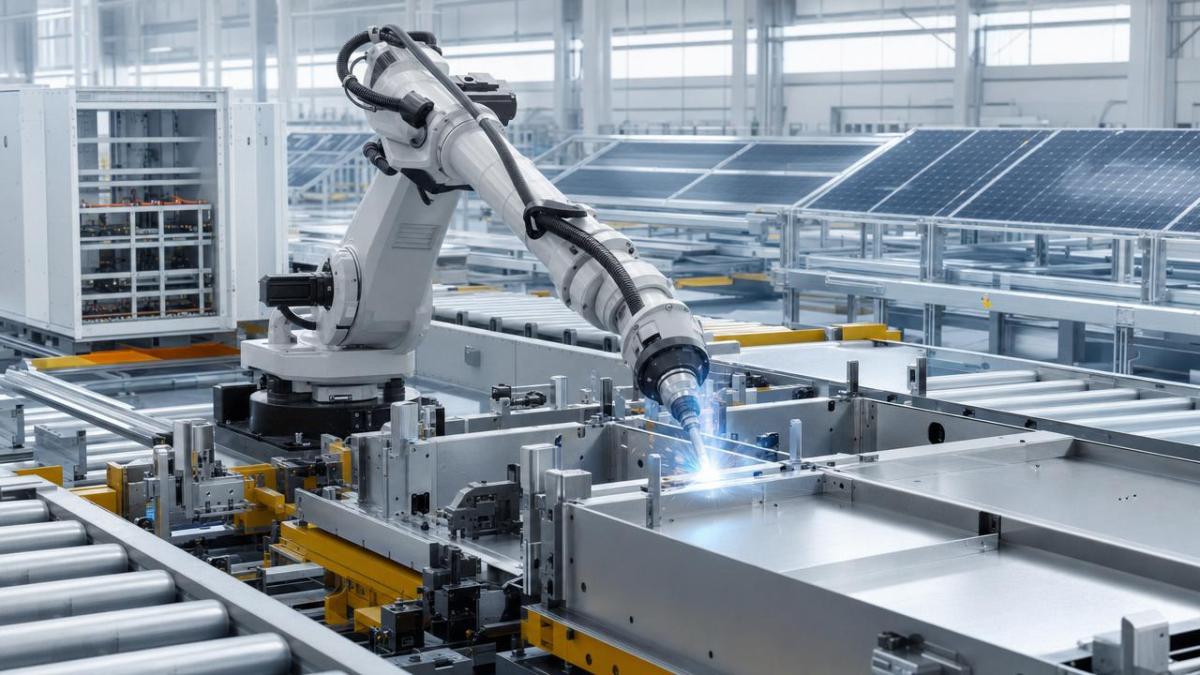
A practical scenario comparison table for procurement teams
Use this table to align welding robot arm price analysis with the actual production context instead of a generic specification sheet.
What procurement should compare beyond welding robot arm price
A good sourcing decision connects commercial terms with measurable engineering outcomes. In renewable energy factories, the following factors often determine whether a quoted welding robot arm price is truly competitive.
Duty cycle and thermal endurance
Robots in high-output solar or storage production may run for extended hours. Ask for tested duty cycle data, thermal behavior under continuous welding, and evidence from similar line loads. A cheaper arm that derates under sustained production creates hidden bottlenecks.
Programming ecosystem and line integration
The real welding robot arm price includes engineering time. If the robot controller works poorly with PLCs, MES systems, scanners, or quality traceability platforms, integration costs rise quickly. For data-centric factories, compatibility with digital monitoring is a major value driver.
Spare parts access and service response
For global procurement teams, local support coverage matters. Compare response time commitments, regional spare inventory, and common wear part lead times. A low welding robot arm price becomes expensive when a failed reducer or cable set stops production for days.
Energy use and operating efficiency
In renewable energy manufacturing, energy efficiency supports both cost and brand positioning. Evaluate standby consumption, motion efficiency, and whether the system reduces unnecessary idle power. Over large fleets, small energy differences accumulate into meaningful operating savings.
Quality stability across material and batch variation
A quoted welding robot arm price should be tied to performance across actual materials, thickness variation, and fixture conditions. Procurement should request trial welds on representative parts rather than standard sample plates that flatter performance.
How needs differ by buyer type and factory maturity
Different organizations compare welding robot arm price differently because their operational priorities are not the same.
Greenfield factories
New renewable energy plants often need scalable platforms, standardized training, and smooth installation. These buyers should favor systems that are easy to duplicate across lines. Even if the initial welding robot arm price is not the lowest, standardization can reduce future expansion cost.
Existing plants upgrading from manual welding
Retrofit projects should focus on floor layout fit, operator learning curve, and compatibility with current fixtures. A competitively quoted robot may still be unsuitable if its footprint or safety envelope forces expensive plant modifications.
Multi-site global manufacturers
These buyers should compare welding robot arm price with regional service capacity, software version control, and training consistency across plants. Supply continuity and governance may outweigh a lower single-site purchase cost.
Common misjudgments when comparing welding robot arm price
Procurement mistakes usually happen when teams treat robotic welding as a catalog purchase instead of a production system decision.
- Comparing arm price without the full cell scope, including torch package, positioner, sensing, guarding, and software licenses.
- Using payload and reach as headline metrics without checking actual weld path accessibility.
- Ignoring maintenance intervals, lubrication requirements, and availability of trained service partners.
- Assuming all suppliers define repeatability, uptime, or cycle time in the same way.
- Failing to model downtime cost, especially in high-volume solar and storage manufacturing.
A sourcing checklist for scenario-based evaluation
Before approving a supplier, procurement teams should validate a short list of scenario-specific questions:
- What is the expected annual weld volume for this product family?
- Is the application high-mix or high-volume?
- What data proves stable performance on similar renewable energy components?
- How much engineering time is required for commissioning and future model change?
- What is the supplier’s local support structure and spare parts commitment?
- What is the estimated total cost per qualified part after energy, consumables, and maintenance?
FAQ: procurement questions about welding robot arm price
Is the lowest welding robot arm price ever the best option?
Only in very simple, low-risk applications. In most renewable energy production scenarios, lower unit cost can increase total cost through downtime, poor weld quality, or weak integration performance.
How should buyers compare quotes from different suppliers?
Normalize the offer into a full-cell comparison: robot arm, controller, welding package, software, service terms, training, commissioning scope, and expected output under your actual production conditions.
What metric is more useful than unit price?
For many buyers, cost per qualified weld, cost per shift output, or total cost of ownership over three to five years gives a more realistic basis for decision-making than welding robot arm price alone.
Final decision guidance for renewable energy procurement
The smartest way to compare welding robot arm price is to anchor every quote to a specific production scenario: solar structures, battery racks, wind subassemblies, or power enclosures. Once the scenario is clear, the right metrics become visible: throughput, precision, flexibility, uptime, serviceability, and energy efficiency. That is where procurement creates long-term value.
For organizations building resilient, data-driven supply chains, a robot arm should be evaluated like any critical industrial infrastructure asset. Ask for evidence, benchmark under real conditions, and match the equipment to the business case instead of chasing the lowest number on the quote sheet. If your team starts with scenario fit, the welding robot arm price becomes a strategic metric rather than a misleading shortcut.
Protocol_Architect
Dr. Thorne is a leading architect in IoT mesh protocols with 15+ years at NexusHome Intelligence. His research specializes in high-availability systems and sub-GHz propagation modeling.
Related Recommendations
- NHI Data Lab (Official Account)Medical IoT Battery Safety White Paper Released
- NHI Data Lab (Official Account)Custom 5-Axis CNC Machining Aerospace Limits to Check Early
- NHI Data Lab (Official Account)AS9100 CNC Machining Tolerances Chart Where Quotes Go Wrong
- NHI Data Lab (Official Account)Industrial Cobot Manufacturer China How to Judge Real Support
- NHI Data Lab (Official Account)Palletizing Robot Suppliers That Support Fast Line Changeovers
- NHI Data Lab (Official Account)Collaborative Robot Payload 10kg Is It Enough for Real Tasks
- NHI Data Lab (Official Account)Where 15kg Payload Cobots Lose Speed on the Factory Floor
- NHI Data Lab (Official Account)6 Axis Robot Arm Wholesale or Local Stock Which Pays Off
- NHI Data Lab (Official Account)How to Compare Welding Robot Arm Price Beyond Unit Cost
- NHI Data Lab (Official Account)Wi-Fi 7+BLE Dual-Mode PCBA Lead Times Extend to 14 Weeks
Analyst